CT100 companies collectively spent $9.6 billion in U.S.-booked air volume for 2025. That’s a steady climb from 2024’s approximately $8.5 billion and is perhaps a surprisingly robust number, given that overall economic confidence waned last year and business travel demand seemed sluggish across the industry as a whole. The CT100, however, bucked that trend, with pharmaceutical and life sciences, banking and professional services companies, and technology companies surging up the rankings this year.
Medical technology firm No. 26 Becton Dickinson—now simply BD—hurtled up 49 spots on the list this year, while No. 27 Danaher leap frogged 32 spots; Novartis and Eli Lilly & Co. also experienced big jumps. Booz Allen Hamilton took a big jump from No. 80 last year to No. 62 this year, on a $20 million rise in U.S.-booked air volume; Citigroup jumped 15 places to No. 53. Meanwhile, No. 9 Microsoft, No. 36 Salesforce and No. 44 Cisco all experienced meaningful upward movement in the rankings this year.
New to the list this year were GE’s spinoff companies No. 81 GE Aerospace and No. 83 GE Vernova (GE Healthcare isn’t yet meeting the threshold); strong performance from NetJets and Atlas Air as well as Royal Caribbean put them on the CT100 for the first time. Private equity firm No. 99 BlackRock as well as No. 97 Major League Baseball entered the CT100 chat this year.
Who, What, Where…
Analyzing the trends across this year’s Corporate Travel 100 list was an exercise in evolution and in recognizing how the pace of change is accelerating in managed travel. Contributing to that acceleration: certainly, the adoption of and growing reliance on artificial intelligence and New Distribution Capability, but also major industry shifts, like American Express Global Business Travel’s acquisition of CWT and the restructuring that move has driven through how—and with whom—the largest business travel programs in the industry are aligning their programs.
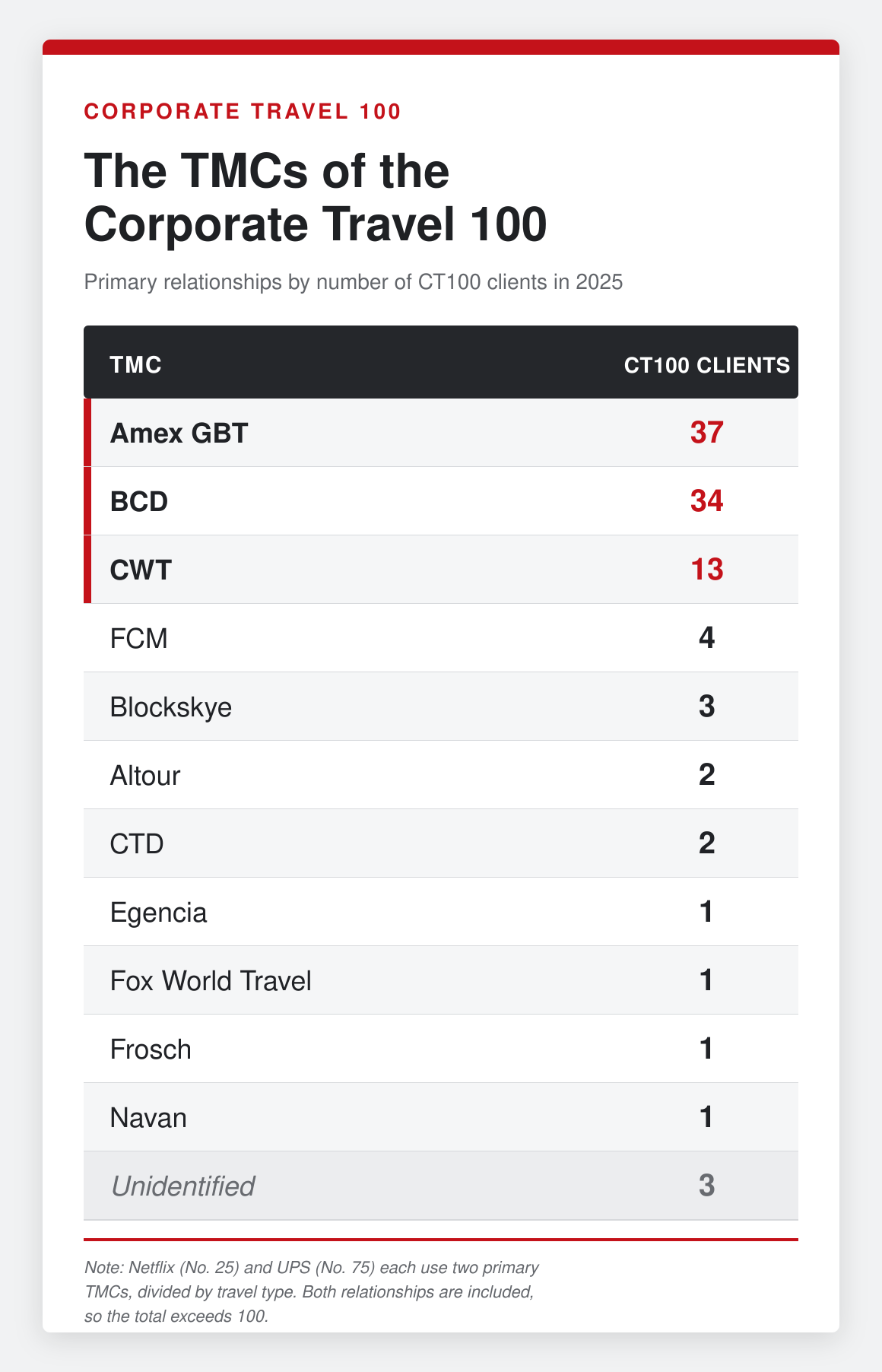 Credit: BTN 2026 Corporate Travel 100
You’ll find in BTN’s chart of the CT100’s TMC partners for full-year 2025, we’ve retained the CWT brand name for the final time. Our methodology here considers these companies clients of CWT for the majority of the year, prior to close of the GBT transaction on Sept. 2, 2025. That said, BTN editors have made efforts to determine next-step partnership decisions for the majority of these former CWT clients and have noted current partnerships in the text of their respective program profiles.
The GBT-CWT merger wasn’t the only factor driving TMC relationship changes, though. The chart above reflects 11 global TMC partners serving CT100 companies in 2025, and more may emerge in 2026. That’s the most diverse TMC roster in more than a decade supporting CT100 companies. That’s not for nothing: technology, data and the promise of new operating models brought to the table by Blockskye, the Concur/Amex GBT Complete platform, Direct Travel (on a Spotnana foundation) and the all-in-one model closely associated with Navan have created a buzzy tension in the industry that new integrations and advanced automation are poised to level up managed program usability.
Re-Thinking and Re-Platforming Corporate Travel
To that end, CT100 companies are leading the industry into some new territories and pushing their suppliers to bring solutions to the table that will fundamentally change how companies can manage travel and servicing costs, how they want to access content and how travelers will experience the program—not just from a travel supplier perspective, but also from a work enablement perspective. More companies are looking to provide travel programs that function in a more “invisible” way behind the tools and systems that are used to manage them. Here are some of the big picture trends driving the most progressive programs today:
1. AI Moves from Experimentation into Travel Operations
Artificial intelligence no longer appears as a future aspiration, and the industry is moving beyond chatbots. Leading programs are beginning to deploy AI in practical workflows, some using AI-powered servicing agents, delivering personalized booking recommendations, automating expense auditing and fraud detection and certainly using AI to support real-time data analytics and reporting strategies.
The approaches vary widely. No. 5 McKinsey introduced conversational booking within employees’ everyday work systems. Cisco is pursuing agentic servicing and workflow replacement. EY is applying AI across reporting, sourcing, disruption management and sustainability. Gilead, Danaher, Bloomberg and the Gates Foundation describe AI operating across multiple stages of the travel lifecycle.
Whether programs will use AI is a foregone conclusion: suppliers are counting on it to right-size their operations and deliver better service. What corporates need to decide is where they want to place AI first and how tightly it will connect with existing systems. They are starting to bring their own roadmaps to their suppliers and asking for solutions. The next step, and one that has challenged many industries, will be to quantify AI’s return on investment while being realistic about whether it is possibly weakening cost or security controls via personalization and data sharing.
2. Travel Booking Gets into the Daily Workflow
A subset of AI’s power in travel programs is the impact it’s having on the booking process. Several programs are challenging the traditional model in which travelers must enter a separate online booking environment. McKinsey’s aforementioned Skylink integration into Slack-based workflows is just one example. Microsoft’s Cytric Easy integration into Teams is another. As more companies begin to demand streamlined access to booking tools in large language model workflows, the form of the traditional online booking tool starts to disappear into a policy and personalization-driven recommendation engine, behind which all the disparate elements of an itinerary are curated.
Even programs retaining traditional booking tools are investing in new interfaces, mobile capability, internal knowledge bases and simplified traveler support. For example, Salesforce optimized travel knowledge for AI-powered assistance through BaseCamp and Slack, while booking remains on the new Concur interface. That said, future booking interfaces may be less of a standalone tool and more of an intelligent travel capability embedded in the employee’s normal digital workplace.
3. NDC Matures from Theoretical Debate to Implementation Issue
The market is moving beyond the yes-or-no decisions for New Distribution Capability content. The important questions now concern content completeness, servicing, economics, implementation by geography and the effect of NDC on program adoption by travelers. That said, programs are at very different stages and strategies differences include GDS connections via Sabre and Amadeus versus direct connects into a booking tool or with the TMC partner.
No. 3 Google has rolled out NDC with 11 carriers across 13 points of sale and links the broader content set to a substantial improvement in preferred-channel adoption. Boeing just began consuming NDC in 2026. Salesforce, Roche, Paramount Skydance and Aon also report active NDC use or expansion. Other companies, including Toyota North America, Pfizer and Bank of America, are beginning or expanding consumption, while programs such as Lockheed Martin and Medtronic anticipate adoption farther in the future.
No. 4 PwC and No. 2 Deloitte are looking more broadly at direct-connect distribution through Blockskye. Spotnana clients like Amazon are looking to ensure all their options with direct-connect NDC airline content as well. And watch that same space for direct-connect hotel content.
4. Data Becomes the Travel Program Operating System
Reporting has shifted from retrospective measurement to active program management. With AI enhancements, the goal is to deliver better strategic insights to finance, procurement, travelers and business leaders while decisions are still actionable.
A number of companies are building more comprehensive data environments. No. 1 Amazon expanded its enterprise analytics platform and added sustainability, contract-management and reporting dashboards. Cisco is developing analytics that combine travel, expense and card data and map it to the business hierarchy. Disney improved reporting for booking adoption and total T&E spend. Chevron is modernizing business-unit dashboards, and the Gates Foundation launched a dashboard for travel-spend visibility.
Several programs are also using AI to identify unmanaged spend, analyze traveler behavior, assess supplier performance and summarize spending trends.
5. Intelligent Cost Control
Cost containment for travel management never really goes out of style, no matter how big the company nor how expansively employees travel. Especially now, however, with hotel costs already high and with oil prices and strong demand keeping airfares quote lofty, applying smart cost controls is on the mind of finance leaders and business travel executives.
The dominant model is targeted control. Programs want tools that can distinguish valuable travel from avoidable expense and influence decisions before money is committed.
Mature travel programs are looking at supplier strategies that include form of payment preferences or traveler loyalty and working to shape programs that can benefit suppliers in ways that go beyond travel volume guarantees. Those are the few. Other companies are pursuing savings through reshopping, dynamic hotel pricing, capped rates and consolidated sourcing and improved analytics.
Despite the overall spending increases in 2025, the BTN CT100 is not immune to travel restrictions, tighter policies and pre-trip approval strategies. ExxonMobil, Sony, Marsh, Booz Allen Hamilton and Danaher cited cost, savings or return on travel spend as priorities. IBM instituted a 15-day advance-purchase requirement. The World Bank adjusted its lowest-logical-airfare parameters. Boston Scientific introduced global pre-trip approval, and Ford built a global approval system.