My headline this weekend is borrowed from a 2020
Op-Ed by Johnny Thorsen, but my article won’t follow its lead. To be honest, reading through a list of BTN articles for 2020 is a really emotional journey, and not a good one, as it chronicles every inch of the Covid-19 pandemic’s destructive march
through the travel industry. I am proud to have been a part of the BTN team that kept the industry informed and connected during the pandemic. The community we brought together held each other up, gave the best advice and from the very beginning of the pandemic was visionary in terms of the ways the industry would re-emerge. I will always admire the incredible grit and perseverance travel industry leaders and front-line workers brought to the table every day. Still, if 2020 is too fresh in our experience, skipping this week's read is totally understandable. As part of BTN's chronicle, however, it is necessary.
__________________________
Travel suppliers were riding significant highs going into 2020. American Airlines saw net YOY income gains of nearly 20 percent at the close of 2019. Delta was on a seven-year
trajectory of quarterly profit gains in final quarter and marked a 21 percent increase in net income year over year. The airline reported “strength
across the board” of its corporate clients roster in January 2020. United ended the year with a four-quarter streak of expanded margins and net income up more than 40 percent year over year. STR reported the U.S. hotel industry’s 10th consecutive
year of performance growth.
A Banner Q1 Craters Into Devastation
Delta’s Jan. 14 earnings call noted “softness”
in China but attributed it to Trump’s trade wars and tariff complications that were spreading into other markets like Korea and Thailand. By the third week of January, however, airlines were looking cautiously at the spread of the novel coronavirus
in China and local airlines were shutting down flights in and out of the country. The World Health Organization by January 30 declared Covid a Public Health Emergency of International Concern.
BTN
began reporting on that day about businesses suspending travel to Asia and including Covid-19 case counts from Johns Hopkins University. Airlines also began suspending service at this point—Air Canada suspended all flights to China, Air France optimistically
estimated a return to mainland China for Feb. 9; Air India was looking at returning to its Mumbai-Delhi-Shanghai route by Feb. 15. American Airlines advised it would shut down flights starting Feb. 9 and keep them closed through Mar. 27. Cathay said
it would have a 50 percent reduction through the end of March, and the list went on.
Asian tourism boards, which relied particularly on outbound incentives and meetings from Chinese groups braced for the impact. Business travelers with critical business in China were advised to wash hands frequently, wear masks to “keep your hands away
from your face and remind you of the risk.” Masks were not, at that point, official advice for preventing disease spread.
The BTN Group launched the BTN Europe brand and media outlet on Feb. 24, 2020 at The Business Travel Show in London. While the show proceeded as planned, it was among the final industry events for 2020, after which Concur
Fusion was moved in record time to a virtual format and the Association
of Corporate Travel Executives NYC conference, and the Global
Business Travel Association convention planned for Denver were eventually cancelled outright. ACTE never recovered from the hit, and shuttered operations in April. GBTA in Nov. 2020 bought
key ACTE assets in a liquidation for $35,000 and reached into the volunteer pool of the former association, naming a number of key executives to vacant board seats—more on those vacancies later.
Selected Q1 Articles
Desperate Q2 Depends on Government Bailout
The U.S. House of Representatives on Mar. 27, 2020 approved the Coronavirus Aid, Relief and Economic Security or CARES Act that addressed $50 billion in economic aid for airlines and $1 billion to Amtrak. Those came with assurances from travel suppliers
that they would mitigate layoffs through the end of September that year. Hoteliers, on the other hand, with their commercial models based on franchise ownership, travel management companies and ground transportation providers were largely left to
seek aid under $349 billion allotted in the CARES Act to Small Business Administration loans, each of which maxed out at $10 million.
Then-U.S. Travel Association president and CEO Roger Dow urged the Department of Treasury and the SBA to expedite the rulemaking process and to get the money out the door quickly, also said the initial rescue efforts fell short of what the industry would
require. “It is clear more will need to be done,” he said.
By May, airlines were laying out “worst
case scenario” options as the government-projected, eight-week “shutdown” failed to show significant effect on the spread of Covid-19 and hospitals continued to struggle with overcrowding. Some airlines offered free or reduced cost flights to medical
volunteers and many hotel companies, desperate to fill rooms and looking to contribute to the greater good, were offering discounted and free lodging to emergency medical responders who were traveling to so-called coronavirus “hotspots” as the disease
flared in certain communities.
Airlines continued to reduce their flight schedules even as they received individual
agreements for and disbursements of government aid. Delta was the first to block
middle seats to ensure social distancing; Southwest and Alaska Airlines eventually followed that policy and kept it in place throughout 2020, but Delta kept it in place through March 2021. American and United Airlines each took different approaches
after blocking middle seats for a short time. By June, suppliers were testing workers and travelers for fitness to fly on their planes or stay in their properties.
Ironically, car rental providers were seeing a booming business as would-be fliers sought socially distanced alternatives.
What quickly developed across the travel supplier segment were partnerships for cleanliness protocols. United partnered with the Clorox
Cleveland Clinic, Delta partnered with the
Mayo Clinic. Those without partnerships outlined their hygiene practices. The
National
Limousine Association created required hygiene protocols for members, while hotel brands rolled out enhanced room cleaning methods and also socially distanced meetings protocols. Tech providers took the opportunity to outfit hotel meeting spaces
with virtual meeting technologies that soon would become du rigueur for the most basic home office as well.
While travel suppliers grabbed for government bailouts, travel management companies spent Q2 gutting
their ranks and scrambling to service clients while making no money on transactions. One TMC CEO told BTN:
"[One mega TMC] was able to take out more than 60 percent [of costs] immediately. We all had to do it. We had to become machines so we could bounce back when travel returns. It's better to beg [clients] for forgiveness and give them a self-service portal
than not to be a company when this is over."
Some companies lost their dedicated agents; others lost their trusted agent services, whether they were dedicated or not. Others grabbed their agents and pulled them into their own companies as continuity assurance for the future—and to continue working
on critical projects like unused ticket credits that would pay for the resource several times over. It’s a question whether the agency side has truly recovered from that devastation as buyers to this day lament the Covid-era loss of knowledgeable
agents.
The business of business travel—in terms of mergers and acquisitions—also came under fire starting in the second quarter. As it became clear that Covid-19 wouldn’t pass as quickly has some had hoped, deals that had counted on the health of the corporate
travel industry began to sour. Payment provider Wex put the brakes on its acquisition of eNett
and Optal; after a legal battle the transaction did take place but at one-third the original acquisition cost. Amex GBT was also caught up in a legal dispute regarding its recapitalization by new investors. The recapitalization, announced in December,
preserved its 50/50 joint venture structure, half of which is held by American Express, the other half comprising new and existing investors under a Certares-led group, Juweel. The Carlyle
Group and GIC, both among the Juweel investors, announced internally in May it would pull out of the investment, citing Covid as a Material Adverse Effect. They successfully ended their participation in the investment. Another big merger for business
travel undone by the pandemic was Sabre’s purchase of Farelogix, which would have put Sabre in the driver’s seat of New Distribution Capability development. After striking a deal to buy Farelogix for $360 million, Sabre walked away from it on Apr.
30.
Selected Q2 Articles
- IATA Projects Airline Industry Q2 Loss of $39 Billion
- Delta Offers Medical Volunteers Free Flights to Georgia, Michigan and Louisiana
- IAG Deepens Capacity Cuts, Reaches Furlough Agreement with Unions
- Los Angeles Hotels Double Rooms Available for Covid‑19 Relief
- Airlines Make Deep Cuts to New York Area Capacity
- United to Reduce California Service
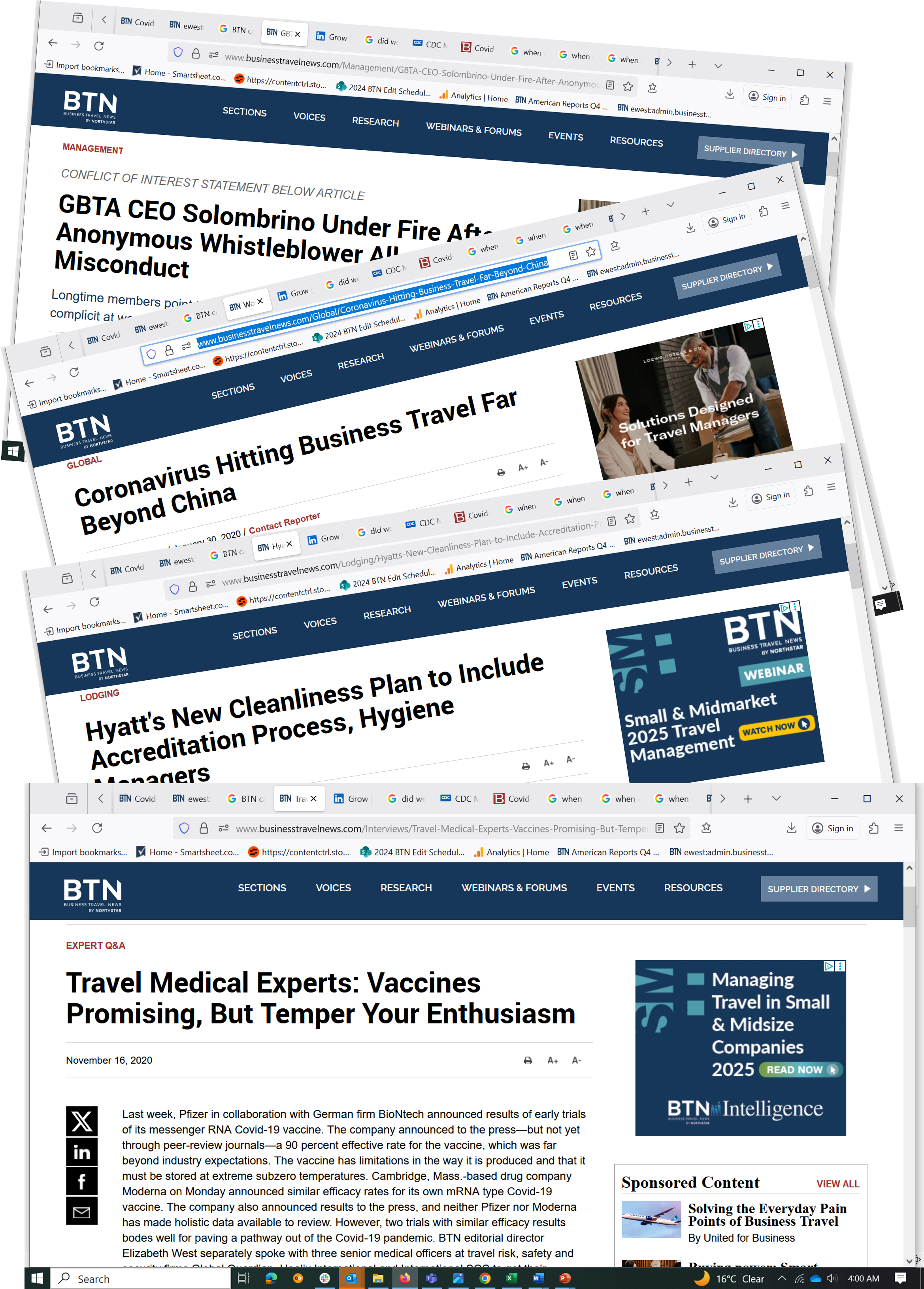
- Hyatt’s New Cleanliness Plan to Include Accreditation Process, Hygiene Managers
- BA to Make Up to 12,000 Staff Redundant
- Accor Reduces Staff, Closes Hotels, Creates Support Fund
- Cancellations and Postponements
- Sabre Scraps Farelogix Acquisition
- Uber To Cut 14 Percent of Workforce
- Extended Stay America Announces Health and Safety Initiative
- Accor Introduces New Cleanliness Program, Label for Compliant Hotels
- AHLA – More Than Eight in 10 Hotels Have Laid Off or Furloughed Staff
- Hyatt to Lay Off 1,300 Corporate Employees
- Virus Tracking Services Could Help Fuel Corporate Travel’s Comeback
- STR: 'Unprecedented Lows' in April US Hotel Performance
- National Stays on Top with Buyers (Car Rental Survey Report)
- Industry Bodies Lobby Congress for Covid‑19 Liability Shields
- Hotel CEOs See Domestic Starts to Years‑Long Recovery
- American Airlines to Resume More Than Half of Domestic Schedule in July
- Virgin Atlantic Plans July 20 Return
- China, US Open Door to Limited Air Service
- Delta to Suspend Service to a Dozen Airports in the Coming Weeks
- Concur Plots Road Ahead with Booking Tool Rebuild
- United Introduces Health Assessment to Check‑in Process
- Delta to Test All Employees for Covid‑19 Virus, Antibodies
Q3 Marred by Leadership Controversy as Business Travel
Bottomed Out
A leadership ouster at the Global Business Travel Association proved an ugly—but in retrospect—a needed change for the industry group. The association has since emerged stronger and with a more committed vision for business travel advocacy, education
and industry advancement, but in 2020 it was in an existential crisis.
In the wake of ACTE’s closure and rocked by Covid’s ongoing shockwaves, then-executive director and chief operating officer Scott Solombrino laid
off one-third of GBTA’s staff. Around the same time, however, the
board of directors approved a title change to CEO. It is unclear if his salary was increased at this time, but 2019
GBTA tax documents showed Solombrino’s salary had reached $1 million-plus annually.
It was on this backdrop that an anonymous letter was sent to the board of directors on or around June 8 accusing Solombrino of unethical and discriminatory activities in his leadership role. It also accused board members of enabling behaviors that enriched
Solombrino and members of the board, while engaging in professional intimidation tactics toward staff. BTN received the letter on June 12 as an anonymous email and later as a paper copy via the U.S. postal service, with a note stating that the board
had taken no action on the outlined complaints.
At the same time, a report in The Company Dime uncovered emails
from Solombrino to the GBTA staff that included crude language directed toward the Denver Convention Center and then-Colorado Governor Jared Polis regarding his compliance to health restrictions for the state that would force GBTA to cancel its upcoming
convention which had been pushed to November. While the email threatened staff with termination if any information about cancelling the convention was “leaked,” the anonymous letter to the board, as
reported by BTN, outlined numerous other aspects of the “toxic” work environment at GBTA.
BTN’s coverage of the letter hit on Jun. 19. By the 20th, the board hired a legal firm to investigate the allegations in the anonymous letter and placed Solombrino on leave. GBTA members, many in financial straits as a result of the pandemic,
began dropping their memberships and support for the organization. Big names like American
Airlines, Concur and CWT and—behind the scenes many more—distanced themselves from GBTA as the investigation proceeded. GBTA
committees refused to continue volunteer work or withheld
expected deliverables and buyers made individual statements about leaving the organization and encouraged others to do the same.
By July 7,recently retired but long-time and well-loved airline sales executive Dave
Hilfman stepped in as an interim executive director as the organization
hired an association consultancy, performed member surveys as it looked to regroup. Several board members vacated their posts. Solombrino in the course of the investigation was cleared
of wrongdoing by Jul. 20. Nevertheless, he mutually agreed with the board he should leave the organization. He did so with a $5 million payout, which eventually was disclosed in the GBTA’s
2020 public tax documentation.
The association performed a full executive search for new leadership. The search resulted in hiring industry veteran Suzanne Neufang in Feb. 2021. Neufang expanded and diversified the board of directors, supported a revamp of the GBTA bylaws, re-energized
and reorganized the GBTA foundation and continues to lead the association today.
Throughout the third quarter, suppliers looked for any green shoots of recovery from the pandemic. Airlines anticipated improvement over the summer months, and a number of carriers re-instated capacity to be largely disappointed as a wave of Covid
swept through the United States over the 4th of July and well across the summer months. The summer wave, indeed, clued travel suppliers into the fact that recovery from the epidemic would be “bumpy.”
Airlines, hotels and ground transportation suppliers over the summer expanded masking mandates and continued to pursue advanced hygiene protocols. Delta rolled out a partnership with Lysol. Some airlines begin exploring the possibilities of rapid testing
protocols as a means to prevent disease spread but also as a lever to re-open international routes. In a move that offered a small glimmer of light that lives on in airline ticket sales to this day, United was the first airline to jettison
change fees for domestic bookings.
Technology providers also began to announce health tracking-related acquisitions and/or new health and safety-related functionalities for their tools. Airports and payment providers begin pushing touchless processes as the wave of the future.
As the third quarter closes, so do government requirements for airlines that received CARES Act aid not to furlough workers. Airlines began to hint that layoffs were likely coming. In the midst of it all, AA and JetBlue laid
plans for a partnership that would become known as the Northeast Alliance. Reportedly, IHG and Accor entertained a merger, but it never broke through.
Selected Q3 Articles
Industry Downsizing Continues Amid Talk of Vaccine Rollouts that Could Open Up
International Travel
The business travel industry remained on the coronavirus roller coaster in the fourth quarter. Encouraging signs for a vaccine began to circulate by September, with media reports indicating they could be available as early as October. It
was November when Pfizer—the first company to announce its test results for a vaccine—announced its findings. Covid-19 testing kits also became more widely available.
The combination of the two held promise for less restrictive travel, especially internationally, where two-week quarantine requirements were often in place upon arrival to prevent disease spread. The idea that a traveler could test before travel and again
after arrival ultimately would become
standard for many countries, but testing wasn’t available enough to make that a universal practice.
Even with hope on the horizon, the business travel industry seemed to be teetering toward extinction going into the last quarter of the year. Air tickets sold during the week ending Sept. 27 were down more than 86 percent year over year, according to
Airlines Reporting Corp. Marriott laid off another 17 percent of corporate workers. Even Southwest sent out notices of looming layoffs—most of which were mitigated by another round of government aid.
TMCs were looking at a different story. Some had been able to secure loans and other financial support from the U.S. government and other sources, but the length of the pandemic and the absence of signs of immediate recovery were causing some TMC leadership
teams to seek alternatives. BCD laid off 3,000 workers, and mergers were all but guaranteed for the industry.
There had been a number of smaller plays during the year, with Frosch picking up a couple of smaller TMCs like Luxe Travel and it made a majority stake investment in Plaza Travel. There were other players merging in the midmarket. In the fourth quarter,
however, the U.S. market was surprised when Australian TMC Corporate Travel Management announced it would acquire longtime, Nebraska-based stalwart Travel and Transport. The latter was the owner of the Radius network as well, which bolstered CTM’s
global vision for the company.
As travel suppliers looked back at a full year of cratering customer demand, many of them moved to ensure travelers would be ready to come back in droves as vaccines and testing were truly in rotation in 2021. Several moves positioned them favorably:
1) Many suppliers extended for an additional year loyalty members’ current status, rather than downgrading valued customers for not traveling during a pandemic. 2) For better or for worse, some suppliers also extended corporate agreements into 2021,
not least because they likely did not have the staffs to deal with arduous requests for proposals and they really just wanted to get that volume in the door. 3) While hotels had lengthened cancellation windows in a protective move, airlines continued
to expand on what United started in Q3 with eliminating change fees for domestic and international travel. Without change fees, travelers were free to book and less worried about what would happen if a wave of Covid swept in to cancel their plans.
Unfortunately, that’s exactly what happened in January—a wave of covid, driven by the gamma, alpha and beta variants, dampened an already distressed industry. Between Jan. 18 and Feb. 21, 100,000 more people in the United States
died from complications of Covid-19, bringing the total to 500,000 according to the Centers for Disease Control.
Selected Q4 Articles