 Johnny Thorsen, VP Strategy & Partnerships, Spotnana
We have reached the end of another crazy year in both the
calendar and the travel industry. It is, therefore, time for me write and share
the next chapter in my “green travel odyssey,” and there is no doubt 2021 has
been the most interesting year in terms of key developments in the sustainable
travel arena. As usual I have spent time reading through my previous chapters
to refresh my memory, and it is fascinating and very positive to see how much
happened in 2021 despite the continued Covid-19 impact on travel and the resulting
lack of resources and money. Based on this, I really think 2022 is shaping up
to be the year where “sustainable travel” graduates from being an emerging trend
to becoming a mandate.
Personal Sustainability Policy
Throughout 2021 I presented my latest edition of the
TravelTopia story to audiences around the world—almost exclusively virtually
with only one in-person appearance. Each time I included a public statement
showing my own travel policy. The reactions were overwhelmingly positive, and a
number of people actually reached out to share how they created their own personal
policy as a result.
I am not telling anyone what their policy should be, but
once you have defined your own sustainable travel policy it suddenly becomes
much easier to decide whether you should travel or not for a given event. Here,
I share my current personal travel policy and hopefully it can provide some
inspiration for creating your own policy regardless of what it might look like.
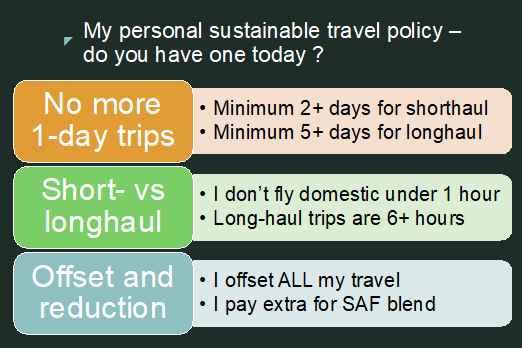 Personal Travel Policy Credit: Johnny Thorsen
Aside from my TravelTopia presentations, I still managed
to take 21 flights with seven different airlines and flew a total of 70,856 km.
With that, I can offer my estimated carbon emissions numbers, and I am also
including my hotel stays for the first time representing a total of 22 room
nights.
Flights: 17.33 tonnes CO2 generated
by 21 flights on seven airlines (0.244 kg CO2 per km flown)
Hotel: 0.72 tonnes CO2 generated by
22 room nights (35 kg CO2 per room night)
Total CO2: 18.1 tonnes CO2
Offset cost: 172.92 ($9.55 per tonne CO2
offset)
I used Thrust Carbon to calculate my carbon emission as
well as for the offset, but I also ran my travel data through four other carbon
calculators to compare the results. The findings were fascinating. I will not
“name and shame” any of the other calculation service providers, but there is
clearly still a problem with inconsistent calculation models. [Editor's note: Thorsen
is an advisory to Thrust Carbon, and a family member is an executive for that
company].
The highest result (flights only) was 20.01 tonnes CO2
and the lowest was 7.46 tonnes CO2 and this is where the problems start. The
variance is significant and one of the reasons why we need airlines to provide
improved data about actual fuel consumption so we can start calculating based
on factual operational data rather than average assumptions.
How Far Will Sustainable Travel Evolve in 2022?
As we
enter a new year it is a tradition to predict what might happen. I am going to
make an educated guess and make several predictions for “sustainable corporate
travel” in 2022. Here we go…
A move from micro to macro measurement. I believe
we will see progress in 2022 on the fuel consumption calculation challenge I
outlined above. With that progress a new model will emerge that no longer
focuses on individual flights and hotel, as that simply creates an unnecessary
workload on both the individual traveler and the travel program owner. I, therefore,
believe we will see the emergence of “whole supplier performance” as the
dominant driver for service and supplier selection. The principle of selecting
a flight based on an estimated carbon emission number three weeks before the
actual date of travel is full of holes like “what will be the final cabin load
factor” and “what if the airline changes the aircraft type.” A much better
criteria would be to look at the average carbon emission per passenger mile
flown as that is an immutable operational data point.
SAF demand
will continue and hopefully become more transparent. 2021
provided an incredibly consistent pipeline of major announcements from airlines
about commitment to future SAF buying. Despite the positive SAF headlines we
still have a major problem on our hands—a majority of the SAF announcements are
made with several assumptions included, and the biggest one is the lack of
basic supply of SAF worldwide which means the airlines can make these
announcements without any real commercial impact.
In
case you wonder, the global SAF production capacity in 2021 was still below 1
percent of aviation fuel consumption. Based on all known expansion plans we
might reach 2.5 percent SAF production capacity in 2025. So while SAF does
reduce carbon emission by 70 percent to 80 percent (depending on which model
you apply), there is simply not enough SAF available to make a real impact
until 2030 or later. So the only alternative strategy for reducing your
corporate travel program CO2 emissions in the next eight years is to travel
less. I know that is bad news for airlines and the wider industry, but there
are no other credible options at present.
One
of the most positive developments was the announcement about SAF commitments at
an alliance level in late 2021. This marks the beginning of a completely new
area of cooperation among the alliance members and will hopefully result in an
overall faster development of increased SAF production capacity around the
world.
Traveler
recognition for sustainable behaviors. Airlines will start
recognizing the travelers who have paid for SAF or carbon offset as part of
their booking. This will probably happen as part of the pre-flight announcement
but hopefully a few airlines will go as far as putting a green sticker on the
seat of the traveler (at least in the digital seat map display) or perhaps
offer a few extra loyalty points in return for the traveler's support.
KPI for virtual meeting vs in-person travel. Large
corporations will start monitoring the number of virtual meetings and maintain
a target ratio compared to the number of in-person trips. An example could be a
corporate buyer launching a policy stating, “We allow one in-person trip per five
virtual meetings.” This will ensure employees are using their limited travel
freedom on the most important trips while going virtual for a majority of
meetings—and also get the travel manager directly involved in the management of
virtual meeting platforms as well.
Travel ban for specific trip types. Large
corporations with strong focus on sustainable travel will introduce travel bans
for select type of trips such as one-day trips. They also will mandate use of
train or car for destinations where the flight time is less than one or two
hours as an example. This is an interesting development as a corporate buyer
quickly can identify how many of these trips the company had in 2019 and then
determine how big a reduction they can achieve by adjusting the policy parameters.
Accelerating the net-zero goal. A few
large corporations will start experimenting with how they can reach net-zero
for corporate travel much faster than the popular 2030 goal or later. A
potential model for doing so could be to direct the fuel cost savings achieved
by not travelling into purchase of SAF or carbon offset until the zero target
has been reached. In other words, if a company spent $20 million on air travel
in 2019 and only spent $5 million on air travel in 2022, they could allocate $15
million to SAF buying or carbon offset and effectively reach net-zero
immediately and operate with a completely new framework for corporate travel.
Rail operators start working smartly together. This
is probably the most unrealistic prediction, and I am making it to create
awareness of how bad the current situation actually is. During my recent
extended stay in Denmark, I tried planning a trip from Copenhagen to London by
rail, and the best connection I could find after extensive research would take
15 hours and 31 minutes and require three changes of train with two of them
only offering 5 minutes and 8 minutes buffer for the platform change. The
distance by rail is only 953 km, so imagine if the rail operators decided to
make this journey possible in 8 hours as a scheduling goal—it would probably be
enough to shift a relevant share of people from air to train and help
corporations achieve their net-zero goals much faster.
______________________
This opinion piece is an edited version of Thorsen's original LinkedIn post, "Time has come for greener air travel - part 5." It was edited and included in BTN's What to Watch 2022 with the author's permission.