Sleep was the main priority for hotel guest satisfaction in last year's J.D. Power North America Hotel Guest Satisfaction Index Study, but this year cleanliness expectations and guest communications not surprisingly are the top drivers for guest satisfaction.
"While the Covid-19 pandemic has certainly amplified the importance of hotel cleanliness, it has historically been an important focal point for hotel guests," said J.D. Power hospitality practice lead Andrea Stokes in a statement. "The other critical variable for the industry right now is proactive communication with guests—both about the specific steps hotels are taking to protect guests and about any service and amenity limitations due to Covid-19."
The overall score for guest satisfaction with room cleanliness in 2020 increased for the fifth consecutive year and reached an all-time-high rating of 8.53 on a 10-point scale. For communications, overall satisfaction scores fall 66 points on average when guests receive no pre-stay communications, according to J.D. Power.
[Report continues below chart.]
Results also show that guests want hotels to be upfront about their limitations, especially as many properties in North America still are only partially operational or are offering limited amenities. Based on J.D. Power data collected since the beginning of the pandemic, "hotel guests understand the challenges faced by the industry and value direct, honest communications now more than ever before," said the company in the statement.
Brand Rankings
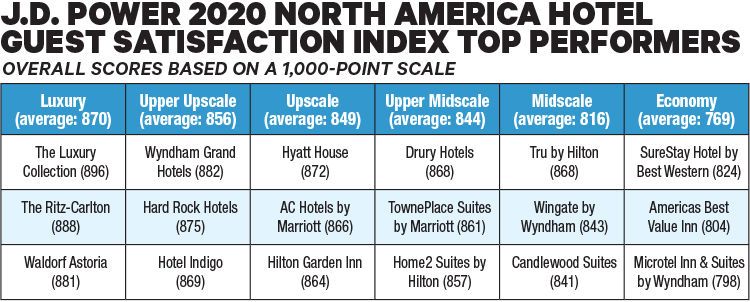
The survey ranks hotel brands based on a 1,000-point scale in the six major segments: luxury, upper upscale, upscale, upper midscale, midscale and economy. The only hotel brand that repeated its 2019 stay atop a segment is upper midscale Drury Hotels, which has led the segment for a record 15 consecutive years.
Shaking up the midscale and economy segments were two newcomers in the top spots: Tru by Hilton and SureStay Hotel by Best Western, respectively. Each launched in 2016.
"A new brand can come in and can win the category potentially. It does happen, but not always," Stokes told BTN. "This year it just so happens we had two new brands [do so]. It's interesting, when a brand can come into a category and competitors have to look at what that new brand is doing and how to compete."
Stokes added that both brands were included in the survey last year, but didn't have enough feedback to be ranked. "It usually takes a couple of years to grow and have enough properties, and we have to find these guests in the general population. This year we could rank them, and were able to find enough guests and hotel stays in our data."
Marriott International brands took the two top spots for luxury, with The Luxury Collection earning a score of 896 points and The Ritz-Carlton, last year's No. 1, with 888 points. Wyndham Grand Hotels, which didn't make the rankings last year, led the upper upscale category with 866 points. In upscale, Hyatt House leapfrogged from No. 5 last year to first this year, earning a score of 872.
Business Traveler Satisfaction by Tier
About 75 percent of respondents were leisure travelers, with the remaining 25 percent business travelers, including those who also added a leisure component. Business traveler satisfaction scores for the chain segments not surprisingly were better for luxury (859 points) than midscale (817 points) and economy (775 points).
Still, there wasn't much of a difference among the remaining tiers. Only 10 points separate the overall satisfaction with upper upscale (845 points), upscale (843 points) and upper midscale (835 points) hotels, potentially showing that the increased amenities and services the latter two tiers have added in recent years—like complimentary breakfast and Wi-Fi—were paying off and making them more competitive with upper upscale options. This also could be of use for travel managers as they look to build their hotel programs for 2021, with an eye for increased value.
The 2020 J.D. Power North America Hotel Guest Satisfaction Index Study is based on responses from 37,843 hotel guests for stays from May 2019 through March 2020. It posed 150 questions and benchmarked the performance of 102 brands. The survey typically runs a full year, "but this year we ended the survey about nine weeks early because of the pandemic," Stokes said.
RELATED: Quality of Sleep a Key Signifier of Hotel Guest Satisfaction in 2019 J.D. Power Survey