The managed travel world—including the world of the top spenders in U.S.-booked business air travel that make up BTN’s Corporate Travel 100—has been in state of limbo for the past 18 months. A major source of that limbo has been resolved in the past six weeks, with American Express Global Business Travel finally closing its massive acquisition of once-mighty CWT in September, after a year and a half of scrutiny in both the U.S. and the U.K. over anti-trust issues.
With that acquisition's completion comes the end of a travel management era, presided over by “the three megas”—American Express Global Business Travel, BCD Travel and Carlson Wagonlit Travel, which just prior to the pandemic shortened its name to its initials and, shortly after the pandemic, saw its namesake family owners sell their last shares in the company for debt forgiveness.
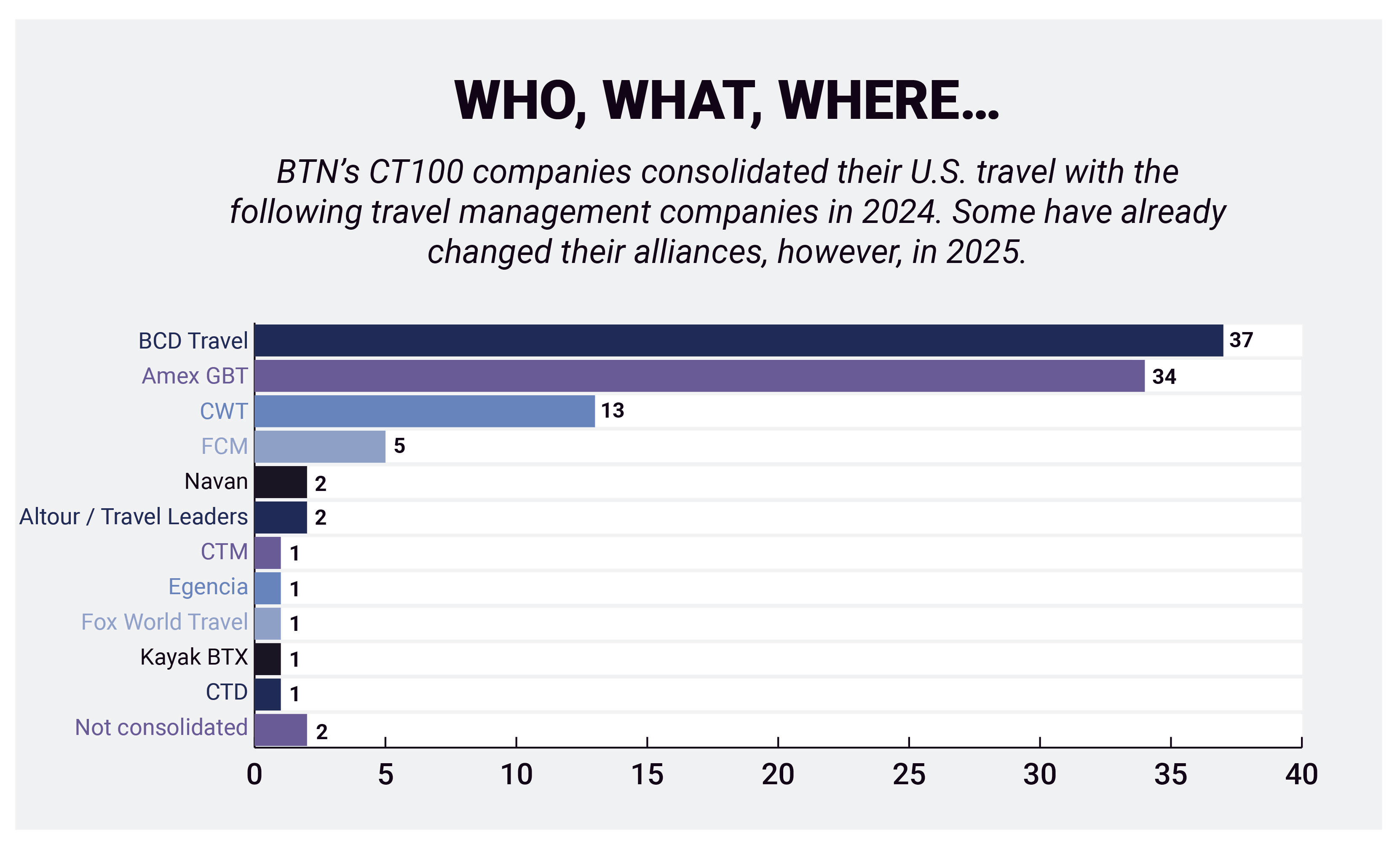
CWT soldiered on, even under financial strain, and kept hold of about 15 percent of the CT100 as major clients almost until the very end. At least 12 members of the CT100 in 2024 relied on CWT as their consolidated U.S. agency—and those relationships often extended to other global regions. Outside the U.S., CWT captured some decent-sized clients as an additional partner to a primary service provider—particularly in China where it had specialized platforms and partnerships. Its specialized services in support of energy and marine clients also kept it tight with companies like Chevron, and some recent innovations with an implant Spotnana technology stack convinced players like No. 3 Meta, No. 27 Walmart and No. 72 GE Aerospace to stick with the company through thick and thin.
How those latter partnerships will shake out after the acquisition is anyone’s guess, but the world of TMC arrangements across the Corporate Travel 100 already was changing—slowly, indeed, but surely.
[Story continues below the chart]
____________________________________
____________________________________
New Names in a New Game
A new batch of TMC names has begun to emerge among the CT100. Last year was the debut of Kayak BTX on the list of CT100 clients. Its origin as the brainchild of the procurement team at PwC guaranteed its standing in the CT100 mix its first year of operation. The blockchain-powered TMC is about to claim more—thanks to a 2024 tender from Deloitte, the newcomer has snagged the U.S. volume of the No. 2 ranked company in the list of big spenders.
BTX isn’t the only new TMC name gaining clients on this year’s list. Navan, as well, is attracting attention—as it has been doing for the last 10 years, especially in its ability to raise investor funds, but not always from large enterprise clients. It debuted on the CT100 list two years ago, with a single client, Netflix. This year, Adobe eked into the list at No. 100, but the company is doing innovative work with its TMC partner around artificial intelligence, New Distribution Capability and enhancing traveler experience. CTM has also appeared in the list this year, partnered up with Mayo Clinic at No. 84.
The upshot is that the list is seeing more diversity in its taste for TMC partners. There is speculation that in the wake of M&A machinations, more companies defected from “the megas” in 2025 to work with new suppliers, rather than trading among the big three names that had reputations for global capabilities.
Indeed, frustration in the ranks of the CT100 has pressed conversations about TMC transparency more intensively than the industry has experienced in the past 10 years and has some looking for “something different.” There are new players not yet represented with CT100 clients—at least not that we can identify today—that may well emerge next year. Specifically, the attention being garnered by the new ownership of Direct Travel with Steve Singh and other investors and the baked-in technology stack provided by Spotnana that also creates the backbone for Direct Travel’s all-in-one travel-payment-expense vision for Avenir. If CWT’s Spotnana users aren’t given satisfaction in the new world order under Amex GBT, might Direct Travel, which in September announced it had acquired long-time partner ATPI, step in to fit the bill?
GBT won’t be so easy to outmaneuver. In an announcement as epic as they come in business travel—but also the subject of a two-month whisper campaign that preceded the impact—the TMC last week announced a tight integration with travel and expense giant SAP Concur. The venture will see the two companies join forces to offer an enhanced version of Concur to joint customers and a roadmap that will see both companies funneling innovation dollars to the collaboration initiative.
While it’s not a merger, the partnership has many of the markings of a JV, wherein the two parties will sell into each others’ products strategically to create a single stream of technology and services to provide the effect of an all-in-one ecosystem. In concept it’s not dissimilar to what Navan has been building, nor to what Direct Travel’s Avenir may develop into.
This new game ultimately may hinge on execution. Can the industry giant out-execute the newcomers? Will corporates that already play in an Amex GBT-and-Concur universe—which hovers around 25 percent of the CT100 list and will be more with CWT’s clients added to the roster—stay put to see how their current partners take charge of innovation?
Or, in an age of AI, NDC and something always unexpected, will a changemaker come from nowhere with a new model that blows up the accepted structures of traditional-minded players that center the TMC in the managed travel universe? And don’t discount BCD Travel, which has plenty of skin left in this game.
It may be a couple of years before we know the answers to those questions with certainty. What we know now is that BTN’s Corporate Travel 100 list continues to lead the way forward with insights and innovations. Below are the major trends that ran through the list this year, along with links to read more about the companies whose partnerships and travel volumes drive the market.