One way or another, irrevocable change soon will consign the
car rental industry of 2009 and the first half of 2010 to the pages of history,
and not just because of the easing of the recession and corporate cutbacks that
brutalized the sector a year ago. Dollar Thrifty Automotive Group, so wounded
by the recession that its stock price dipped below 65 cents a share, soon will
become the property of Hertz Corp. or, less likely, Avis Budget Group, for a
billion-dollar price tag.
(Click here to see a pdf of this section, with all charts
and auxiliary features.)
At press time, Avis Budget's bid to disrupt Hertz's
announced acquisition of Dollar Thrifty with a more lucrative offer hadn't been
settled. Whatever the final result, the acquisition of Dollar Thrifty from 2009's
bankruptcy bait to 2010's billion-dollar prize is to an extent emblematic of an
industry that effectively rethought its fleet strategy and capitalized on an
improving used-car market to claw out of last year's pit.
Corporate buyers with the ability to direct significant
volume, though, still can expect a strong hand in car rental negotiations—the
industry hasn't come that far yet. Smaller accounts might find vendors less
interested in cutting rate-based deals than last year, but corporate demand
still goes a long way.
"Taking a glance at our top 200 accounts, there are still
a few pockets that aren't as rosy as we'd like, but there is positive,
reasonable growth," said Avis Budget senior vice president of commercial
sales Bob Lambert. "During the downturn, there wasn't as much volume
there." He added, "We're happy 2009 is over. We're cautiously
positive as things move forward. 2010 is a much better year."
Avis Budget's 2010 could well hinge on the outcome of their
outside bid for Dollar Thrifty. Hertz in April agreed to buy Dollar Thrifty for
$1.2 billion, but Avis Budget officials a week later expressed interest in
outbidding Hertz with "a substantially higher offer." The situation
remained in flux at press time, but whatever the outcome, the competitive
business travel landscape shouldn't be too roiled: Neither Dollar nor Thrifty
are key corporate brands, but they would allow Hertz to provide a broader
package of price points.
Dollar Thrifty largely has remained mum since the Hertz
acquisition announcement in April. "We continue to believe the improvement
in the overall economy, combined with the ongoing recovery in consumer
confidence, will result in low single-digit growth in rental days in 2010,"
said president and CEO Scott Thompson in May during Dollar Thrifty's
first-quarter conference call, after the acquisition was announced. "The
company believes that customer demand for its value-oriented leisure brands
will result in moderate increases in revenue per day on a year-over-year basis.
Accordingly, we are reaffirming our outlook for revenue growth of 2 percent to
4 percent compared to the level in 2009."
Sitting on the sideline this time is Enterprise Holdings,
author of the last major car rental deal in 2007, when it acquired the Alamo
and corporate-centric National brands. "The industry is getting more
competitive," said Enterprise vice president of business rental
development Brad Carr. "We're seeing business come back slow but steady,
with a slow increase since January. We're still slightly below 2008 levels, but
it is starting to come back."
Corporate customers "have been aggressive," Carr
said. "They understand the competitive landscape. They are leveraging
National and Enterprise. We are taking it case by case. Our costs are still
expensive, and are going up, not down." As such, he said, customers should
not expect tremendous negotiating power. "We want to maintain consistent
pricing as much as possible, relative to spend," he said. "Everybody
is fighting for share with an eye on the margin for each account."
Hertz began to see "a modest uptick" in corporate
business take hold in January, said senior vice president of global sales Robert Stuart. "Nobody's really loosening their belts, but in our top 40
or 50 accounts there's more normalcy in travel patterns."
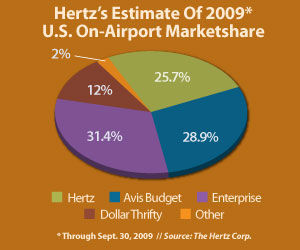
Hertz "isn't going to do crazy things on pricing, but
we want the team prepared so they don't miss any opportunities," Stuart
said. "They want to save a buck, and you have to get creative with them.
They're pushing rate, ancillary revenue, GPS, even blackout dates. You have to
weigh the whole picture, and there are so many variables that go into that."
Lambert also noted that Avis Budget was less than inclined
to give significant ground on negotiated rates. "We've taken a stronger
look at commercial, and we are less flexible, but it's not just a pure rate
play," Lambert said.
Meanwhile, Avis Budget's lengthy public flirtation with U.S.
no-show fees—in place in some European markets—led to their debut in a handful
of U.S. cities, but have been applied only on leisure rentals as part of
voluntary offers in which the traveler also receives a discount. The company
sees the application of such charges, which levy a fee when renters neither
show up nor cancel a reserved car, as in line with other travel supplier
practices.
"There's a great assumption that travel managers will
hate this," Lambert said, "but look at restrictions in the air
industry. The travel management world has widely embraced that concept. Nobody
wants restrictions, but once we explain to people that they let us manage our
assets better so you have a better experience, they understand." Any
expansion of such fees would be gradual, he said, as opposed, for example, to
airlines' checked-bag fees. "That's another misnomer: We won't go from
zero to 60 overnight. We're not going to flip the switch."
Carr said the Enterprise brands have "no current plans
for no-show fees." Stuart said, "We've said we'll evaluate them, but
we have nothing to announce," adding that a systemwide rollout of such
fees would be a significant technological undertaking, given the number of
available car rental booking platforms.
Car rental companies' technological advances in the past few
years, such as global positioning systems and electronic toll-payment devices,
have created other negotiating avenues for some buyers. Creating difficulty in
negotiating such deals toll devices, Carr said, is the lack of a unified
countrywide electronic toll booth mechanism. "There's so many ways they
are done," he said. "We're exploring different options. It can be
frustrating for customers."
Much of the car rental firms' solidifying position can be
credited to a stronger market for the sale of used cars and the employment of
more effective fleet strategies. "Fleet costs haven't eased off, but the
used car market is fairly stable," Carr said. "We're holding on to
cars longer. Last year, there was contraction, but we have increased our fleet
size. We expect pretty good demand. We think contraction is over, and we want
to grow again."