The American Express Meetings & Events 2021 Global Meetings and Events Forecast, released Monday, confirmed what many meeting planners and managers know: Hybrid meetings will be a path to in-person gatherings; small, local and regional events will be more popular than large meetings in 2021; and hygiene as well as safety and security assurances—not just stated protocols—are paramount for events to move forward.
The report is based on a survey of more than 560 meeting and event professionals who represent corporations, associations, buyers and suppliers from 37 countries, as well as interviews with 16 industry experts. The survey and interviews took place in August and September 2020.
New to the survey is the addition of small and simple meetings as its own category of meeting. Respondents said that small and simple meetings would be the most common type of meeting held in 2021 in all formats—in-person, hybrid and virtual—at 21 percent of all events, followed by internal meetings at 18 percent.
Respondents cited two main factors when considering whether to hold an in-person event: 68 percent cited confidence in attendee health and safety components, and 59 percent said flexible cancellation and attrition terms. The capacity to accommodate social distancing, noted by 77 percent of respondents, was the overwhelming factor in meeting location choice, followed by disinfection protocols at 52 percent.
Travel Vitals, a platform launched in July by American Express Global Business Travel, of which Amex M&E is a division, "is one way meeting professionals can get information about health and hygiene guidelines and government restrictions around the world," Amex M&E SVP and general manager Gerardo Tejado told BTN. "It is a combination of leveraging third-party sources for what is needed to make sure people feel comfortable."
Virtual Challenges
Interviewees acknowledged that virtual meeting components likely would be here to stay, not just because they have proven to be effective for certain types of meeting needs, but they also increased the number of potential audience members, allowing more inclusivity for those who might not have been able to attend in-person events.
The top challenges with virtual meetings, however, according to survey respondents, are a lack of knowledge or experience in using them (40 percent), technical issues (32 percent) and lack of engagement (18 percent). For North American respondents, the top responses were lack of knowledge or experience (36 percent), lack of engagement (34 percent), and limited budgets (21 percent).
One way to help with engagement is to align virtual meetings to attendee personas, Tejado said, referencing Amex M&E's identification of seven types of virtual attendees. "We identified who attends and how you need to understand who they are and what they are looking for to tailor content to them," he added.
Further, industry professionals cited in the report cautioned that planning a virtual or hybrid event involved more than setting up a conference call or live-streaming a face-to-face meeting. For hybrid meetings in particular, it could be the "equivalent to the work of planning two separate meetings—one in-person and one virtual," according to the report. Survey respondents said that 35 percent of virtual and hybrid events would require the services of a full-service agency. Additional costs could also include any pre-event needs, such as recording devices, or items for participatory events, like a wine tasting.
The findings show that "more is needed out of the meeting planner," Tejado said, explaining that planners must focus on procurement, engagement and now even more on safety and security. "They need to make sure they have the right tools to give recommendations."
Spend Trends
Average projected 2021 per-attendee per-day meeting spend varied based on the type of event, from a low of $426 for small and simple meetings to a high of $906 for incentives and special events. Overall, respondents estimated that 2021 meeting budgets would decrease year over year by 3.7 percent globally. By region, North American respondents expect those budgets to decrease 5.7 percent, Europe is expected to be down 8.1 percent, Central and South America down by just 0.6 percent, and Asia-Pacific lower by 1.3 percent.
The cost per attendee, excluding air, also is expected to fall for 2021, across all regions and all meeting type categories, with conferences and trade shows showing the steepest declines in North America (4.6 percent) and Europe (5.5 percent).
[story continues below chart]
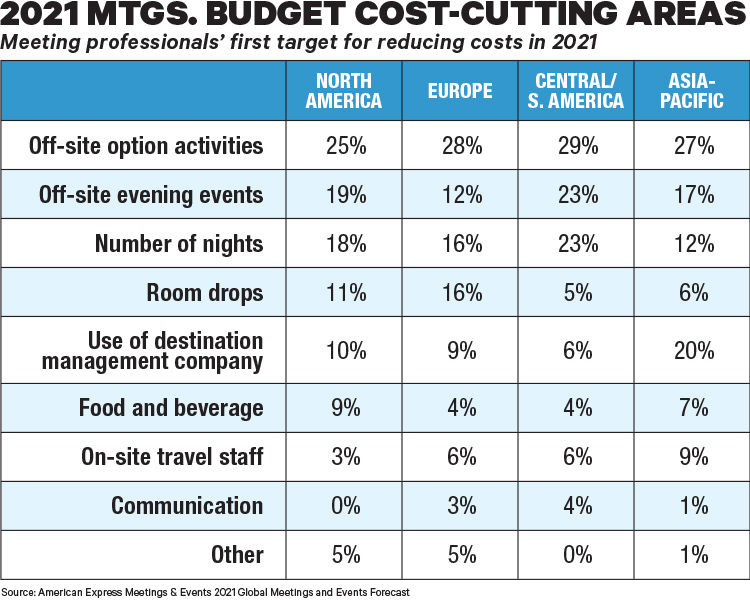
When asked what meeting aspect would be cut first with a budget decrease, 27 percent of respondents selected off-site optional activities, and 18 percent each first would reduce either the number of nights of the meeting or off-site evening events. Should budgets increase, 33 percent said they would use the extra funds to improve the on-site experience, and 31 percent said they would increase the use of technology.
Predicted average 2021 group rates for hotels varied by region. Globally, 42 percent of respondents expect to see rate declines. North American respondents predict a drop of 2.2 percent over 2020 rates, followed by Europe at a 2.1 percent decline.
Group air costs in 2021 were anybody's guess: 32 percent predicted a year-over-year increase, 32 percent predicted a decrease, and 22 percent said they didn't know what to expect. Crisis management and favorable cancellation policies polled higher than in previous years for what is most valued in a group air provider. Respondents also said that aircraft cleaning protocols and the ability to socially distance passengers were equally important factors.
Location and Space Concerns
Respondents said 36.9 percent of their 2021 events would take place in mid-tier hotel properties, a drop from 45 percent in the last survey. Non-traditional facilities, however, fared extremely well compared to last year, going from 10 percent to a projected 16.2 percent for 2021 events.
Part of the reason for the wider embrace in nontraditional sites could be the increase in small and simple meetings. "Two things have happened," Tejado said. "In some of these nontraditional venues, content has been more easily available on their platforms. What we are also seeing is, there was an uptick in use for them because they have more space for social distancing requirements."
Meeting professionals expect space to be readily available in 2021 but more difficult to book in 2022 due to increased competition and the potential contraction of supply due to bankruptcies and closures. Further, spaces contracted will need to be larger to accommodate for social distancing requirements, which also could squeeze available supply. Hoteliers, however, countered that they expect closed hotels to reopen under new ownership, thereby increasing availability in 2022.
Silver Linings
One positive to come out of the pandemic, according to the report, is that companies are taking a closer look at their meetings management policies. In North America, 72 percent of respondents said they have a formal policy for meetings, with 74 percent having an approval process. Those figures were surpassed only by Europe with 77 percent and 76 percent, respectively.
Tejado said he was a bit surprised that Europe led the category of having managed programs, because "in previous years, North America was leading in regard to meeting management policies," he said. "There was always an uptick, but I would say this year the European counterparts saw that as a tremendous jump."
Globally, 67 percent of respondents said their meetings and events policy contained explicit language around safety and security. That was the most popular policy component in North America (68 percent of respondents) and Europe (76 percent).
Further, meetings are on the rebound in the Asia-Pacific region, with 16 percent of survey respondents there indicating they had already resumed in-person meetings, while 47 percent expected to resume some in-person events before the end of 2020.
In addition, sustainability has remained a priority, with 79 percent of respondents indicating their organization emphasizes the concept in meetings and events. Depending on the region, anywhere from 58 percent to 67 percent of respondents said they are very likely or completely likely to address sustainability in their meeting plans for 2021; 64 percent of North American respondents said they would do so.
The top three ways respondents said their organizations address sustainability are by avoiding disposable items (64 percent), recycling (58 percent) and choosing organic, local food-and-beverage options (49 percent). Less travel and more scrutiny on who will be able to attend events also will lower an organization's carbon footprint for meetings, at least for the near-term.