The United States and Israel began a joint military
offensive in Iran early Saturday morning Eastern Time. The goal of the attacks
is regime change, according to U.S. President Donald Trump and Israel Prime
Minister Benjamin Netanyahu. Iran’s Supreme Leader the Ayatollah Ali Khamenei was
killed in the initial wave of attacks this weekend. It is unclear now who is
running the country and leading Iran’s military responses.
The U.S. has maintained a do-not-travel recommendation for
Iran since Dec. 5. It has no consular presence in the country. The United
Kingdom in early January updated its position in Iran, withdrawing all staff
and operating the embassy remotely. Canada updated its travel warnings to the
highest level and limited consular activity operating out of Turkiye. France,
Germany, Ireland and Italy—among other European nations—similarly increased
increased travel warning levels to Iran in early 2026 as the U.S. called
military forces to the region.
The U.S.-Israel joint military campaign follows the murder
of at least 3,117 Iranian government protestors. That is the official toll from Iran’s government
offered on Jan. 21 but never updated. The U.S.-based Human Rights Activists
News Agency estimate the death toll among protestors could have reached
more than 7,000 during the January government crackdown. Medical professionals on the ground in the country, who treated
protestors as the crackdown continued, estimated that number could
be as many as 30,000, according to investigative reporting in The Guardian.
The Trump Administration had built up its presence in the
region throughout January, as Iran and the U.S. engaged in talks to come to a
deal on shutting down nuclear weapons, eliminating Iran’s proxy military groups
in the region and eradicating government human rights abuses. As late as Friday
evening, Trump indicated his frustrations to reporters at the White House, but
also that talks were ongoing: “I'm not happy with the fact that they're not
willing to give us what we have to have. I'm not thrilled with that. We'll see
what happens. We're talking later." But the attacks launched less than 12
hours later during midmorning Saturday in Tehran.
So far, more than 200 Iranians have been killed in the
attacks, including children in an attack on a school in Minab that killed 85 people.
An estimated two-dozen Israelis have been killed and three U.S. service
members. Death tolls are rising in other Gulf Cooperation Council countries
[the GCC includes Bahrain, Kuwait, Oman, Qatar, Saudi Arabia, and the United
Arab Emirates] as well as in Lebanon, as Iran and its proxy groups throughout
the region launch retaliatory strikes.
Travel Infrastructure a Major Target
Dubai International Airport, the most trafficked airport in
the world in 2024 and a critical layover point particularly between Europe and
Asia Pacific, suffered damage on Saturday. Travelers scrambled to flee smoke-filled
terminals. Kuwait International Airport was also hit and forced to evacuate
passengers. According to CNN, blasts hit several major cities Sunday, including
Dubai again, Abu Dhabi, Doha and Bahrain’s Manama.
Airspace across Iran has been closed and the broader Middle
Eastern region is shutting down commercial airline access to airspace as Iran
expands retaliatory attacks. According to Flightradar24, the airspace above UAE,
Qatar, Kuwait, Israel, Bahrain and Iraq remained nearly empty Monday morning. [Story continues below image]
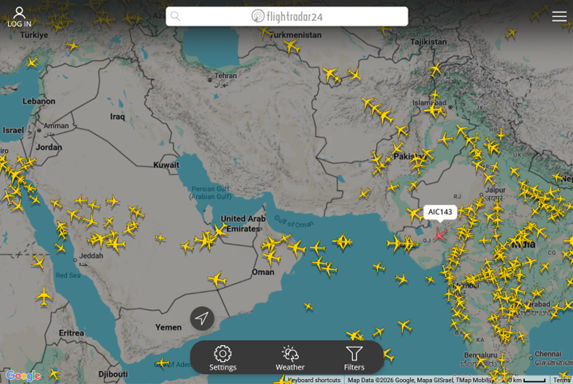 Source: Flightradar24
With the closing of Ukrainian and Russian airspace for the
last four years, options for global airlines to navigate routes between Europe
and the Middle East as well as Europe and Asia Pacific have narrowed. A
prolonged closure of a broad swath of the Middle East and one that includes
major international hubs certainly impacts flights into the region but will
also bleed over into other international routes that depend on transit in
regional airports or access to regional skyways.
A Global Guardian bulletin noted Iran’s “continued targeting
of U.S. bases and now civilian areas within the GCC states
will anger and frustrate these allies of the U.S. In doing so, Iran hopes to
get the GCC to pressure the U.S. to provide an offramp to Iran
or offer a ceasefire.” It also noted, however, that proxy groups for Iran are
likely to induce local violence, while increased Iran-sponsored terrorist
activity, cybercrime and other tactics are likely.
Oil Infrastructure and Shipping Obstruction
“As regime change is
the goal, Iran will respond with all possible options in
order to guarantee its survival—all targets are now viable including oil and gas
infrastructure and U.S. military bases,” according to Global
Guardian.
The UK Maritime Trade Operations Centre reported Monday
morning that two shipping vessels around the Strait of Hormuz were struck, and
an "unknown projectile" was reported to have "exploded in very
close proximity" to a third. The Strait of Hormuz is a narrow passage that
runs from Iran to Oman. Nearly 20 percent of the world’s crude oil runs through
that passage. Without Hormuz, oil shipping will be re-routed around Africa.
By Monday morning, Brent crude had jumped nearly 10 percent
to $82 a barrel; it eased back later in the day to just over $79 a barrel but
remained high. West Texas crude has jumped more than 7 percent to $72 a barrel.
Analysts say that prolonged crisis in the region could send oil prices
rocketing. That will edge up the price of gas the pump for consumers, but
airlines will take a big hit, and while most airlines have hedged on fuel, prolonged
conflict could push them toward fuel charges or to bake the cost of higher fuel
into regular fares. That becomes a one-two punch for airlines that also are forced
to re-route flights around closed air space.
Travel Stocks Take a Hit
Global travel shares took a hit on Monday morning as travel
disruptions rippled around the globe, and declines weren’t limited to airlines:
Reuters reported shares in TUI, Europe's largest travel company, dropped 7
percent in early trade, while British Airways-owner IAG was down 9 percent, and
Lufthansa and Air France-KLM both fell 7 percent. Hotelier Accor and cruise
company Carnival also fell sharply. U.S. airlines in pre-market trading dropped
5 percent and may sink lower when the markets open. Several Asian airlines were
also impacted. Japan’s ANA Holdings, Air China, China Southern Airlines, China
Eastern Airlines and others saw shares trading down by about 4 percent. Cathay
Pacific dropped by 7 percent before recovering to a 2.9 percent decline.
BTN is providing updated information on flight
cancellations, suspensions and change waivers on European and U.S.
airlines.