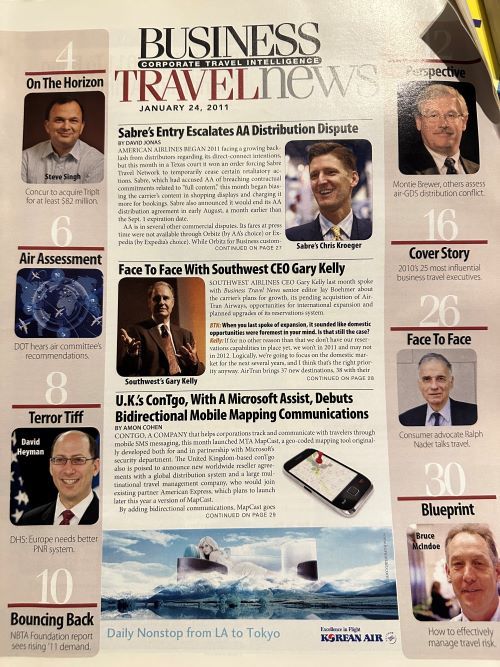
 Business Travel News underwent a short-lived re-design in 2011. It included a pictorial cover, with story headlines pushed mainly to a table of contents, taking the form of a 'news magazine' as opposed to a 'newspaper.'
All signs are pointing upwards for business travel in 2011. The National Business Travel Association changed its name to its current moniker the Global Business Travel Association in February of that year. It also projected during its annual convention that business travel volumes would surpass $1 trillion globally for the first time ever.
Airlines were investing heavily in joint venture partnerships, both transatlantic and, now, transpacific, vying for hegemony over increasingly active east-west routes, as tech companies like Apple, Microsoft and others made huge investments in mobile phone design manufacturing as well as mobile platforms and app technologies.
They were also investing in upgraded product. Premium economy seats were on the minds of airlines, corporate travelers and corporate travel buyers alike. United announced its expansion of Economy Plus on domestic routes to its merger partner airline Continental would debut in the next 12 months. Delta announced it would introduce a premium economy product internationally by summer.
Additionally, the merged United-Continental committed to investing $550 million into onboard products.
The Mobile Tech Boom
Apple rolled out the iPhone in 2007, and plenty of other companies contributed to the frenzy of mobile tech coming into the market by 2011. Palm, an early smartphone and operating system provider, had been acquired and then retired by Hewlett Packard in 2009. Blackberry, the corporate device OG, had cratered on the heels of the iPhone rollout. By 2011, however, Android phones and the operating system underneath them had surpassed Apple adoption. The upshot of all this is that the market was shaking out by 2011, adoption was reaching peak levels and early adopters were shifting to newer, updated technologies.
Here are some fun 2011 stats from Mobile Future:
- 1 billion apps were being downloaded worldwide each month
- $3 billion paid by Apple to independent app developers
- 8 trillion texts were sent—up from 1.1 trillion in 2010
- More smartphones than PCs purchased in the U.S.
- 2.4 million American jobs supported by wireless
- $27.5 billion investment in U.S. mobile networks by wireless carriers
- 500,000 jobs and $400 billion to U.S. GDP with additional 500 MHz of additional spectrum
I’m going to be honest, it took me a second to understand that last bullet point. But suffice to say, mobile tech was killing it in 2011, and we haven’t turned back. Today, an estimated 23 billion texts are sent globally each day, which totals about 3.4 trillion annually. (I personally account for about 43,000 of those texts daily—probably.)
The travel industry felt the mobile tech boom in a very real way. While mobile travel booking had been nascently available in the consumer space for about a year with Booking.com, Expedia and a couple others, the corporate travel industry was a little behind that curve.
Concur rolled out a mobile app in 2010, mostly for expense, but it had mobile search and hotel booking. Expedia’s Egencia (now owned by American Express Global Business Travel) had rolled out an itinerary management-style app in 2010, but mobile booking hadn’t broken through. The same could be said for American Express Corporate Travel rolling out its non-booking app in 2010, CWT’s deep partnership with Worldmate strictly for itinerary management, etc.
To be fair, corporate travel tech is harder to configure and the limited screen real estate of the mobile device proved to be a challenge—working in policy guidance and the right messaging and how to pull the right results, according to policy, plus additional content that might be critical for the traveler.
Air bookings were the most challenging, but 2011 finally brought the first “native” mobile corporate booking tool when then-Concur president and COO Rajeev Singh announced that the corporate travel tech provider would enable booking for “an entire business trip, from air and rail to hotel and car—all from your mobile device, and all in policy” for BlackBerry, iPhone and iPad devices. Reardon Commerce’s Deem online booking tool (Deem is now owned by Travelport), however, was already looking at “relevance” issues, rather than only offering options available in policy.
A New Compliance Battleground
It wasn’t just managed travel tools working to convert lookers to bookers. Supplier apps entered fast and furious in 2011, and not just for check-ins and mobile boarding passes. Mobile travel booking had become widely available, and according to a 2013 mobile booking report from Phocuswright, more than 25 percent of leisure and unmanaged travel bookers were using mobile platforms to arrange and purchase their trip components.
This market was not lost on any travel supplier, and competition was heating up. Hotels rolled out mobile booking promotions to lure potential bookers to their direct mobile sites. Airlines were the same—now with more merchandizing power from ancillary services to throw in to sweeten the deal in addition to the occasional discount.
While the efforts to get direct bookings may have been aimed at luring bookers away from online travel agencies—and, therefore, converting cheaper bookings (no agency or distribution fees to contend with for the airlines and hotels)—managed business travel certainly got caught up in that dragnet of direct-booking promos.
BTN issues were dotted with articles in 2011 about the ills of losing compliance control via app bookings, and whether it could be prevented or—hopefully—short circuited by providing better service, access to centralized itinerary management through the agency app and other benefits that the managed travel industry was working to provide quickly.
It wasn’t easy—and it remains a challenge even as managed travel apps have improved.
Flash Forward
Of course, today we’re not worried about whether we can or cannot (or whether we should or should not) book via our mobile devices. We do it. We expect it as a table stakes for a tech provider in the managed travel space and those that haven’t been able to deliver a reasonable experience on mobile have seen proportionate user erosion. Those that have delivered on mobile experience? Well, let’s say there are other factors in play for corporate travel and one of those major factors was hitting a massive stride in 2011.
You’ll see in the December highlights that Concur was undergoing a huge global expansion. It had acquired mobile itinerary management app TripIt earlier in the year, and as mentioned above, was the first to deliver highly anticipated mobile air bookings. KDS, the Paris-based travel and expense provider, would hit the market with Neo about six months later, which included hotel, air and rail bookings.
It would take a few years before mobile-first tools would emerge for policy-constrained business travel booking.
Providers like KDS and Reardon, however, were laying the groundwork in 2011. Right-sizing content for mobile display would require a layer of machine learning that KDS Neo was experimenting with in 2011 before it launched. Reardon Commerce’s Deem was also looking at how algorithms could determine “relevance” before hitting a tiny mobile screen with selections for business travelers.
The original cohort of “mobile-first” tools like TripActions (now Navan, has raised $1.28 billion in funding and poised to go public); TravelPerk (acquired AmTrav last year, has raised $700 million in funding); Pana (acquired by Emburse, now defunct); Lola (now defunct); TravelBank (acquired by U.S. Bank); Mezi (acquired by American Express, now defunct) wouldn’t roll around until about 2015. In about four weeks, we’ll look at a “where are they now” trajectory of these next-gen providers that are now approaching their 10th birthdays.
_______________________________________________________________________

_______________________________________________________________________
January
American Airlines wins a court order in Texas directing Sabre Travel Network to temporarily stop retaliatory actions after the GDS accused the carrier of
breaching contractual commitments. It started biasing its content, rescinding
discounts, and moving to end its AA distribution agreement early.
Concur announces it will acquireTripIt for at least $82 million, and with
the intent to retain all TripIt’s current employees.
The U.S. Department of Homeland Security tells a
congressional subcommittee that the EU needs a unified passenger name record system to fight terrorism.
ConTgo introduces MTA MapCast, a geo-coded mapping tool developed with
Microsoft's security department. The company also announces new reseller
agreements with a global distribution system and a large travel management
company, which would work alongside American Express' upcoming version,
Guardian Angel.
February
Lanyon, Inc. buys Uversa International, a
provider of corporate spend management solutions. The acquisition includes
Uversa’s on-demand spend management platform which helps businesses source and
manage transient preferred hotel rates.
Two airline joint ventures vie for corporate business between the U.S.
and Japan are preparing to launch on April 1. American Airlines andJapan Airlines will start contract discussions by late spring or early
summer. Meanwhile, United Airlines and All Nippon Airways foresee
taking up to two years to move all its clients to joint agreements.
A BTN buyer survey shows 45 percent are looking into mobile
travel management programs, while 30 percent have no plans for such
systems. Industry experts believe that travelers themselves will drive
adoption of these tools.
Persian Gulf airlines Emirates, Qatar Airways,
and Etihad gain corporate business due to their growing international
networks, lower fares, and competition in the fast-consolidating aviation
market.
March
US Airways and Sabre ink a multi-year,
full-content distribution and merchandising deal. The carrier intends to make its fares, schedules
and ancillary content, specifically Choice Seats, available through Sabre's
GDS.
The National Science Foundation tests a new air travel policy that lets travelers choose between
refundable, contracted fares or nonrefundable ones, which could generate
$2.7 million in savings.
Premium economy becomes more available for US
corporate clients. United Airlines seeks to expand Economy
Plus to Continental Airlines in 2012, while Delta Air Lines aims to have an international premium economy product by summer.
American Airlines, United-Continental, and Frontier
Airlines reduce capacity growth plans due to rising oil prices, following Delta's lead. The
hike in crude oil prices has also helped carriers justify higher fares.
April
Egencia announces launch of “next-generation” mobile tools for the second quarter of 2011. It
initially offers itinerary and general travel information and is only available
on iPhone. It does not support shopping or booking.
Business travel management matures in Latin America, with more companies in the region tightening
controls and encouraging online booking tool adoption.
The GBTA's Airline Ancillary Product Global Task Force formed to
create solutions for reporting ancillary airline fees, encounters
setbacks. Ongoing pain points include standardizing data submission and
coordination among industry stakeholders.
Carriers cut capacity to and from Japan due to lowered demand after the Tōhoku earthquake and
tsunami.
Expedia has not confirmed if its corporate travel arm, Egencia, will benefit from its
new deal with American Airlines, which involves using a GDS to
access fares, schedules, and services via direct connection.
A survey from World Wide Fund-UK reveals that
among large U.K.-based firms, 47 percent had cut business flights and
63 percent have enacted or will enact a policy for fewer business flights
in response to climate change.
May
Travel management is becoming more widespread across the
world, as various companies recognize that the benefits outweigh the
challenges. Two newly published industry papers state there is a need to track
travelers as part of global security, and that even small firms have global business travel.
Lufthansa denies accessing competitors' pricing
through corporate card data. A spokesman said that while the
airline collects data from its subsidiary AirPlus International, it
ensures confidentiality through data protections.
Columbia University researchers explore how frequent business travel may negatively impact health. They
urge companies to focus on wellness aspects of their programs like
healthy eating incentives, fitness facilities, stress management, and
education.
American Airlines files an antitrust lawsuit against Travelport and Orbitz,
accusing them of monopolistic business practices. US Airways has made
a similar claim against Sabre.
The U.S. Department of Transportation defers a
ruling on whether airlines will need to make optional services fee
data available via GDS.
To cope with rising gas prices, carriers are implementing fare hikes. J.P. Morgan aviation
analyst expects U.S. carriers to spend $10 billion more on fuel than they did
the year prior.
June
American Airlines' Direct Connect program could raise
operational costs for TMCs. In response, Carlson Wagonlit Travel will
apply fees to search and book AA tickets outside traditional GDSs.
The U.S. Department of Justice investigates the
alleged anticompetitive practices of GDSs. The probe coincides
with other plans to assess competition in airfare distribution.
Hotel companies launch mobile apps that include shopping and booking. The
platforms offer convenience but compromise data and compliance, since they
enable direct bookings.
As demand for corporate meetings inflates worldwide, it raises concerns
about higher costs and the potential softening of policies many companies
adopted after the 2008 recession and the push for meetings management.
July
Brighter Planet's study of over 9 billion airline
departures has found significant variations in carbon efficiency across the flight industry. The firm
proposes an advanced way for corporations to calculate the carbon
footprint of air travel.
U.S. senators call on the Transportation Security
Administration to allocate more of its budget to rail security.
Egencia finds average first-quarter ticket prices for
North American travel up 13 percent year over year, driven
by increasing fuel costs, higher demand, and tightly managed capacity.
Average daily hotel rates in the first quarter rose in most major business
areas due to the return of corporate demand and reduced scale of new
supply.
August
Cvent secures $136 million in venture funding for technology development, global
expansion and potential acquisitions.
TripIt, which enables its parent company Concur to
target the business travel market, reaches a million mobile users. Concur
chairman Steve Singh says TripIt aims to eventually get to the level of 10
million users in total.
Travel buyers say only 68 percent of hotel bookings complied
with preferred vendors and policies. New online tools offering better amenities
and rates are making it harder to increase hotel program compliance.
The U.S. Department of Transportation proposes that major domestic carriers will have to disclose revenue data in 16 new ancillary fee categories. This would
improve fee transparency and potentially result in new taxation.
Citi Commercial Cards says it will issue chip-and-pin smart cards for U.S. corporate cardholders who
travel internationally.
September
American Airlines and Sabre extend the terms
of their content agreement. The carrier anticipates that the
legal proceedings could last until 2012.
Global Business Travel Association appoints the
Research Triangle Institute’s Jim McMullan as its president, and the University of Texas’
Kevin Maguire as its vice president. Both travel managers ran unopposed and
will serve a two-year term.
Through 2013, United Continental Holdings says it
will invest $550 million into onboard products, including flat-bed seat
expansion, upgrades to transcontinental service, increased connectivity, and
more overhead bin space.
A 2011 study from GBTA Foundation predicts that global business travel will rise by 9.2 percent and
surpass $1 trillion.
Concur sets up the first native mobile air booking experience for business travelers,
scheduled to deploy to all clients in the next few months.
Following the expiry of its full-content deal with American
Airlines, travel software company Amadeus faces a $5.50 per-segment bookings
surcharge from the airline.
October
GetThere’s Suzanne Neufang succeeds BCD Travel’s Chris Crowley as the Association
of Corporate Travel Executives president.
Delta Air Lines topped BTN’s Annual Airline Survey
for the first time, ranking high in 5 service-delivery
categories. It marks the start of a 14-year streak.
Sabre rolls out a new customer profile management
system called Sabre Profiles. It enables those using the Sabre Red
Workspace to manage and access customer data and integrate it with their travel
management. The company is also working on the Sabre Red App Centre.
GBTA launches a new standardized hotel RFP that focuses on globalization, as
well as reducing the RFP’s number of questions.
November
Ed Adams, Navigant International former head, becomes CEO
of NJ-based travel management company Directtravel.
Maritz Travel CEO David Peckinpaugh leads Maritz Inc.’s corporate
restructuring, which includes 100 layoffs but aims to provide more “autonomy”
for three divisions: Maritz Research, Maritz Loyalty and Maritz Travel. Maritz
Travel would be subsumed into Maritz Global Events in 2020.
With a limited North American presence outside of Motel 6, Accor views North American business travelers as a key customer base.
Paul Wait, Virgin Atlantic general manager for global
sales, warns that traditional corporate route deals are being threatened by the
consumerization of business travel, as employees increasingly prioritize
individual trip costs over company travel policies.
European airlines reconsider card payment surcharges following the EU’s approval of a new consumer protection directive, which prohibits
merchants from charging customers more than the merchant fee for card
transactions.
December
CWT North America president Jack O’Neill announces retirement, with Håkan
Ericsson will take over his role.
The EU and U.S. signed a PNR data sharing deal that would replace the existing one
from 2007. The updated contract includes new privacy protections but maintains
the transfer of 19 data types from airline databases to U.S. authorities.
Rearden Commerce creates a "relevance
engine" for its Deem booking tool that organizes search results based on different travelers' preferences
and spend categories. It is first rolled out for hotels.
After reporting 23 percent revenue growth for Q3 2011,
Concur aims to double its sales force over 24 months, build a new operations
center in Manila, and grow its existing facility in Prague.
Amid the boom of credit card surcharges imposed by airlines in Europe, the
industry examines the benefits and costs of card payments.
Tony D’Astolfo advises travel managers to rethink the
concept of lowest logical airfare. He posits factors beyond price, scheduling
and corporate discounts should be considered: like fees, productivity and
status.
Timeline produced this week by AI and BTN editorial content and engagement manager Gianna Song
_______________________________________________________________________

Elizabeth West is the editorial director of the
BTN Group. She has reported on the business travel and meetings industries for
24 years. Beth was editor-in-chief of Meeting News from 2006 to 2008 and
director of content solutions for ProMedia Travel from 2008 to 2011, when
ProMedia was acquired by Northstar Travel Media and merged with BTN. She became
editor-in-chief of BTN in 2015 and editorial director of the BTN Group in
2019.
_______________________________________________________________________