Updated Jan. 26, 9:50 p.m. Eastern
The House has passed and President Donald Trump has signed a bill to end the shutdown through Feb. 15.
Updated Jan. 25, 5:10 p.m. Eastern
The measure to halt the shutdown has passed the Senate and moves to the House.
Updated Jan. 25, 2:45 p.m. Eastern
U.S. President Donald Trump has asked Senate Majority Leader Mitch McConnell to put forth in the Senate a short-term spending proposal to halt the partial government shutdown until Feb. 15. Trump said backpay for government workers would be issued “very quickly or as soon as possible," once he signed a deal. "It’ll happen fast.”
Filed Jan. 25, 2 p.m. Eastern
As a result of the partial shutdown of the U.S. federal government, flights on the East Coast have been delayed and at some points were halted today. For over a month, the shutdown has promised tangential effects on the corporate travel industry, but on Day 35, direct impact was made, and dominoes likely will fall. U. S. Travel Association EVP Jonathan Grella noted, "More than 50 percent of all flight delays and cancellations nationwide originate in the New York, New Jersey and Pennsylvania airspace. Delays in these regions are likely to have a ripple effect on travelers across the country."
Signs Were There
On Jan. 11, the National Air Traffic Controllers Association became the third union of federal employees to sue the administration of U.S. President Donald Trump. The suit seeks a restraining order for depriving controllers of compensation without due process and alleges that the FAA is violating the Fair Labor Standards Act by not paying minimum wage and not paying promptly for overtime. The charges are based on the government's requirement for certain employees to work without pay until the shutdown ends, a matter that affects TSA airport security checkpoints, as well. Government employees are supposed to be paid once the shutdown ends, but whether they will be paid in full or at all is in question. Today, for example, TSA administrator Devid Pekoske tweeted, "Most employees @TSA I-band and below who worked in an exempted status during Pay Period 26 will receive a partial payment for that pay period." Today marks the second payday without a check for government workers.
And on Wednesday, the presidents of the U.S. air traffic controllers, pilots and flight attendants unions—National Air Traffic Controllers Association president Paul Rinaldi, Air Line Pilots Association president Joe DePete and Association of Flight Attendants-CWA president Sara Nelson—released the following statement: "We have a growing concern for the safety and security of our members, our airlines, and the traveling public due to the government shutdown. This is already the longest government shutdown in the history of the United States and there is no end in sight. In our risk averse industry, we cannot even calculate the level of risk currently at play, nor predict the point at which the entire system will break. It is unprecedented."
The system broke Jan. 25, as LaGuardia, Newark, Philadelphia, Atlanta, Washington Reagan and Tampa, Fla., implemented ground delays in light of a staffing shortage among air traffic controllers. LaGuardia, the first airport to be affected today, tempted fate with a pre-9 a.m. tweet: "What a difference a day makes at #LGA! Clear skies have returned and so too has normal flight activity (delays < 15 mins)." Normal flight activity most definitely did not follow. Around 10:30 a.m., the airport tweeted, "Due to staffing shortages at FAA air traffic control centers along the East Coast there are major delays at LGA. Confirm your flight with your airline." And around 12:45 in the afternoon, the account posted this:
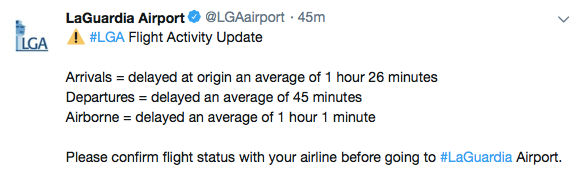
.
Delays worsened throughout the day.
The FAA stated, "We have experienced a slight increase in sick leave at two facilities. We are mitigating the impact by augmenting staffing, rerouting traffic and increasing spacing between aircraft when needed." Business Insider pegged the issues to be occurring at a Leesburg, Va., and Hillard, Fla., control centers, which handle much of the East Coast's aviation traffic.
The sick leave the FAA referenced comes on top of a 30-year low in ATC staffing levels, according to the union presidents' statement, which added that pre-shutdown, those at the busiest facilities already were working 10-hour days, six days a week. The statement called out other aviation-critical areas stretched for staffing during the shutdown, including TSA officers, air marshals, law enforcement and FBI agents. And the union leaders questioned the integrity of the safety-reporting data ATC uses to prevent accidents.
Will flights be canceled en masse? "If issues continue, that will be the next step," Cowen and Co. analyst Helane Becker wrote in a research note. "The airline industry drives 7 percent of U.S. GDP, so growth would be negatively affected if this persists. We expect short haul flights to be affected first, as business travelers decide not to wait in two- to three-hour security lines (it might be quicker to drive)."
Long-Term Effects
Union leaders called attention to lingering effects of the shutdown. The FAA has frozen hiring and closed its training academy, the statement said. "The National Airspace System will be crippled" if the 20 percent of Certified Professional Controllers who are eligible to retire do so now, to avoid working without pay, according to the union presidents. The TSA is in the same position. Becker wrote: "Hawaiian airports reported earlier today that a number of TSA agents resigned this week. This is not a surprise, and is likely to get worse the longer the shutdown drags on. What's worse is that because of the shutdown, they can't be replaced until the government reopens."
As for the effect on airlines, Becker called the incident a speed bump. "The underlying impact is likely impossible to forecast because we do not know when it will end." Nonetheless, she said Delta expected an impact of $25 million in January alone and Southwest reported a $10 million cost so far in January. American and United, which have not tried to quantify the impact publicly, have the most exposure in the short term via United's hub at Washington Dulles and American's hub at Reagan, she wrote.
Becker also expressed concern about demand for air travel should the shutdown extend into March, and she noted that airlines may delay route launches. Already, Southwest has signaled it likely will push back the launch of Hawaii routes and Alaska Airlines has put off plans for Paine Field in the Seattle area. Becker also noted delays in inspections, and thus deliveries, of new aircraft.
What If the ATC Weren't Part of the Federal Government?
Becker recalled futile bills previously proposed in Congress to remove ATC from the FAA and place it under a nonprofit corporation. "This is another major factor in airlines' support of setting up a private company to manage the country's air space," she wrote. "This issue could be a turning point for change."