Get top-flight travel buyers in a room, and the conversation about managed traveler happiness goes something like this:
“Happiness is the No. 2 priority in my program, after procurement.”
“It’s changing over the years and it changes by company. ... At [my current company], it’s No. 1, and that’s why I love working there. But our requirement as travel professionals is to know the company’s priorities and how to optimize the program within that framework.”
“Happiness equals compliance equals procurement. You manage through education and data, but happiness drives compliance.”
“Happiness has to be in the context of the purpose of the trip. Was there value in what they did? That particular trip and the suppliers they took … that’s just an enabler. I’m a little bit concerned about even talking about happiness.”
“You can separate the pain of doing an expense report from the success of the trip. To a certain degree, happiness is as good as your last trip; but if you repeatedly have negative experiences, it comes at a cost.”
“Attach that to attrition.”
“People hang around even when they are unhappy with aspects of their job; they just get disengaged. That’s bad for the company and bad for the travel program.”
LOST IN TRANSLATION
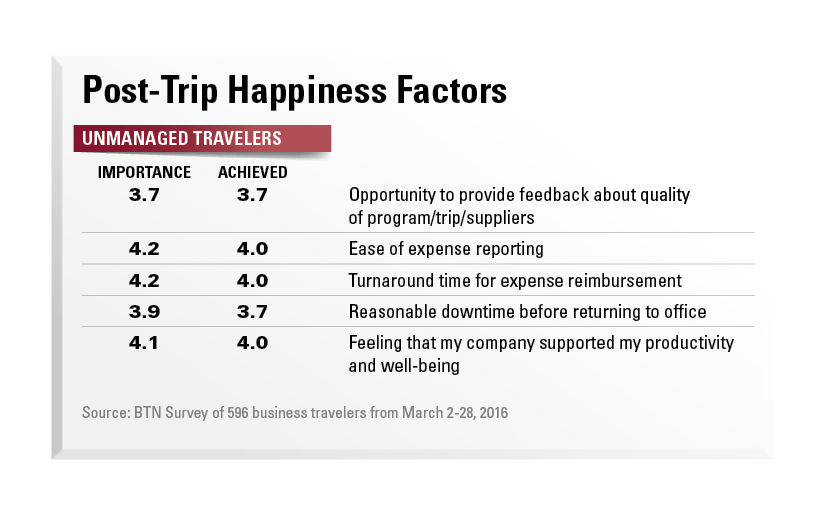
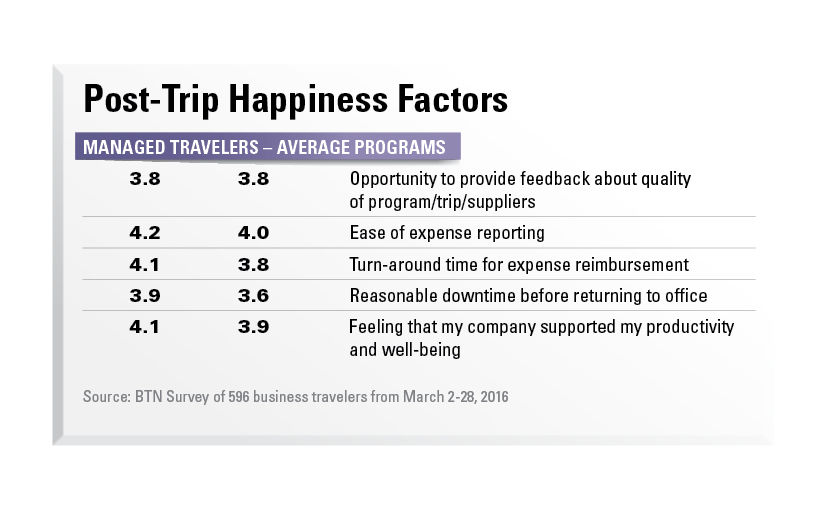
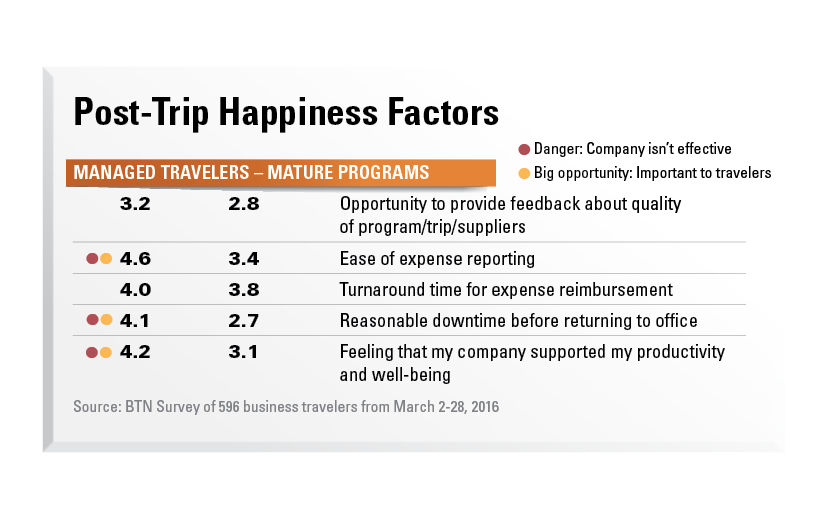
With ambivalence around the term “happiness,” it comes as little surprise that business travelers within mature travel programs scored lowest on BTN’s Traveler Happiness Index. The survey measured three levels of travelers: unmanaged, “average” managed and mature managed (see page 8 for group selection details). On a scale of 0 to 100, where 50 would be characterized as “neutral” or “nominally satisfied,” the groups returned the following results:
________________________________________
Index Score
72 Unmanaged
69 Average managed
59 Mature managed
________________________________________
“Mature travel programs have been defined in the past as those most effective in terms of procurement and compliance,” said Paul Tilstone, founder of London-based consulting firm Festive Road. “I wonder if what we are seeing in these numbers is some backlash in response to that kind of environment.”
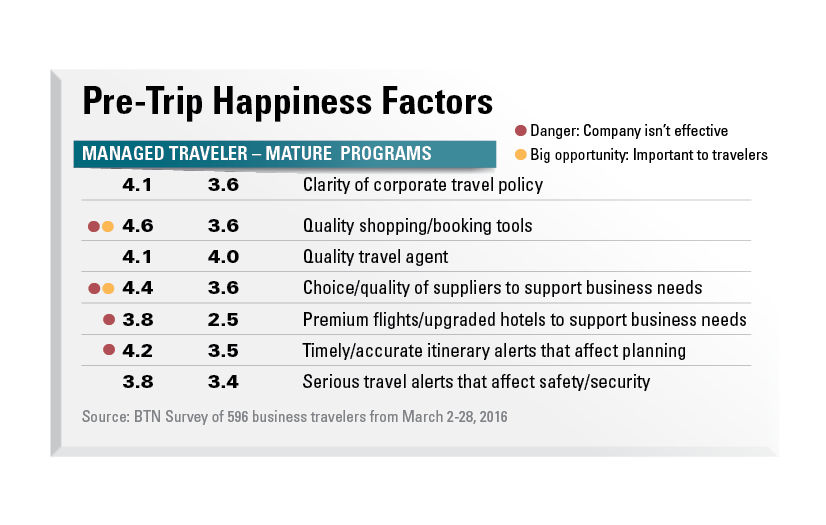
Travelers in mature programs returned significantly lower “effectiveness” ratings for the supplier choices available in the confines of their programs, not to mention limited flexibility to upgrade to higher classes of service based on business needs. Many buyers would persuasively argue that this is evidence of procurement efforts working: driving travelers to a limited number of preferred suppliers to boost volume negotiations and holding travelers accountable to policies that require judicious use of corporate monies. “We make calculated trade-offs,” said Steven Mandelbaum, vice president of information systems for The Advisory Board Co. “Companies that aren’t doing this are leaving a lot of money on the table.”
Even so, traveler sustainability informs the equation for Mandelbaum. “Our most important people are on the road. They are experts in the field ... and we are fortunate to have assembled an unbelievable bench of employees,” Mandelbaum added. “We want to be good stewards of resources but also strike the balance to make our talent as efficient as possible.”
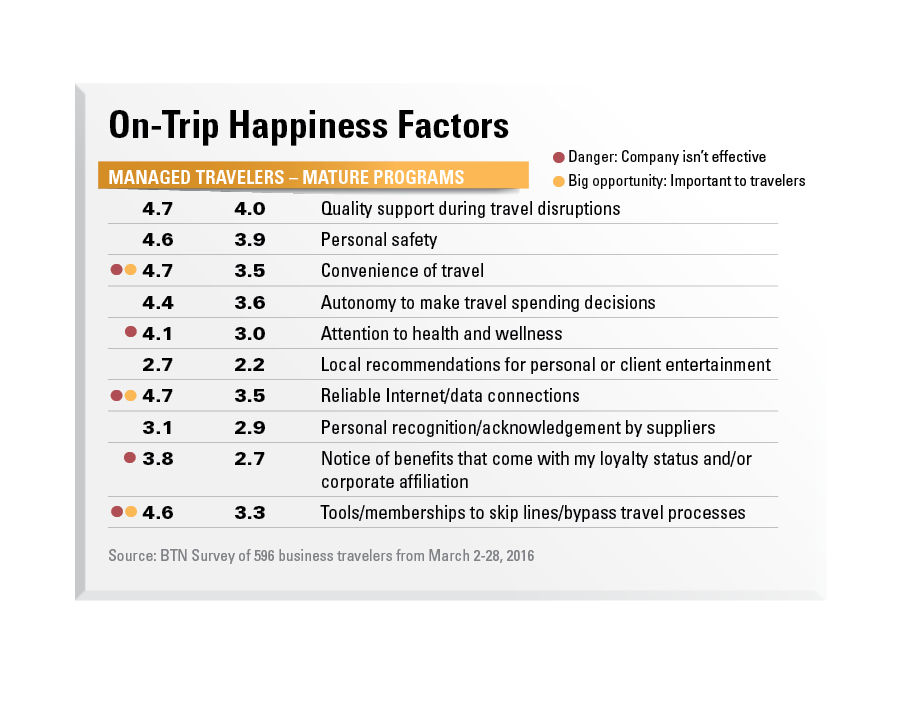
Efficiency isn’t just about driving savings and restricting choice, though. Mature travel programs show a lot of strengths when it comes to supporting productivity. Their policies offer much broader allowances to support work away from the office and even in transit. More than three-quarters of travelers in mature programs were reimbursed for hotel Internet charges, and half were reimbursed for in-flight Wi-Fi.
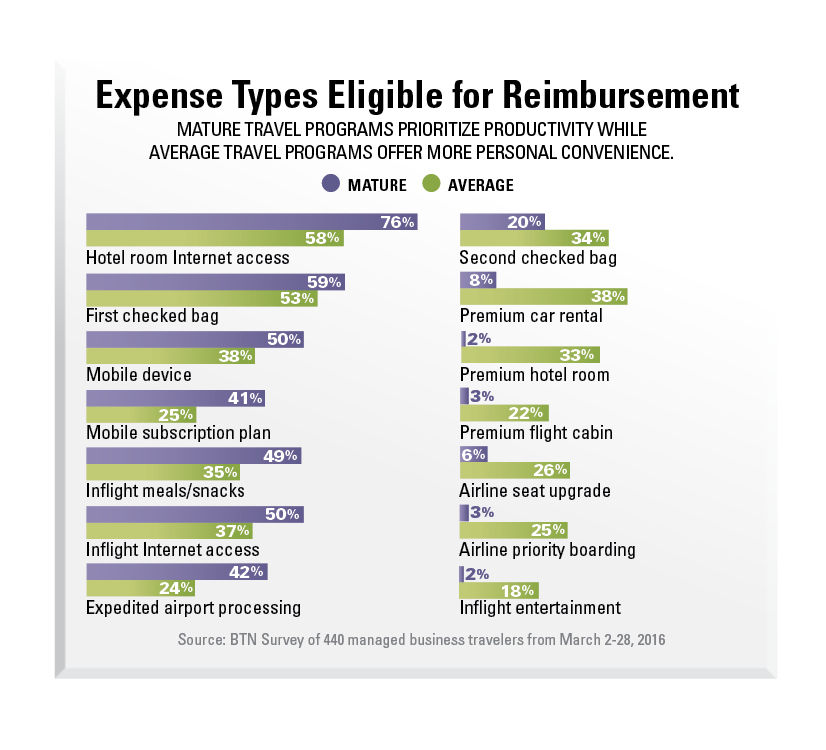
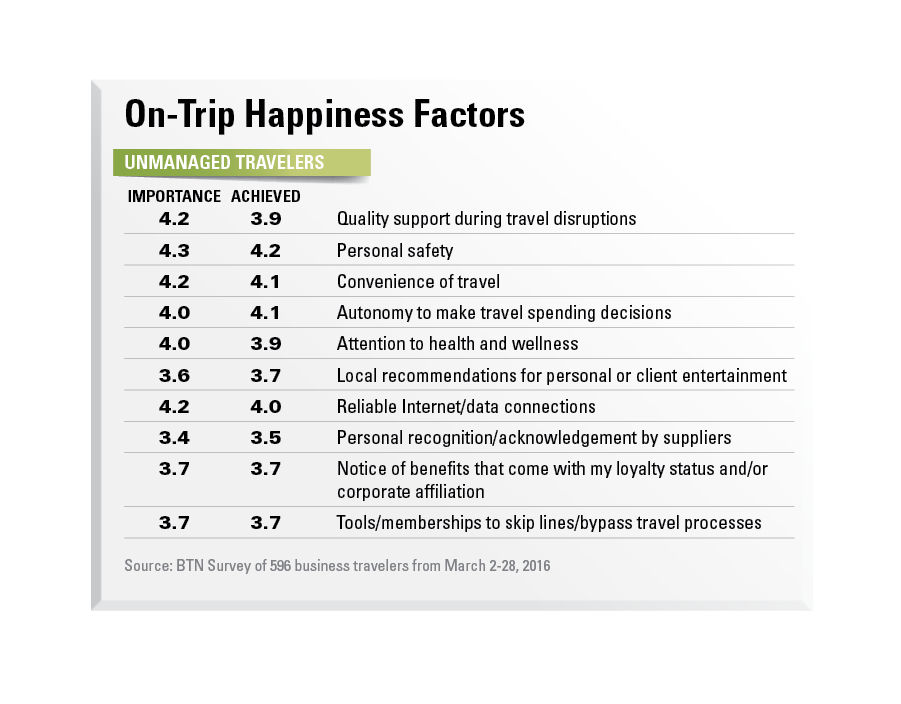
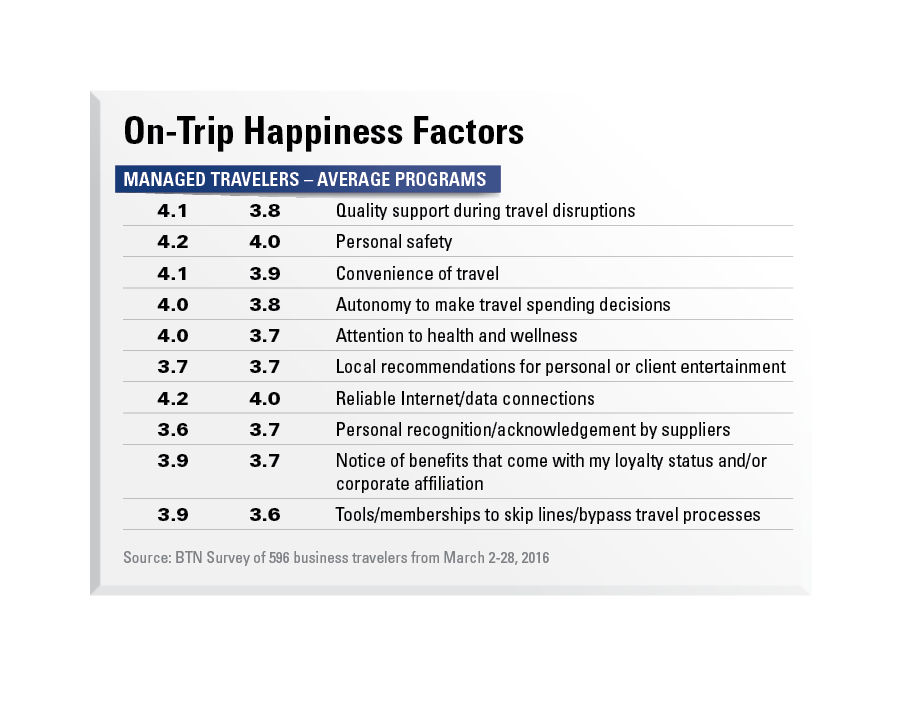
That compares with just 58 percent of travelers from average programs who were reimbursed for hotel Internet and 37 percent who were clawing back funds for connecting in-flight. Much broader allowance for mobile phones and subscription plans, in-flight meals and expedited security processing made working while traveling more attainable for travelers in mature programs. On the other hand, their average program counterparts reported vastly more access to upgraded products and services, in-flight entertainment and allowances for extra baggage.
If upgraded services and entertainment options are the fundamental drivers of business traveler happiness, then mature managed programs don’t really have a shot. Even Tilstone, who supports the progressive reengineering of managed travel paradigms, suggested, “A happy traveler may not be one who is doing what they should for the business. Is satisfaction or engagement a better measurement?” But survey results suggested that travelers in mature programs were looking for something deeper than perks and goodies.
THE VALUE OF TIME
Travelers in mature programs valued one thing above all: time. In return for traveling on behalf of their companies, they expected travel programs to deliver streamlined processes across the entire business trip: intuitive booking and accurate mobile alerts to airport security facilitation and airline boarding to bypassing car rental counters and hotel check-in processes.
Travelers were eager to gain time, no matter how it came about: company-provided tools, one-off program benefits, negotiated loyalty status or personal status jockeying. But don’t pan the pretty: If time savings were bundled with upgraded product or services, all the better.
Survey results showed that communicating these types of benefits at the point of sale would influence traveler decision-making. More than 64 percent of managed travelers said knowledge of program benefits at the point of sale would significantly improve their experiences; the same percentage said that about details regarding loyalty benefits. Travelers in mature programs, who were largely road warriors, would rely more heavily on loyalty-benefit details at the point of sale if the capability was available. Just 50 percent of these travelers said details about negotiated benefits would significantly improve their experiences, but 60 percent would like to see loyalty integrations.
COMPLIANCE: UPSIDE & DOWN
Even with a happiness index score 10 points lower than their average managed program counterparts, travelers in mature programs reported much better compliance to the booking channel. More than 80 percent booked through the agency or online tool more than 90 percent of the time. This does not translate into 90 percent compliance to the booking channel overall, as noncompliance among road warriors has an outsize impact on travel programs; plus, road warriors veer from the program more often than less frequent travelers.
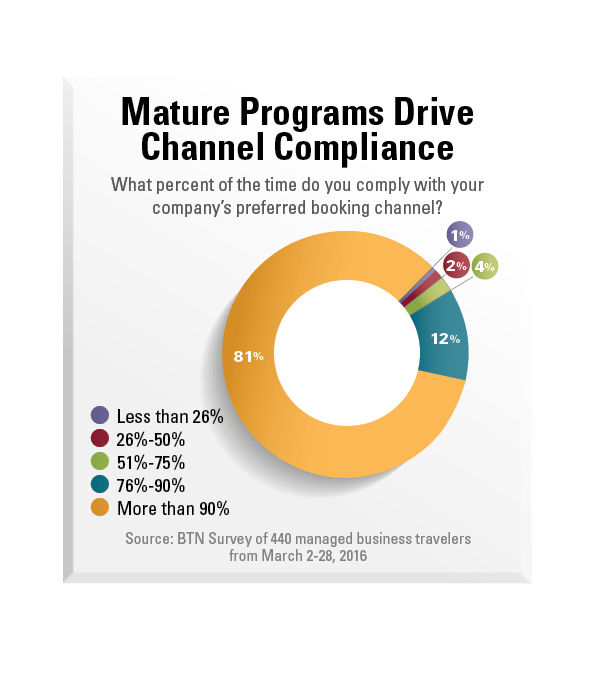
Still, compared to travelers in average programs in which only 37 percent booked through the preferred channel more than 90 percent of the time, mature programs are driving vastly higher compliance. The upside is the ability to harness volume data for supplier negotiations, to access travel management company support in the event of travel disruptions (highly valued) and to track itineraries for duty of care.
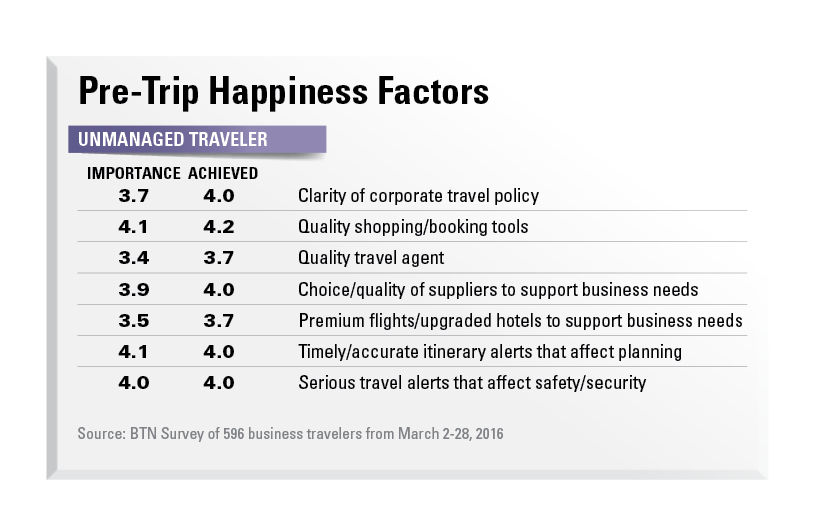
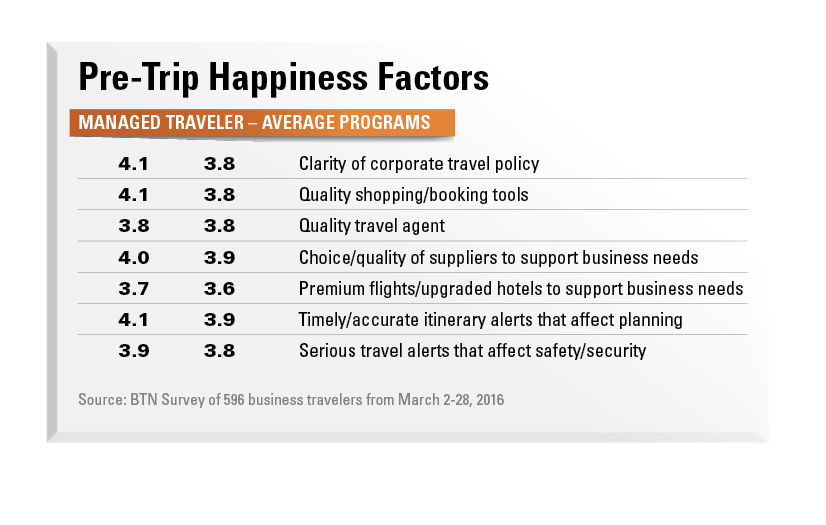
Survey results suggested, however, that companies with mature programs suffered from a compliance funk that dragged down the overall index score. Factor-by-factor analysis showed that travelers who reported more restrictive travel programs had higher expectations for travel tools and processes. In addition, they seemed to be harsher judges of program delivery overall, giving consistently lower effectiveness ratings.
BOOKING TOOLS: A STICKING POINT
Specifically, the discrepancy between how important the booking experience is for these travelers versus how well it’s being delivered was a notable pain point. More than 93 percent of travelers in mature managed programs rated intuitive booking tools as “very” or “extremely” important. That compared to just 78 percent of average managed and unmanaged travelers who said the same.Moreover, 22 percent of travelers in mature programs who sometimes booked off channel, reported leaving the channel to get a better rate or value, but the same percentage said they just couldn’t deal with the booking experience itself. The average managed traveler showed much less angst on this point, compared to their other priorities like rate and value.
A logical interpretation is that the happiness score for average managed travelers, who projected more autonomy to book outside preferred channels, is not solely a measure of in-program experiences. Rather, it may include their perceived autonomy to go outside the program to access a better experience.
Margaret Brady, former global travel buyer for Grant Thornton, is a proponent of incorporating open booking strategies into core programs. “You can’t look at the trend [in hotel direct booking] and not be in the position to accept open booking. You end up missing 25 percent of your spend.” she said. “It may not be the core of the program. If you can set up the right services, people will come 95 percent of the time through the main engine, but we are kidding ourselves if we don’t set workflows to take [off-channel] data into our systems and make us whole.”
HAPPINESS AS A LEVER
All roads do not lead to open booking and letting travelers off the leash to pursue their business travel bliss. With mature programs having mastered sourcing and transactions, though, travel buyers still have to prove they can deliver value. Opening the booking channels and capturing a couple million in leakage on the back end is one way. Using travelers’ ratings of suppliers to drive service levels and further tighten the program is another.
Will Tate, partner at GoldSpring Consulting, has built a business on using traveler satisfaction for leverage with suppliers. “We help clients narrow the field by looking at competitive properties in a city,” said Tate. “The deciding factor, if price is competitive, has to be service.”
Tate surveys client travelers to get a satisfaction rating for 10 hotels in a market, for example. He combines that with the negotiated rate to get a combined value rating for each property and informs each hotel that it can move the value rating by adjusting price or service level. In that scenario, Tate said, “the corporate can tell suppliers that they are dropping the bottom three properties. Plus, they can ask the other seven to make improvements to be more competitive.”
Often, every property in the set will move both levers: a better price or amenity package, plus service enhancements like greeting travelers by name, upgrading to a concierge floor or offering a small check-in amenity. “Something that builds some brand loyalty from the corporate travel perspective,” said Tate. “We see service ratings go up and [total price] go down. You can’t get that with procurement alone. Without the traveler experience lever, you can’t get the rate.”
After wrapping a communications campaign around the initiative and labeling selections as “Employee Choice” in the booking tool, “you see bookings skyrocket,” said Tate.
That’s the kind of tactic Mandelbaum can endorse. “The best wins are service innovations that don’t cost any money … with suppliers or with tools,” he said. “Addressing specific traveler preferences might get you a short-term blip, but then you may give away ground and get nothing in return over the long haul.”
THE BIGGER PICTURE
Dana Rixter, director of travel services for BAE Systems has recently immersed herself in corporate diversity and inclusion concepts, and she has concluded that travel programs can achieve more than efficiency and savings. They can help drive overall corporate productivity and performance excellence.
“When employees are engaged, they are more productive, and that extends to travel,” said Rixter, but achieving engagement requires more than driving nominal satisfaction. “Satisfaction really isn’t good enough. We want to make them happy, as employees and as travelers. When individuals feel included and when they perceive that their company values what they bring to the table, they put forward discretionary effort to the company’s benefit.”
Rixter cited a 2013 Gallup study: Public companies with 9.3 engaged employees to every actively disengaged one achieved 147 percent higher earnings per share than their competition in 2011 and 2012. “It’s an internal conversation that I am having with my management and with supervisors to get them to understand the importance of this,” she said. “Those in financial and procurement roles [need to buy into the strategy]. Evidence suggests that the return can be transformational to an organization.”
BCD Travel/Advito managing director April Bridgeman has been beating this drum for years. “It’s very feasible not to lose savings but to gain savings,” she said about engaging travelers through a travel program that they want to be a part of. “If you motivate travelers and arm them with knowledge, that investment in traveler happiness will produce returns.”
BY ANY OTHER NAME
For some, the conversation gets easier if you tweak the semantics. Talk about traveler “satisfaction” or traveler “engagement” or traveler “centricity” and the concept squares more easily with business strategy. But as the industry talks about the effect of “consumerization” on managed travel and rails against supplier loyalty programs that siphon travelers away from core programs, it’s worth asking how it is that industry “frenemies” are competing for managed travelers and winning. Could it be that they are simply making them happier via a better business travel experience?
If so, how can individual travel managers push more positive experiences and happiness—something that goes beyond mere satisfaction—through their programs? More broadly, what does the industry need to do to drive innovations that will support managed traveler happiness?
“I was in a meeting the other day with a bunch of buyers” said Festive Road’s Tilstone. “The user experience had become the top priority KPI for all but one in the last 18 months.” Asked what these buyers were actually doing to reach that key performance indicator, he cited small service enhancements. “Unfortunately, not enough,” he said.
True progress, he said, may have to come with a more “scorched earth” approach that assumes “nothing is sacred: TMC, GDS, policy, nothing.”
The goal, he said, would be to safeguard managed programs from external influences by surpassing the value of those influences. In doing so, he postulated that suppliers might eventually recognize the premium value of corporate channels.
“The real objective is for buyers to create such effective engagement channels that suppliers actually realize that going direct themselves achieves one thing but that [the corporate channel] is a dynamic channel through which they can reach high-yield customers through this buyer or TMC,” he said. “I’m an optimist, and I believe we will make progress this year, but right now it’s just not being achieved.”