Door-to-door itineraries, predictive and personalized recommendations, a focus on loyalty and traveler satisfaction—managed travel programs are venturing out from under the umbrella of traditional procurement and shining a brighter light on the travel experience.
Ask any industry supplier or consultant, and they’ll confirm that for the past three years, corporate buyers have focused much greater value on service levels, corporate recognition programs and more-personalized experiences that keep travelers happier on the road but also more engaged in their travel programs.
From a technology perspective, buyers consistently tell Business Travel News they are desperate for smarter corporate booking tools that can access traveler history, make better recommendations for individual travelers and expose richer content during the shopping and booking process. They are looking for seamless integrations and mobile travel experiences that will allow corporations to support their business travelers en route and provide the individualized “consumer” experience travelers have come to expect in their personal lives.
Why has the managed travel industry arrived at this place, when just five or six years ago, buyers were more intent than ever to identify savings opportunities, put the squeeze on suppliers and implement restrictive policies and approval processes that often reduced business travel overall?
The easy answer involves the global economic crisis that caused businesses to pull back the reins on travel and often to engage with suppliers—which were in dire need of business—almost exclusively on the basis of rate. As the United States and other global markets emerged from economic paralysis, however, travel buyers discovered that the downturn had not fettered travel industry
innovation, and in fact, the consumer travel technology market was alive and well—and thriving ways that were driving up the expectations of their business travelers. Think: mobile, social, personalized recommendations, amped up loyalty schemes, rich shopping content and deals, deals, deals if the traveler knew where to look. And business travelers were looking.
At first, and sometimes still, the industry pinned these developments on a generation issue: Millennials were entering the workforce in droves. Many travel buyers—and suppliers—pointed to these “digital natives” as a vector of noncompliance in otherwise stable travel programs. Research conducted at the time by BTN showed that managed travelers across all age groups were regularly jail-breaking their travel programs in search of better rates and/or more intuitive shopping and booking paths that had become de rigueur in their daily lives.
Ultimately, the industry has arrived in an era of odd bedfellows in which many travel buyers have concluded that compliance must rely less upon rules and mandates and more on an ecosystem of intuitive tools, meaningful added-value benefits, possibly a choice of booking channels, and policies that don’t make business travelers feel penalized for participating in their managed travel programs. In short, program compliance—and even the last frontier of procurement—relies on traveler happiness. The happier managed business travelers are with the tools, processes and right-time support systems their companies provide, the more they will engage with the programs.
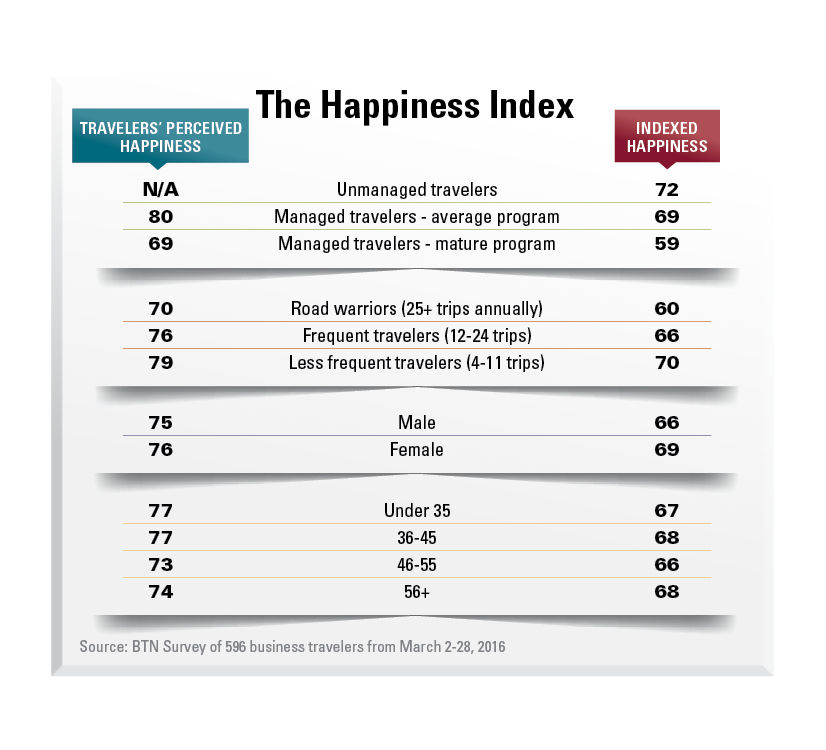
CREATING THE TRAVELER HAPPINESS INDEX
Overall, the managed travel industry is still at the beginning of the traveler-engagement process. As it moves deeper into transition, BTN’s Traveler Happiness Index attempts to measure business travelers’ satisfaction with their travel programs,and identify which developments would make them happier and, therefore, more compliant while traveling on behalf of their companies. The survey included queries about the importance of various features of travel program policy, technology and service triggered along the lifecycle of a business trip. Analysis includes an industrywide score for business traveler happiness, as well as a breakdown of happiness scores along select verticals, including program maturity and frequency of travel.
BTN’s objective in creating the Traveler Happiness Index is to identify the most powerful drivers of traveler happiness and to use the data to suggest a logical road map for travel managers as they transform their programs. To create the index, BTN divided the business trip into three parts:
Pre-trip – The activities and considerations that a traveler must engage in to plan, book and prepare for a business trip.
On-trip – The activities, trip variables, productivity tools and on-the-ground experiences that a traveler has on the road.
Post-trip – Common tasks that a traveler must complete to close out a business trip, plus recovery from the impact that business travel has on personal life.
NORTH OF SATISFACTION
To take the inquiry beyond the concept of “satisfaction,” BTN inquired about aspects of business travel that sit a level above logistics and focused on areas that enhance the traveler’s experience of the travel program and the business trip. Clarity of policy, booking experience, supplier choice, access to assistance during disruption, convenience of the itinerary, ability to maintain health and wellness, access to Internet or data connections, ease of expense reporting, reasonable downtime before returning to the office—BTN queried 22 experience elements in all to begin to track traveler happiness.
BTN asked survey respondents to rate each element along two vectors:
Importance – Respondents rated each element on an importance scale, where 1=not important and 5=extremely important. This inquiry created an overall picture of the respondent’s expectations of the business travel experience.
Effective Delivery – Respondents also rated each element on a delivery scale, where 1=not effective and 5=very effective. This inquiry created a picture of how well the respondent’s company was reaching individual expectations.
CALCULATING HAPPINESS
To calculate an overall Traveler Happiness Index score, BTN normalized the effective delivery scale to a midpoint of zero to achieve a clear positive and negative pull on happiness scores. A perfect raw score, for which every factor had an importance level of 5 and was delivered at an effectiveness rate of 5, was equal to 220 points. A total program failure delivered a raw score of -220 points, reflecting an importance rating of 5 for every factor but a delivery rating of 1 for every factor.
Raw scores were then normalized to a 0- to 100-point index. When considering Traveler Happiness Index scores, the following guide may be useful:
Less than 50: Travelers are not yet satisfied with their business travel experience. As the score positively approaches 50, results show nominally increasing satisfaction.
50 to 60: Travelers are satisfied, but the program would benefit by improving the experience for elements the group identified as most important.
61 to 70: Travelers are satisfied with their business travel experience and consider the company able to deliver at least some of the important experience elements that make them happy.
More than 70: Travelers are happy with their business travel experience overall and consider the company largely able to deliver on many of the experience elements they identified as important.
Partially effective delivery on highly valued experience elements could result in a higher index score than full delivery of experience elements that travelers do not deem important. Also important is a trend identified in the research that suggests very high experience expectations may magnify a negative perception of how well a corporation delivered. That said, perception is reality when it comes to happiness. Companies with travelers who have very high expectations have to work harder to move the needle.
ACCOUNTING FOR SURVEY SCOPE
Limiting the query universe is critical to any survey, but so is an understanding that good results rely on asking the right questions. To control for unidentified factors that impact traveler happiness, BTN asked survey respondents to consider their perceived happiness with their business travel experiences and to rate that happiness on a scale of 1 to 10. Multiplying those responses by 10 adjusted those results to the same 0- to 100-point scale as the calculated Traveler Happiness Index score for a side-by-side comparison.
On average, survey respondents rated their perceived happiness with their business travel experiences 10 points higher than the happiness calculated by BTN’s 22 index measurements. More important than the average variance, however, was the constant nature of the variance. Nearly every group surveyed pegged their perceived happiness 9, 10 or 11 points higher than their calculated index score.
The good news is twofold: 1) BTN’s Traveler Happiness Index provides a measure of business traveler happiness that has a consistent relationship to perceived happiness. 2) We can also assume that corporations are delivering well on a host of factors that affect traveler happiness outside the scope of the survey.
GROUPS SURVEYED
BTN fielded the Traveler Happiness Index survey primarily to North American-based business travelers. Respondents were screened for a minimum of four business trips in the past 12 months that included an airline ticket and at least one overnight stay. A total of 596 business travelers completed the survey. Respondents hailed from more than 30 industry verticals, with particular concentration in technology, finance/banking, insurance, education and consulting. BTN placed particular importance on pulling in a cross-section of business travelers for the purpose of comparing three major groups:
Unmanaged Travelers (156 respondents) – Including these travelers, whose business travel experiences are formed by the consumer space, served as a benchmark to measure the managed travel industry’s success in delivering consumer-style happiness. In reality, unmanaged travelers expected noticeably less from their business travel experiences than did managed travelers in mature programs. That said, unmanaged travelers largely complimented their companies' ability—or perhaps their own abilities, depending on how you view it—to deliver travel experiences commensurate with their expectations.
Managed Travelers: Average Program (262 respondents) – “Average” is used in its mathematical sense in this instance, not a qualitative one. BTN had no prior connection with the sample for this respondent group, and they were not associated with any particular travel agency or travel management company. Travelers from fledgling programs were mixed with travelers from mature programs in this sample. Therefore, the index scores associated with this group reflect a cross-section of respondents and provide average numbers to represent the whole.
Managed Travelers: Mature Program (178 respondents) – BTN also fielded the Traveler Happiness Index to travelers in six mature travel programs with which it is familiar. Each partner had pushed his or her travel program toward innovative tools, policies and supplier partnerships recently, though none had fully realized its vision. That said, some programs were further along than others, and the index score represents the aggregate experience of this group. Another important note about this group is the high percentage of road warriors represented. Two-thirds of survey respondents from mature programs were also classified as road warriors, a fact that skews results for this group heavily toward the expectations of the road warrior subgroup.
The extent to which survey respondents were managed informs much of the research discussion in this special issue of BTN. The frequency with which groups traveled also brought to the surface different “happiness factors” from overall results. But other demographic factors are important, as well, when identifying the needs of travelers within any organization. The Traveler Happiness Index above shows top-line results for both the travelers’ perceptions and their actual indexed scores for level of management, travel frequency, age groups and gender.
THE FIELD STUDY
BTN fielded the Traveler Happiness Index survey from March 2 to 28, 2016. Equation Research programmed the online survey and tabulated results. BTN worked with consulting firm Spectrum International to create the index formula.