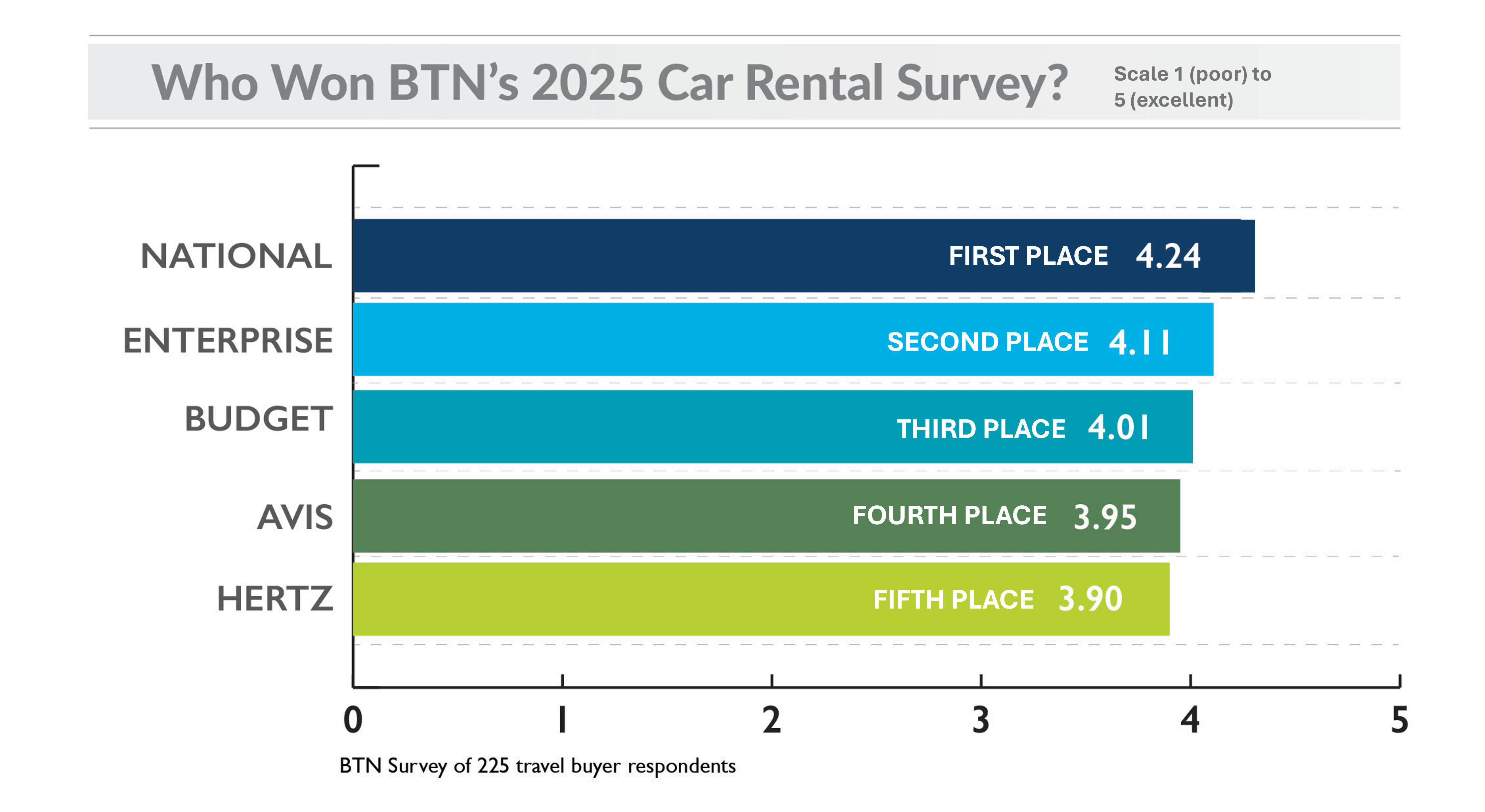
For the 10th year in a row, National Car Rental was the
top-rated supplier in BTN's 2025 Car Rental Survey, with Enterprise Rent-A-Car coming
in second for the fourth year in a row.
National's average score was 4.24 on an ascending scale of
one to five, with Enterprise at 4.11. Budget moved up a notch into third place
at 4.01, followed by Avis at 3.95 and Hertz at 3.90.
"We've very proud of not only where our service is at
and how much pride we take in that, but the consistency of that over the last
several decades," Enterprise Mobility VP of business rentals sales and
global operations Mike Guadagnoli told BTN. "What makes us unique is all
of our employees. They start as a management trainee in the rental branch in
operations, learning the founding values of our business. How to take care of
your customers at an exceptional level. Everything you then do throughout your
career is measured based on your customer-service score."
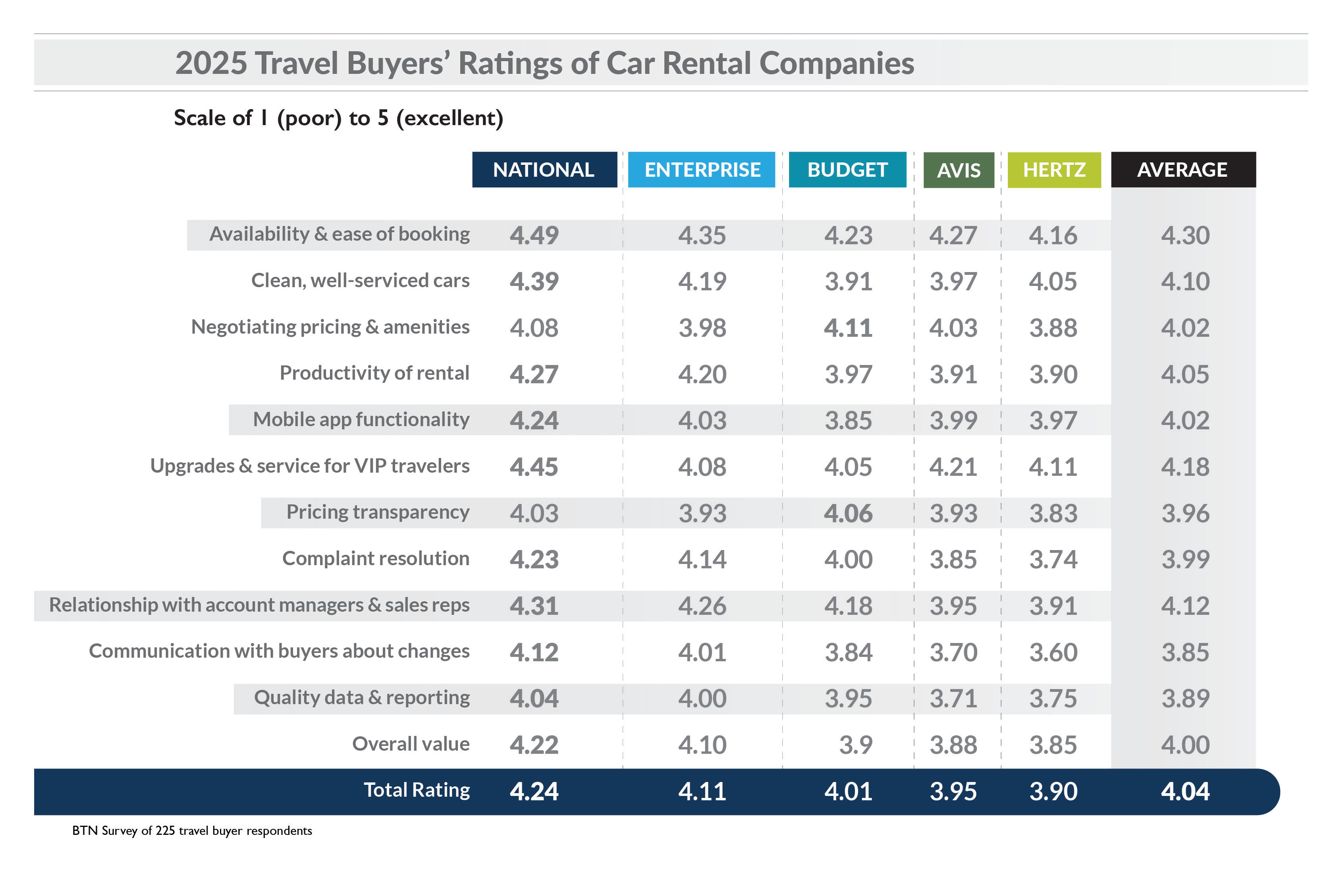
National also took top honors in 10 of the 12 surveyed
categories, with its availability and ease of booking garnering the highest
overall score at 4.49.
"Some of that, if you're comparing it to previous
years, is inventory in the market has become more readily available for us to
purchase," Guadagnoli said. "We understand the production demands
that [original equipment manufacturer partners] have or that they're under, and
how many vehicles will be coming. When we took advantage of that, we saw growth
in the marketplace and got ahead of the buy and made sure that we secured
enough vehicles to buy into it."
Deutsche Bank senior research analyst Chris Woronka said
that Enterprise Mobility "has the benefit of size and scalability.
Although Hertz and Avis are not small companies," he said. "But
Enterprise, their fleet is almost twice as big as even Avis and bigger than
Hertz. … Enterprise can move things around a lot faster. I don't want to make
too much of it, but I think there is some benefit to size and scalability in
terms of fleet management."
Budget was the only brand to post an increased rating over
2024 results, gaining 0.04 points. It also received the top scores for negotiating
pricing and amenities, and for pricing transparency.
"We're thrilled that Budget improved its overall rating
this year [and] in these two categories," Avis Budget Group SVP of sales Beth
Kinerk said in an email. "This reflects our focused effort to make budget
the clear choice for value-conscious corporate customers. Over the past year,
we enhanced our internal systems to better meet the needs of our corporate
clients and empowered our sales teams with clearer guidelines and streamlined
decision-making, enabling faster and more tailored negotiations that reflect
each client's specific needs."
Another continuing trend this year is the decline of the
industry average, which dropped to 4.04 from 4.08 a year prior. Granted, that
differential is slight; however, eight of the 12 categories BTN surveyed on
also posted declines. Quality data and reporting slipped the most, landing at
3.89 from 4.02 last year—it almost always is the lowest rated category. It was
followed by mobile app functionality, which dropped to 4.02 from 4.12.
KesselRun Corporate Travel Solutions VP of program
management Krissy Herman thinks the reporting drop could be the way the data is
presented. "The data we get from car rental companies is raw data,"
she said. "We manipulate it and spit out whatever we're looking for. I
don't know if the expectation or desire is more visualized data or more dynamic
data. Conversations across the board in travel I'm hearing is that more and
more people are looking for that. They might be referring to something more
[like a] dashboard. From my standpoint, when you ask for a full detail report,
you are getting every bit of information you could ever possibly want."
On app functionality, ABG's Kinerk said that the company
launched several behind-the-scenes upgrades to improve app performance and
reliability, and the company invested in a redesign, which includes a more
intuitive interface. Avis Budget also is "integrating better loyalty and
billing features specifically geared toward business travelers," she said.
Enterprise's Guadagnoli echoed those comments, saying that
the company is "always investing in our digital properties. … And small
evolutions along the way have increased the speed of the apps and made them more
dynamic and user-friendly."
As far as overall satisfaction with customer service, 18
percent of respondents said car rental service improved the past 12 months,
down from 27 percent who said the same in 2024. Service stayed the same for 69
percent of respondents, up from 64 percent, while 12 percent said service had
declined, up from 9 percent a year prior.
Woronka reiterated that Enterprise may have a natural
built-in advantage with size and scalability—"I don't want to take
anything away from them; we understand them to be a very good operator"—but
Hertz and Avis are making changes "that in the long-run should be good for
customers," he said. They're bringing more AI into damage assessment,
regarding staffing, they're trying to become more efficient. "They're
doing it to improve not just their own efficiency, but they're really trying to
make it a better customer experience, but it's not all the way there yet."
Current Trends
Hertz and Avis Budget each reported either some first-quarter
pullback in corporate travel or that demand had moderated.
"Some of that came in March when we started hearing the
tariffs were a real possibility. And when you think about the first quarter,
March is more than a third of the quarter," Woronka said. "If you see
softness in March, it's more troublesome than if you see it in January or
February. I think a lot of that was just hesitation, people waiting to see.
They heard that tariffs were going to come in early April, so there was a
little bit of a pullback, and let's just see what happens and reassess. That's
probably the No. 1 factor that was driving the commentary."
Tariffs
The tariff conversations likely are having a short-term
positive effect on the market. Rental companies already have their next
model-year contracts locked in at prices determined prior to the tariff
announcements. And the price for used cars is increasing, which is generally a
good thing for rental companies selling off older models.
"We looked at the Manheim Index in April, and used cars
I think posted one of their biggest monthly increases ever," Woronka said.
"The overall theory on tariffs has been we don't know that there's
necessarily much of an impact on demand or pricing. If used car prices go up,
that's generally a good thing for car rental companies. The flip side is
eventually they have to buy cars."
Basically, that means for 2025, corporate rates will
probably remain stable, but when the next year of cars is contracted, depending
on the tariff situation, prices might go up.
"The suppliers we've spoken to about [tariffs],
everybody's taking a smart, let's not have a knee-jerk reaction or concern,"
Herman said. "Corporations are not necessarily doing a hard stop on travel
right now. It's 'let's take a measured approach, let's see what happens.'
"
Should there be a price increase because of tariffs, travel
managers can mitigate those possibly with consolidation and supply commitments,
GoldSpring Consulting partner Neil Hammond said. "You can get much better
deals if you're prepared to deliver on commitments. That's in any of the
categories," he said. "I've seen many examples where you get better
offers on the table, but you've got to meet [commitments]. All suppliers now
are tracking their performance metrics. The account manager has to go to their
revenue management team and build a case for the buyers. If the buyer ends up
not delivering, then the account manager's head is on the chopping block."
Pricing
Woronka added overall there is "positive momentum in
terms of demand," he said. "It's pretty closely tracking the
[Transportation Security Administration numbers], there's also some correlation
with hotel demand, but it's a little bit less."
Pricing could be a different story, though. "It's hard
to tell in the numbers that get reported by the companies, because there's a mixed
shift if they're doing more off-airport business versus on-airport business, or
if they're doing leisure versus corporate," he said. "Pricing is
probably kind of flat on a truly comparable basis to what we saw last year."
That tracks with survey results. Negotiating pricing and
amenities was one of the few categories that improved from last year, gaining
0.09 points to 4.02. Herman noted that last year there was more
"noise" about pricing going up, but agreements are generally for two
or three years, so anyone in the open comments who complained about increased
rates might not have negotiated their deals until this past year, and they're
now "catching up" to the trend from last year.
Still, scores for pricing transparency and overall value
declined by 0.08 and 0.06 points, respectively. What could be happening is that
even though base rates may have stabilized, there are increasing fees being
added to rentals.
Stealth Charges
Hammond has seen an ongoing trend where car companies are
adding "stealth" charges. He noted that more destinations are getting
city surcharges, and those cities that already had them are seeing their tiers
get pushed up, say from a $3 per day surcharge to now $5 per day. The
surcharges vary by city, with New York's somewhere between $20 to $30, Hammond
said.
He's also seeing weekly and monthly multipliers increase. Normally,
it would be if you rent a car for a week, they'd charge you the daily rate for
four days, Hammond said. "Now it's five and a half even six" days of
charges for that seven-day rental, so the discounts are decreasing.
There also are higher fees for one-way rentals, and some
shorter-term rentals are getting different rates, Hammond added. "You may
have an increased price or surcharge for same-day rentals, one-day rentals, two-day
rentals, because the turnaround is a cost," he said. "We are seeing
penalties, premium surcharges, however you want to discuss it, for day-of-the-week
rentals. Depending on what day the rental starts, typically it's a Tuesday or
Wednesday, sometimes Monday, it gets a $1 or $2 surcharge."
Rental companies also are getting "a bit more
vigilant" about the condition of the vehicle, "the little dings and
dents which they used to overlook," Hammond said, adding that they're
starting to charge for those. "It's these kinds of things buyers really
need to be wary of and pay attention to when negotiating, because it may look
like from the daily rate that you've got a reasonable new deal going forward,
but these little stealth things will just make it different."
To mitigate these potential cost increases, buyers could
look to consolidate their suppliers and increase their leverage, Hammond said,
but reiterated that the companies need to meet their volume commitments or
they'll lose their deals.
Sustainability
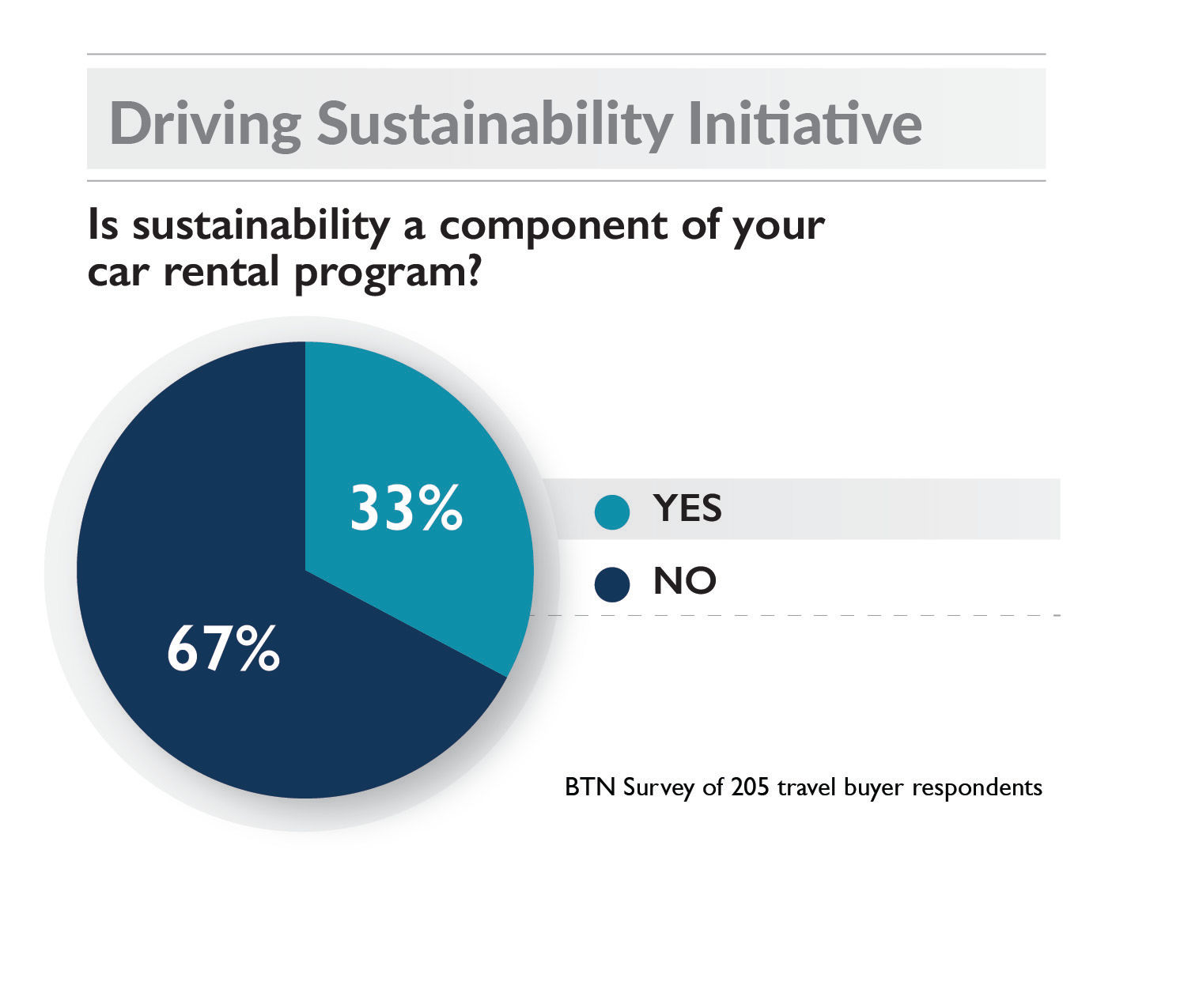
Responses on sustainability questions remained steady with
2024 results. About one-third of respondents have a sustainability component in
their car rental program, while two-thirds do not. But that doesn't mean
interest in the topic is waning.
"We're getting asked for a lot of sustainability
reporting," Guadagnoli said. "It's all based on the mileage of the
vehicles and how much you're driving. We've invested more in a connected fleet,
which will tie the vehicle itself back into some of the reporting and analytics
that we can pull from the vehicle."
Avis Budget has seen buyers take "a more holistic
approach," looking beyond emissions to how travel programs align with
broader social and governance goals, Kinerk said. "We've responded by
strengthening initiatives that reflect responsible operations such as enhancing
fleet safety through advanced technician training and supporting employee
well-being through inclusive workplace programs."
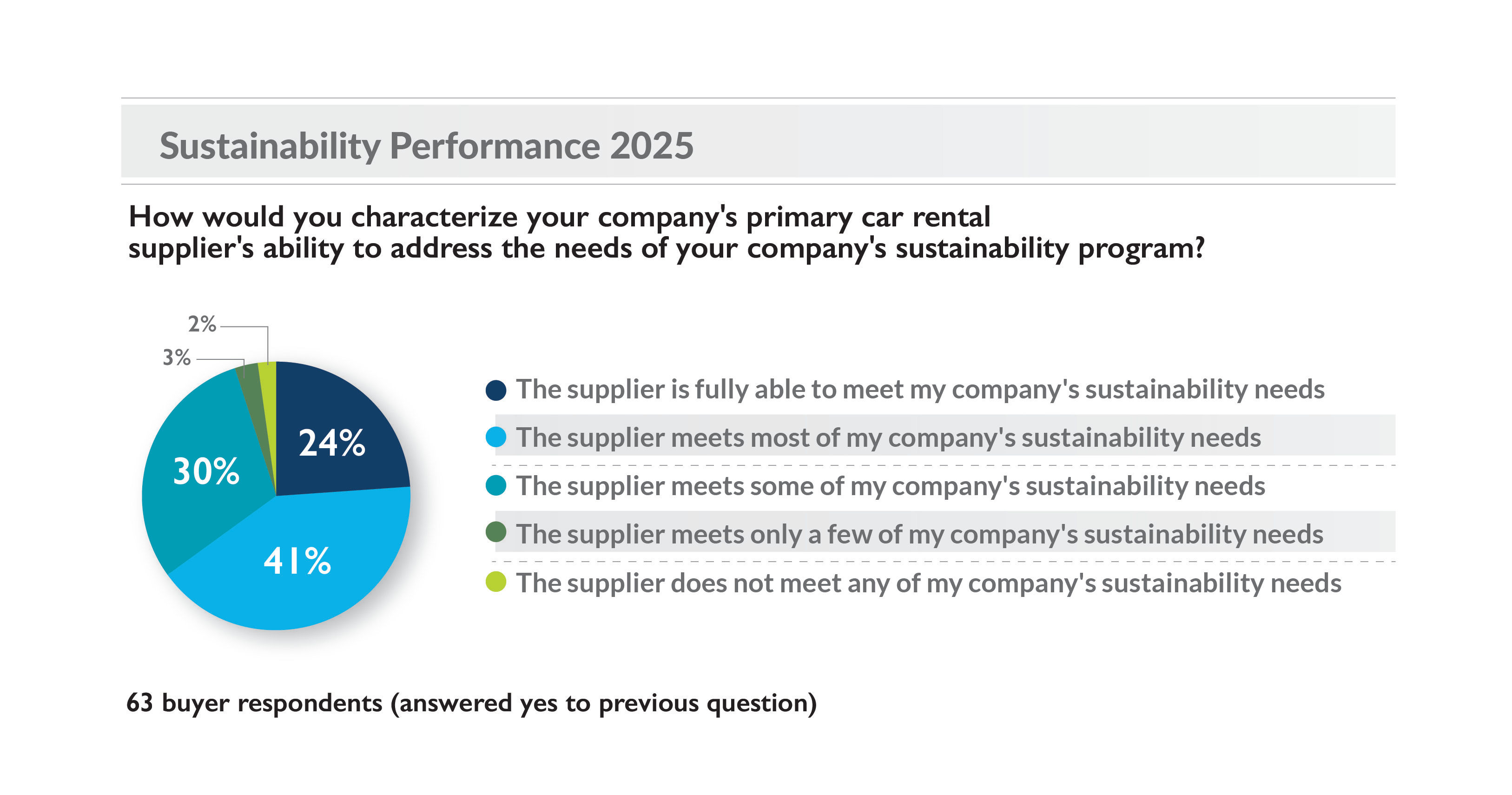
And yet, the responses for how well suppliers can meet
companies' sustainability needs shifted a bit the past year. Only 24 percent of
respondents said that primary car rental suppliers were fully able to meet
their sustainability needs, down from 34 percent in 2024. Most needs being met
remained steady at 41 percent compared with 40 percent a year prior, while suppliers
meeting only some needs increased to 30 percent from 23 percent.
"I've definitely seen a broader request for
sustainability-related data and never not been able to get what a
sustainability leader is looking for for their ESG reporting," Herman
said. "But education still lacks around what is the difference between
this EV and that EV except potentially a very big price point. And being able
to distinguish that in an online booking tool where most bookings are made is
not the easiest thing to do. I think companies struggle with allowing them,
encouraging them, communicating about them, even though they may be part of a
corporate rental agreement."