Cost pressures and safety concerns are influencing how and where U.S. companies are organizing meetings,
according to a survey of 300 U.S.-based meeting
professionals conducted by travel and tourism marketing
firm MMGY Global.
The survey, conducted in January 2026,
showed that financial pressure is increasingly shaping planning decisions for
the next 12 months. Nearly two-thirds of planners (63 percent) identified travel expenses
as the primary obstacle for 2026, while 60 percent cited accommodation costs
and 58 percent noted limited availability or high pricing of event suppliers
and vendors as significant challenges. A further 58 percent expressed concern
over the ability to “ensure the financial success of a
meeting in the current environment.”
These results align with findings from
the latest industry pulse survey by Northstar Meetings Group and Cvent (Northstar is the parent company of BTN), which
surveyed 474 U.S.-based meeting planners between January 20 and February 2. The
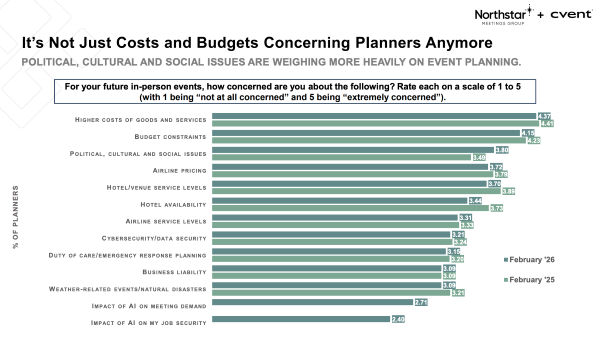
survey indicated that rising costs and budget limitations remain planners’
foremost concerns, followed by political, cultural and social issues [see graph below].
 Credit: Northstar Meetings Group & Cvent, Pulse Survey, Feb. 2026
Geopolitical tensions are now weighing more
heavily on event planners compared to a year ago, and are now more important in
site selection, according to the survey.
Planner optimism has also waned, with 24
percent of respondents feeling “more optimistic” in February about their
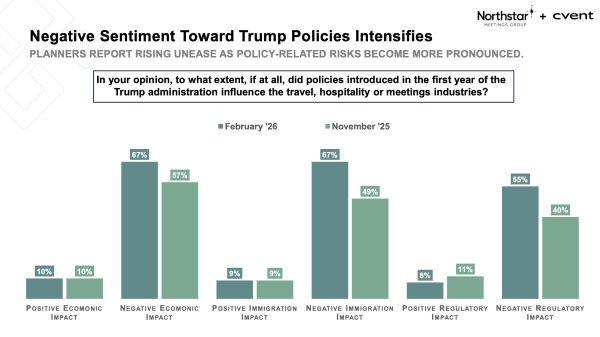
go-forward meetings rosters, down from 27 percent in November. There is growing apprehension among meeting professionals
regarding the Trump administration’s policies. Two-thirds of U.S.-based meeting
professionals perceive recent economic and immigration measures as detrimental
to business travel and meetings.
According to the MMGY survey, safety also
emerged as a key factor in destination choice, as
highlighted by 72 percent of planner respondents. This survey also included
responses from 1,000 meeting attendees (who had attended at least one
exhibition, convention, conference or large meeting within the last two years),
where the risk of terrorism and crime emerged as the biggest factors
influencing the decision to travel for a meeting or event, according to 62
percent of respondents. Additionally, 59 percent cited
political instability or civil unrest as major concerns.
Despite these pressures, the appetite for in-person events remains strong, with
90 percent of planners stating face-to-face interaction is critical to the
meetings and events they organize, and 85 percent expect to plan in-person
meetings over the next year. Northstar’s survey also found
that the perceived value of face-to-face events remains high, with 51 percent
of planners reporting their company or clients consider in-person events
“significantly more valuable” than alternative sales, marketing or business
development initiatives. This compares to 52 percent who said so in February
2025.
 Credit: Northstar Meetings Group & Cvent, Pulse Survey, Feb. 2026
Event sourcing and booking remain
steady, with 33 percent of planners actively sourcing and another 33 percent
booking new events in February, compared to 38 percent and 33 percent,
respectively, the previous year.
While meeting planning activity continues at pace, fewer planners
anticipate producing more meetings this year compared to the prior three years.
In 2026, 43 percent of meeting professionals surveyed expect to organize more
meetings than last year, compared to 52 percent at this point in 2025, 58
percent in 2024, and 66 percent in 2023, according to pulse survey data.
The February 2026 pulse survey also noted a moderate decline in
cross-border meetings (43 percent in 2026 compared to 45 percent in 2025), due
to a pullback in U.S. inbound meetings and events for international groups
(down to 40 percent in 2026 from 54 percent in 2025).