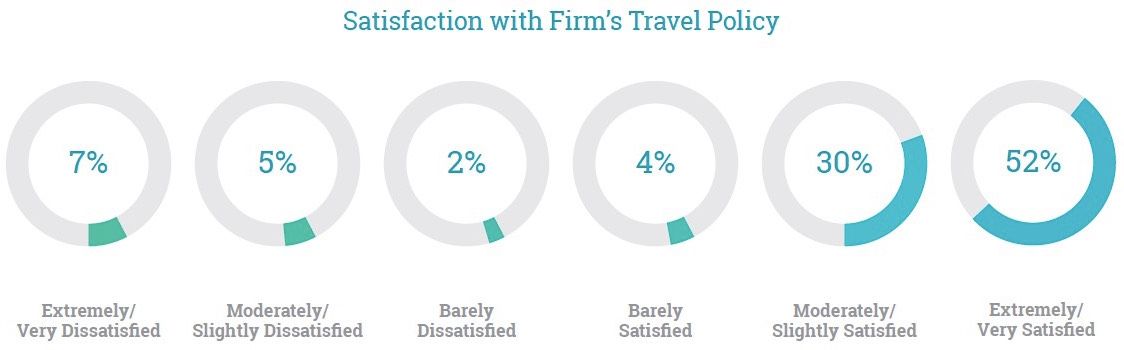
While 86 percent of road warriors are
satisfied with their travel policies, about half want to travel less in the
next two years, according to a survey released Sunday. Eighty-five percent of
road warriors would change jobs if it meant the same amount of travel but a
better travel policy, and 83 percent said a new employer's travel policy would
be equally important or more important than pay or responsibilities.
 Source: Airlines Reporting Corp., American Express Global Business Travel & tClara's "Traveler Friction: Insights from U.S. Road Warriors"
MMGY Global conducted the study, "Traveler Friction:
Insights from U.S. Road Warriors," for Airlines Reporting Corp., American
Express Global Business Travel and tClara, surveying 757 business travelers
between May 19 and May 28. Respondents were born before 1993, made $50,000 or
more a year, had spent at least 35 nights on business travel during the past 12
months and used commercial airlines or trains for the majority of their trips.
"By understanding this research and having
the right technologies in place and partners by their side, travel managers can
deliver productive experiences to reduce employee burnout and increase the
quality and success of their travel programs," Amex GBT digital traveler
vice president Evan Konwiser said in the release of the study.
 Source: Airlines Reporting Corp., American Express Global Business Travel & tClara's "Traveler Friction: Insights from U.S. Road Warriors"
The study identified eight traveler friction "symptoms,"
such as, "I often feel extra stress in the days before the trip," or,
"I find it hard to have a healthy lifestyle when traveling." The
average road warrior encounters four of the eight symptoms, according to the
study. One-third experienced two or fewer, while another third experienced six
or more.
When asked how travel policies could be improved, 18 percent
selected nonstop flights as their first or second choice, 13 percent chose
better or more convenient hotels and another 13 percent requested business
class travel on flights longer than six hours.
They consistently reported that adoption of their requests
would increase their willingness to travel by 10 percent. They also said it
would improve their productivity by 44 percent on average. Sixty-four percent
reported it would have a very or extremely positive impact on their willingness
to stay at the company.
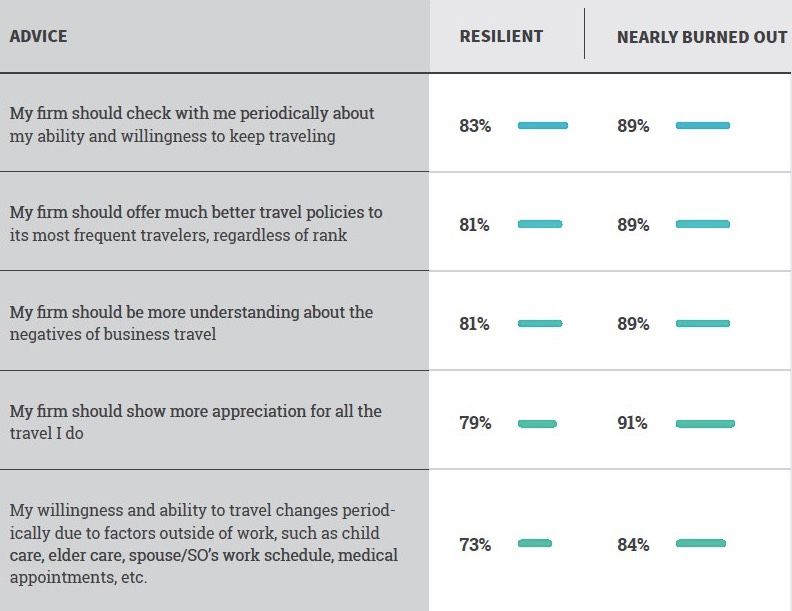
The study found some level of burnout in
travelers at all trip volumes, yet a significant portion of the highest-volume
travelers are far from being burnt out. Two-thirds said they're not anywhere
near burnout, while 15 percent are nearly burnt out.
"This
study is significant as it quantifies what for so long we’ve intuitively known:
that frequent business travel can also be wearing," said ARC COO and vice
president Lauri Reishus. "But what is most interesting is that it’s not
trip frequency that matters, it’s the trip quality."