Ancillary revenue growth in 2025 outpaced overall revenue growth for airlines by nearly two to one, according to the latest report from IdeaWorksCompany, released Tuesday.
Total ancillary airline revenue in 2025 for the 58 carriers that appeared in each this and last year's reports rose about $13.2 billion year over year, a 13.4 percent increase compared with overall airline revenue growth of 7.2 percent, according to the 2026 SeatMaps.com Yearbook of Ancillary Revenue by IdeaWorksCompany. For those same carriers, traffic increased 2.5 percent for the period, showing that "ancillary revenue is a major contributing factor" to carriers' bottom-line growth.
Of the 63 airlines IdeaWorksCompany examined, 30 generated at least $1 billion in ancillary revenue in 2025, up from 27 in 2024. The report cites seat assignment fees as a key driver of ancillary revenue growth over the past five years.
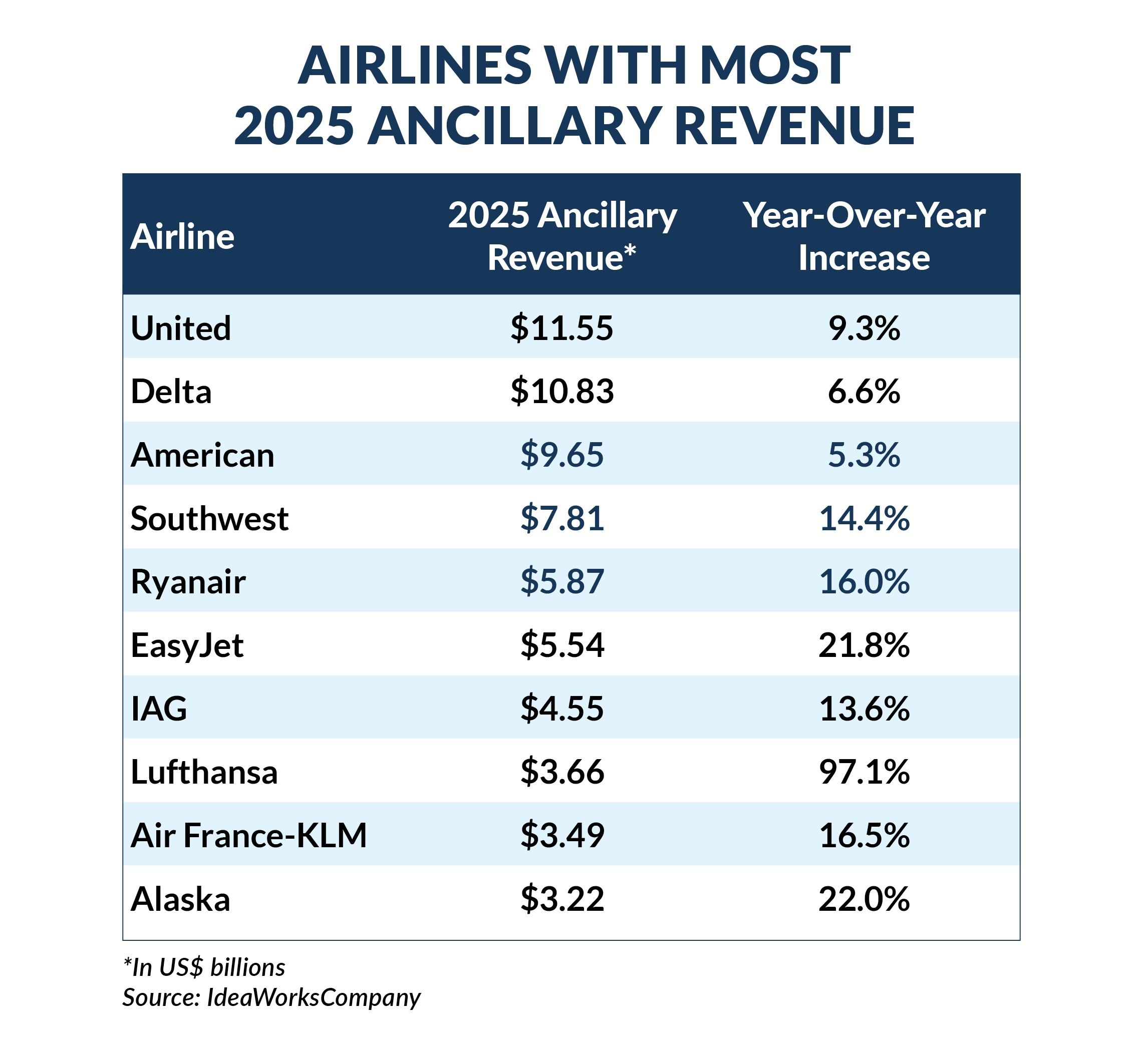
United Airlines led the carriers with nearly $11.6 billion in ancillary revenue in 2025, up 9.3 percent from a year prior. Southwest Airlines' ancillary revenue increased 14.4 percent year over year to $7.8 billion, while its per-passenger revenue climbed about 19.5 percent for the period to $58.25. The carrier in May 2025 started charging for checked baggage and in July 2025 certain seat assignments.
The report defines ancillary revenue as revenue beyond the sale of tickets that is generated by direct sales to passengers or indirectly as part of the travel experience. Categories include frequent-flyer activities, a la carte features, commission-based products, advertising sold by the airline and the a la carte components associated with a fare or product bundle.
LCC Ancillary Revenue Dependence
Low-cost carriers dominated the rankings based on ancillary revenue as a percentage of total revenue. Frontier Airlines led this category in 2025 at 60.2 percent, down 1.8 percentage points from 2024. Spirit Airlines, which ceased operations in May 2026, was second at 59.8 percent, an increase of 1.2 percentage points, followed by Allegiant Air at 59.6 percent, up 6.7 percentage points.
Jet2.com topped the rankings for ancillary revenue per passenger with a record $100.73, up from $89.99 in 2024, according to the report. U.S. startup Breeze was second at $86.78, down from $89.82 a year prior. Rounding out the top three was Allegiant at $83.89, up from $79.23 in 2024.
Still, LCCs faced increased competitive pressure as American, Delta and United continued to refine their basic economy strategies.
"Ancillary revenue gains over the past five years have been powered by the airline industry's embrace of seat assignment fees and greater reliance on branded fares," IdeaWorksCompany president and report author Jay Sorensen said in a statement. "Ancillary revenue has demonstrated remarkable durability in both good times and bad."
Loyalty Revenue
The four largest U.S. carriers—American Airlines, Delta Air Lines, Southwest and United—were the top four generators of frequent-flyer revenue. They pulled in a combined $27.9 billion in 2025 from their loyalty programs, equivalent to an average of $37.72 per passenger, according to the report. That figure is above the $35.43 generated per passenger in 2024 and the $25.71 per passenger found in 2019.
Delta in 2025 led the group, generating nearly $7.6 billion in SkyMiles frequent-flyer revenue ($37.96 per passenger). American was second with its AAdvantage program at more than $7.5 billion ($33.77 per passenger), followed by United MileagePlus at more than $6.7 billion ($37.27 per passenger) and Southwest Rapid Rewards at nearly $6 billion ($44.57 per passenger).