Low-cost U.S. carriers have had a harder time recovering
from the pandemic than their legacy cousins, at least according to their
earnings histories. Some even are making moves to offer premium services and
cabins that are narrowing the gap between what their traditional value propositions
have been versus the big three—American Airlines, Delta Air Lines and United
Airlines. Examples include Southwest Airlines moving to seat assignments, extra
legroom and red-eye flying, as well as JetBlue expanding its premium Mint
product and introducing lounges.
Will these and other offerings have an impact on corporate
travel share? The jury is still out, since some of these strategies have yet to
occur, but one thing is certain: Travel patterns have changed since the
pandemic, which affects LCC performance.
"The pre-pandemic travel patterns where discount
airlines could just put a bunch of capacity into peak-hour travel and have very
high aircraft utilization? That's almost impossible to do today," said Citi
Americas airlines and Latin transports research analyst and managing director Stephen
Trent. "We don't have the equipment, and … we don't have the air traffic
control capability capacity either. So, if you are a discount carrier, what
we're seeing these days is they're busy trying to adjust their business model
and at least adding some premium cabin relative to the network carriers that
already have plenty of premium cabin."
Financial Trends
Before breaking out their play for premium, it's key to look
at the finances of some of these carriers.
Though not known to attract many business travelers or even
be included in managed corporate travel programs, ultra-low-cost carrier Spirit
Airlines filed
for chapter 11 in November 2024 and is planning to exit bankruptcy by the
end of the first quarter. Fellow ULCC Frontier Airlines, which is in some
travel programs, twice has unsuccessfully attempted to acquire Spirit, in
2022, and again earlier
this year, in order to better compete with the "big four" when
you add Southwest Airlines into the mix. Frontier ran in the red until last
year's $85 million net profit.
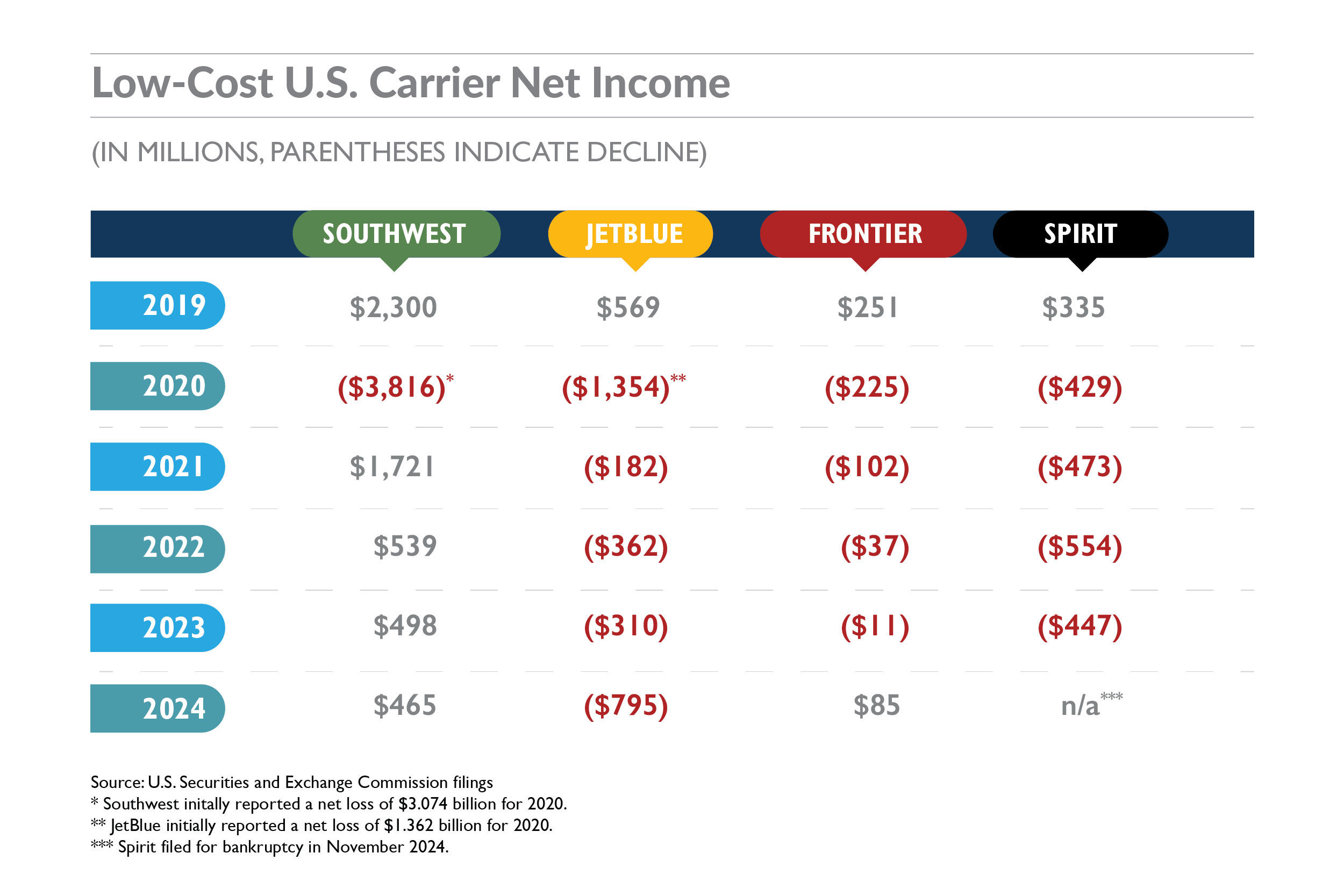
Then there's JetBlue. It also tried to acquire Spirit in
2022 even though it has reported annual net losses from 2020 on, most recently losing
$795 million in 2024. The two carriers
abandoned that planned $3.8 billion merger after a judge in early 2024
ruled against the acquisition in a lawsuit brought by the U.S. Department of
Justice.
As for Southwest—which ranked second in BTN's
2024 Airline Survey and Report and was the only carrier to improve its
score year over year for two years in a row—it has reported an annual net
income for the past four years, but the carrier's most recent profit of $465
million in 2024 on record revenue of $27.5 billion is a fraction of the $2.3
billion it made in 2019.
How do those 2024 performances compare with the big three?
American had record revenue of $54.2 billion, up 2.7 percent
year over year, with net income of $846 million. It had made $1.69 billion in
2019. Delta also had record 2024 revenue, at $61.6 billion, up 6.2 percent from
2023, with net income of $3.46 billion, though this was down from the $4.77
billion reported in 2019. United reported 2024 revenue of $57.1 billion and net
income of $3.15 billion, an increase of 20.3 percent year over year and up from
the $3 billion reported in 2019.
.jpg "Legacy Carrier Net Income lg")
The three legacy carriers also all offer a basic economy
section to directly compete with the bargain carriers, even though most
corporations keep those seats turned off in their online booking tools. Though each doesn't always report on that segment of sales, United
chief commercial officer Andrew Nocella in January during a Q4 2024 earnings call
noted that during the quarter, the number of basic economy passengers increased
21 percent year over year and now represents 15 percent of domestic passengers,
up 2 percentage points compared with 2023.
"The network carriers have been able to use basic
economy like a dagger," Trent said. "If they compete against
Southwest or JetBlue or [whomever] on a particular route, they can just offer a
couple of seats at the back of the plane, non-refundable tickets at a very low
fare relative to what the discount airlines are, [or] similar to what the
discount airlines are going to offer. That creates stickiness for their demand,
and it gives them some protection from discounting line capacity on similar
routes.
“They can arguably price their basic economy seats well
below where they price everything else because first class, business class,
economy plus, domestic main cabin, etc., that stuff has already paid for the
trip. … [It] deters your discount airline competitor and is probably no skin
off your back."
Mergers in the Air?
A new administration in Washington that is more business-friendly
means that it also is likely to be more merger-friendly. With low-cost carriers
struggling compared with their big three counterparts, a merger could benefit two
ailing airlines. Could an acquisition be on the near horizon?
Spirit
Airlines may have spurned Frontier Airlines' most recent bid, but JetBlue
is vocally in the market for a partnership, despite courts ordering the dismantling
of its Northeast Alliance with American Airlines and quashing
its merger with Spirit.
JetBlue CEO Joanna Geraghty on the airline's Jan.
28 earnings call said the carrier was "having conversations with a
number of carriers right now to discuss the potential for future partnership. …
But there's nothing to announce now."
Merger rumors started to swirl, and on Jan. 31, United
issued a U.S. Securities and Exchange Commission filing stating that it was
"not in negotiations or discussions with any other airline regarding a merger,
acquisition or similar strategic transaction and has not been in any recent
discussions with any airlines regarding the same."
While United may not be a partnership target, JetBlue
president Marty St. George during a Feb. 19 Barclays conference reiterated that
JetBlue was "talking to multiple airlines, [and] we're still
talking," he said. "If we find a deal that is accretive, we will
absolutely do it. … I definitely think a partnership will be good for
JetBlue."
St. George noted that the NEA "never fully played
out" as it was ramping just as the judge struck it down. But the judge
also "laid out a roadmap of here's what a partnership could look like, and
frankly, when I look at the benefits that we got from the partnership we had, I
think that is something that is attractive for us."
When asked about the potential for a new airline merger, Citi
Americas airlines and Latin transports research analyst and managing director
Stephen Trent said that an alliance similar to an NEA-type partnership could
possibly come back into the picture, but to make a call on a particular merger
might be harder to do.
"One thing that we were expecting for a while was
Alaska Air and Hawaiian, and that one came through," he said. "But in
both cases, the acquirer and the target, neither company was a top-four carrier
in terms of domestic market share. If you look at the top four from a domestic
market share perspective, it's going to be challenging for any of the top four
to be involved in any outright M&A. But that doesn't mean that they won't,
for example, be able to get back to alliances, joint business agreements, like the
Northeast Alliance JetBlue had with American Airlines. Something like that from
a regulatory perspective as a lower bar, yes, you could see some of that stuff
come back."
—Donna M. Airoldi
Unrest at Southwest
In addition to lower profits, Southwest has an activist
investor on its hands. After disclosing it had a $1.9 billion stake in the
carrier, Elliott Investment Management pressed Southwest to make executive and
operational changes, including ousting president and CEO Bob Jordan. After several
contentious months and possibly to avoid a proxy battle, the
carrier and Elliott came to an agreement in October 2024: Southwest
replaced six board members and accelerated former CEO Gary Kelly's departure from the board. Jordan got to keep his job—for now.
On Feb. 17, however, the
Dallas-based carrier announced a 15 percent reduction in its corporate
workforce, or about 1,750 employees—the first time the carrier has had to
take such measures in its 53-year history. That figure includes 11 senior
executives, not counting EVP and chief transformation officer Ryan Green, who
was overseeing the Southwest's cabin reconfiguration and other changes. He subsequently
announced his departure after a 23-year history with the airline.
"It was a very sad day to read the announcement,"
said a travel buyer who has Southwest in their program and who asked to remain
anonymous. "They've never had layoffs in 53 years. They kind of thrive on
that … which is taking care of their employees.
“With some of the leadership changes they've made and this [new]
direction and the investor coming in and wanting to have more say in their
board, I think their culture is changing. … My biggest concern is that they're
going to lose their secret sauce to success in making all these changes. They're
going to be like everybody else, and it's not going to work for them. I hope
they don't lose all of that as we go forward."
This buyer added that their account team has not been
directly affected by the layoffs.
KesselRun VP of program management Krissy Herman, however,
said that two of their reps reached out to say KesselRun would receive notification
from those reps' VP, but that they remained their reps for now.
Immediately following, Herman said, was a form letter saying,
in effect, that Southwest remains "committed to your success and the
success of Southwest Business. If your contact has been affected, we'll be back
soon with a new point of contact for you. Nothing is more important to us than
ensuring you have the right support from Southwest Airlines." Herman has
yet to hear from KesselRun's five or six other reps.
"So, the cuts are definitely affecting the corporate
group," she said.
In Pursuit of Premium and Other Changes
Traditionally, LCCs and ULCCs were known for their single
economy cabins and no-frills, a la carte offers while making money on ancillary
fees for everything from bags to getting a seat assignment to meals. JetBlue last
year even began "surge
pricing" for checked bags during peak travel times.
Often, the final ticket price on one of these carriers could
meet or exceed that of a ticket from a legacy carrier that would offer some of
those ancillaries in its base price. The exception has been Southwest, which does
not charge for the first two checked bags, nor for seats, changes,
cancellations or a phone reservation. Its additional charges include fees for
more than two bags, EarlyBird check-in ($15-$99 each way) and upgraded boarding
($30-$149 per segment).
With travel demand projected to remain strong, especially
for premium cabins and seats, some of the low-cost carriers have begun to
change their operating models.
Frontier last May eliminated change fees on most tickets, organized
its seats into four options—basic, economy, premium and business—and some of
these categories now include certain ancillary options that used to be charged
separately. In December, the carrier announced that in 2025 it was to add
a first class and offer new loyalty benefits.
JetBlue introduced its initial business-class Mint product
more than a decade ago, and in 2021 developed a newly
upgraded premium Mint product with more private suites and new studios for
its transatlantic service that was to launch that year. The carrier in
2024 began to expand this premium Mint offering to domestic routes, one
Canadian route, and a few Caribbean destinations, including Puerto Rico. JetBlue
also is rebranding its Even
More Space extra-legroom seat as a bundle that includes new benefits and
amenities. In addition, the carrier announced it would introduce
airport lounges beginning in late 2025 and first-class
seating in 2026, and it announced its first-ever premium credit card.
Southwest famously does not have assigned seats, and all the
ones on its planes are the same. That
will change beginning in 2026 when it plans to begin offering assigned
seats and a cabin in the front of the plane featuring seats with additional
legroom. The carrier also announced its first international
partner—Icelandair—and said it has plans to introduce another later this year.
All these changes narrow the gap between the network
carriers' offerings and those from low-cost competitors. But legacy airlines do
not seem to be concerned. For one, American, Delta and United have the
capability to offer significantly more premium seats on their flights, and they
are doing just that, with cabins reconfigured or new aircraft including more
and more such seats. Further, premium revenue growth is outpacing main cabin
for some, they've been at the game longer, and low-cost carriers, with all
their extras being added, may not be as low-cost as in the past.
"What will happen is, if [low-cost carriers] do choose
to continue to upgrade their products, it is going to force them to also
upgrade their price points, which will help our Main Cabin revenues as
well," Delta CEO Ed Bastian said during a July 2024 earnings call, adding
that "premium is more than just putting more room in seats. It's the
overall experience. … Premium is also based on a foundation of overall
reliability and service, first and foremost, and that's what we have focused on
and specialized and done better over the last 15 years and then the airline, we
continue to get better."
United's Nocella in January made a similar point. "You
can't snap your fingers and make those generational investments overnight,"
he said when asked by an analyst about more competition in the premium space by
discount carriers. "I'm a bit surprised by the amount of change, but the
effectiveness of that change remains to be seen. The effectiveness of what
we've been putting in place for years now has been proven. … I don't expect
that we are going to see airlines compete at the level of United in terms of this
broad range of products and experiences anytime soon."
A Play for Corporate
Does a play for premium among low-cost carriers equate to a
play for more corporate sales? For some, the answer is a resounding yes.
In addition to the changes noted above, Frontier last
February announced a new
fare bundle targeted at business travelers and available through the global
distribution systems that includes a premium seat assignment, complimentary
carry-on bag, priority boarding and other perks.
That move surprises KesselRun's Herman since Frontier left
Sabre last year, she said. "Such a significant portion of volume goes
through Sabre, especially in the U.S." Still, she added that across KesselRun's
entire client base, Frontier represents "less than a couple hundred
flights a year."
Southwest over the past several years has done much to expand
its appeal to corporate customers, from introducing Southwest Business to
adding fares to the GDSs. Adding seat assignments and a cabin with extra
legroom seems to appeal to that same base.
"This announcement about reserved seats, special
seating, is certainly their next play at trying to entice corporate
travelers," Herman said. "It'll be really interesting to see how it
prices. It sounds like from recent conversations I've had that they're still
trying to work out the nuance of that pricing. From what I've heard, loyalty
status with Southwest sounds like it will be very important as it relates to
some of the seating."
"It's positive for the business community, especially
people who travel a lot," said the anonymous buyer. "The assigned
seating will help, but they have to use it in the right way. They have to
compete the same way with their loyalty programs, with their upgrades, with
seat assignments that all the other airlines do to get that business. … You
have to make sure it's accurately fared in the booking tools. Because if you're
classified as premium economy and premium economy isn't allowed [in the travel
policy], … you have to make sure that you're competing apples to apples with
American, Delta and United for the same type of fare class, even if you're
calling it something different. They have to be very, very careful how it's
being represented in the booking tools and how they are managing it on the
backend with upgrades and loyalty. You can't just put it in and then hope it
works."
Southwest adding international partners also could be appealing
to business travelers. Icelandair "is a leisure play," Herman said.
"But what interests me is this second international partnership that is
yet to be announced and what that might mean."
JetBlue, on the other hand, has been incredibly vocal about
focusing its recent changes on being the best leisure airline in the Northeast.
It has cut several routes in the past year that seemed to have business appeal,
and is about to end flights
between Boston and New York's LaGuardia Airport. It also downplays the
corporate business that it does receive, even though that segment "set
records" in the fourth quarter of 2024 according to a recent earnings
call.
JetBlue also has not changed its relationship with the
anonymous travel buyer, who has the carrier in their program. "We've had
some frank conversations about their leisure focus, but for me, we're a big
customer to them, and we still get a lot of attention. I still have my same
account manager. They are still very focused on us and growing their business
with us, and the route changes haven't really impacted us too much."
Further, "bringing Mint to domestic or Mint Light,
whatever they're referring to it as, this is absolutely a play to attract
business customers," Herman said. "Developing lounges, I think that's
really business-focused and those things, even if it's not intentionally trying
to draw business travelers, there's a greater likelihood that business
travelers will be more drawn to that product because of that premium-ization of
their offerings."