
Delta's Winning Streak Extends to 14
Southwest earned second place for the third consecutive year and once again was the only carrier with an improved score.


"The more things change, the more they stay the same," French writer Jean-Baptiste Alphonse Karr said in 1849. The phrase is apropos for BTN's 2024 Airline Survey and Report.
Delta Air Lines earned an unprecedented 14th consecutive win as the top-rated carrier in the survey with a score of 4.32 on an ascending scale of 1 to 5. Southwest Airlines continued to close the gap with Delta and was second for the third year in a row at 4.21. United Airlines retained its third-place finish at 3.69 for a third year, while American Airlines came in last, also for the third year in a row, with a rating of 2.15.

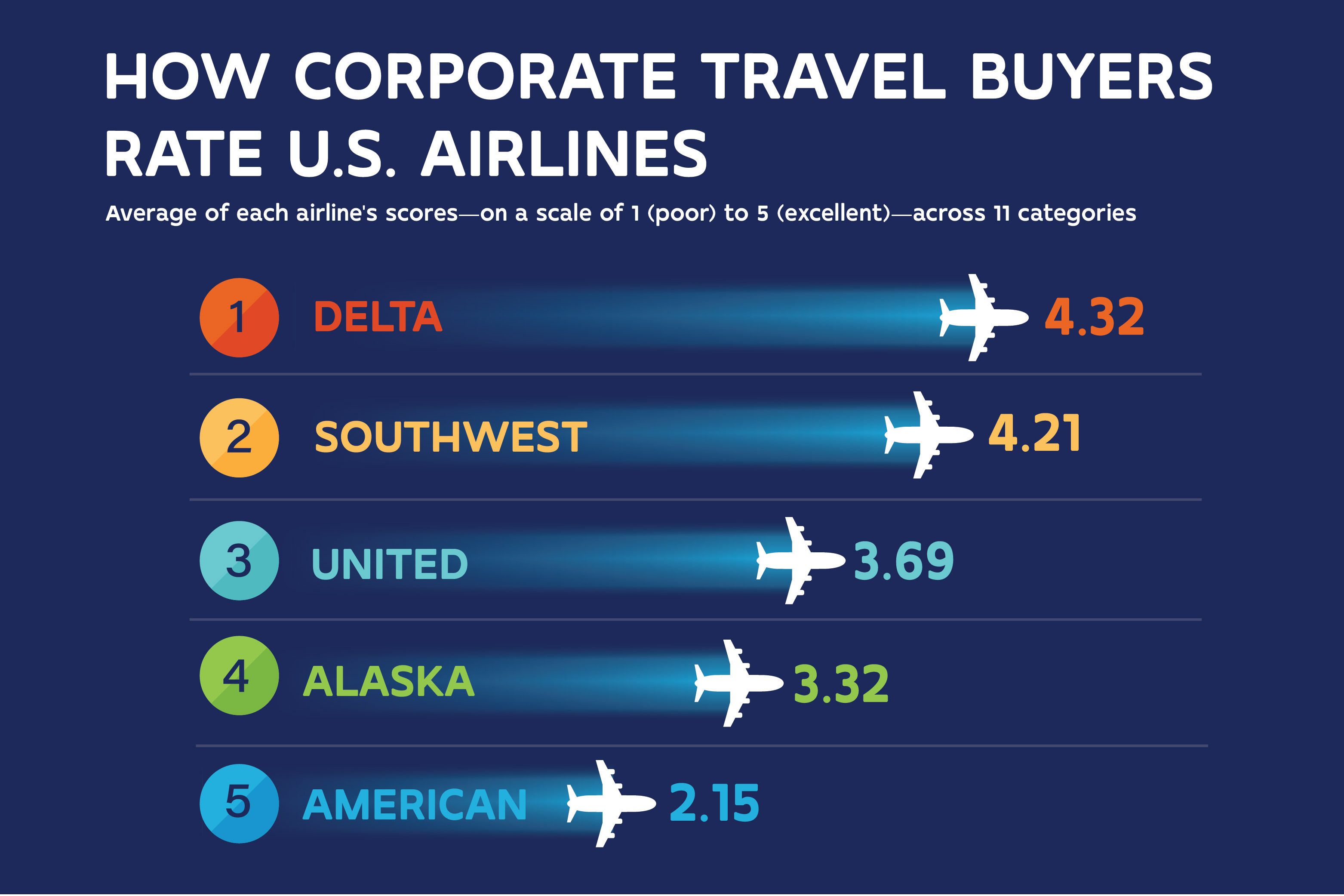
As in 2023, Southwest was the only carrier to have its score increase year over year, albeit by a slight 0.02 points. Delta slipped 0.04 points, United was down 0.09 points, and American dropped 0.18 points.
The one big change this year, however, is that for the first time since 2013, a fifth carrier qualified: Alaska Airlines, which landed in fourth place with a score of 3.32.
None of the consultants BTN spoke with found the overall results surprising. If anything, all thought Alaska would have been higher, and one thought American would have been lower, noting that its score was a "pretty big repudiation of their corporate strategy, if you can call it that," said Partnership Travel Consulting SVP of global supplier engagement Bob Brindley, referencing American's controversial New Distribution Capability sales and distribution strategy that started in April 2023 but was significantly undone beginning in May 2024.
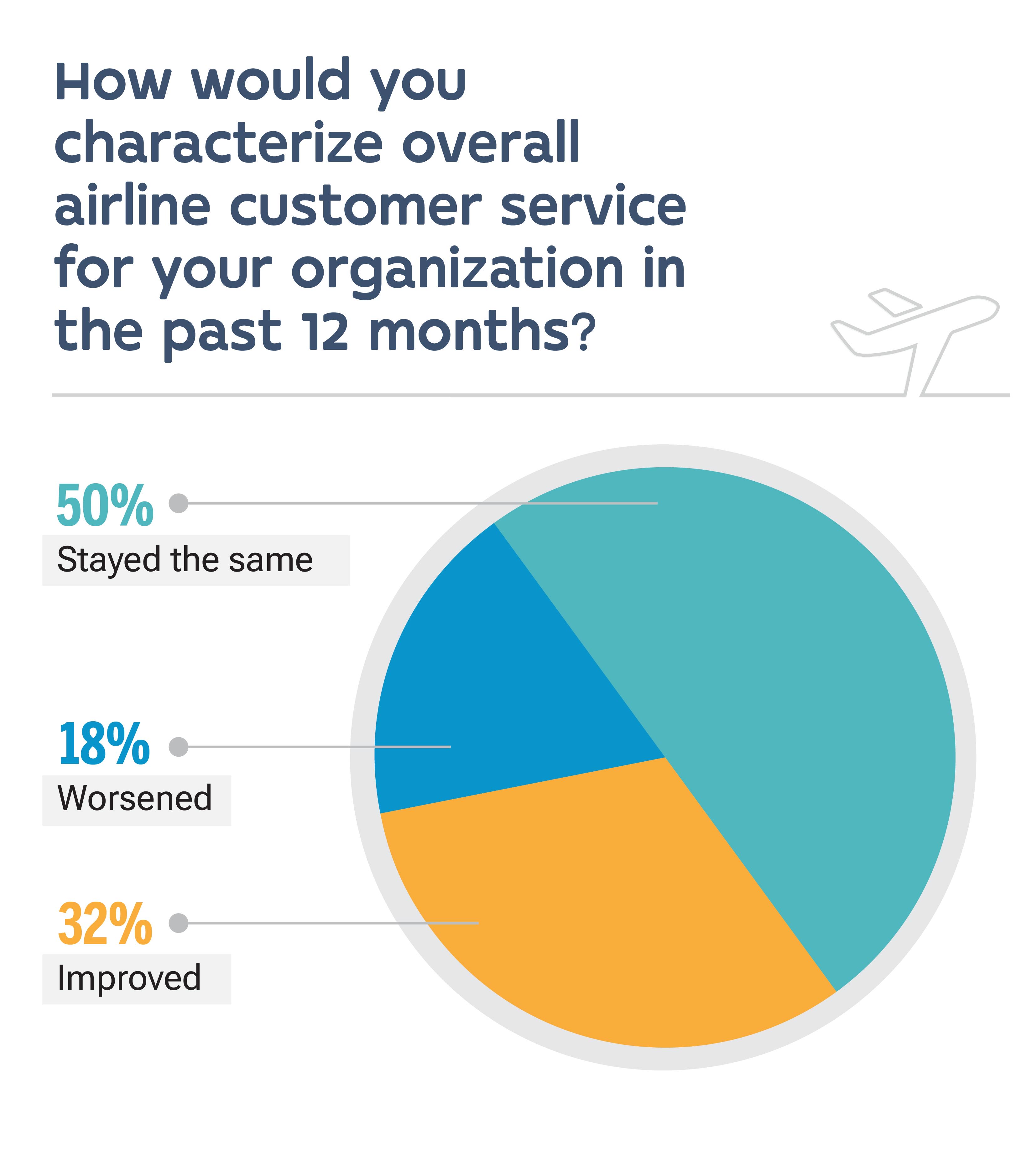
Still, despite mostly lower scores, nearly one in three (32 percent) respondents said airline customer service for their organization improved the past 12 months, with another 50 percent saying it stayed the same. About 18 percent said it worsened.


587 respondents
Performance Breakdown
Delta Air Lines
Delta dominated eight of the 11 categories rated by travel buyers and earned the top score for any category in the survey for "quality of customer service" at 4.49, which it also won last year with the same top score. Several of the respondents in the open-ended questions praised Delta sales reps with adjectives including "responsive," "proactive," "helpful," "caring" and "communicative."
The carrier managed to garner those accolades even after it was hobbled by the July CrowdStrike outage that wreaked havoc on Delta for five days with thousands of cancellations and delays—and which coincided with the Global Business Travel Association convention in the carrier's hometown of Atlanta.
"The one thing we learned from [CrowdStrike] was that it certainly happened. It certainly was impactful, but in retrospect, the credibility that we built up with these customers over the years was really the one thing that allowed us to overcome it," said Delta SVP of global sales Bob Somers. "Our customers were not happy. Nobody was. Neither were we, but the reality was the way we handled it, the way we communicated, complaint resolution."


"The one thing we learned from [CrowdStrike] was … the credibility that we built up with these customers over the years was really the one thing that allowed us to overcome it."
Somers added that he thought survey respondents would hammer the carrier in the complaint resolution category, but its score there was only 0.01 points down from last year and was the second-highest scoring category for Delta. "I truly think the reason we didn't [get hammered] is because of the way [the CrowdStrike issue] was handled and then the customer service, those being two of the top three scores that we had were really, really pleasing to all of us."
While many in the industry are awaiting the rollout of Delta's NDC plans in early 2025, the carrier in the past year introduced other products including Delta Business Traveler for any type of business traveler as well as the dedicated premium Delta One check-in process and lounges in New York and Los Angeles, with more on the way.
Additionally, Delta launched a "power of the people" campaign internally. That is what Delta calls "value-based selling," Somers said, rather than focusing on the transactional elements of a relationship.
"It's a program where every single seller around the world went through this pretty extensive training. It's about selling Delta not as a commodity, but as a trusted business partner. [It] allows our sellers to take it deeper and wider with a deeper knowledge of what our customers' needs are, providing them with tools to be able to answer questions, drive better trust, knowledge, loyalty. We didn't introduce that until … the [end of] the second quarter, third quarter. I think the fruits of that and the impact it's going to have on our relationships is really going to show big dividends in 2025."
Southwest Airlines
The three categories not won by Delta were led by Southwest, and those included the "value of your relationship with account managers and sales reps" at 4.45—the second-highest average score for a category and one it led in 2023—"quality of data and reporting tools" at 4.21 and "overall price value" at 4.16. Buyers in the open comments repeatedly credited Southwest for its "consistent quarterly reviews," communications and ability to transfer unused flight credits.
"This journey we've been on was about the company investing in this team to create and professionalize a business-to-business function," said Southwest chief operating officer Andrew Watterson, who is heading up Southwest Business while the carrier looks for a successor to long-time head Dave Harvey, who left in May. "We had been doing business, but we didn't really scale it, and so we made that commitment a couple years ago. It was a multi-year commitment and regardless of who's in what chair, that continues. It's gratifying to see that our partners recognize that and rate us on that. But we did continue to invest this past year. We'll continue to invest next year and constantly improve our offering to satisfy our customers."


"This journey we've been on was about the company investing in this team to create and professionalize a business-to-business function. It was a multi-year commitment … that continues. It's gratifying to see that our partners recognize that and rate us on that."

548 respondents
Watterson added that regarding Southwest's category win for data and reporting, which was its most improved category, up 0.09 points from last year, it was "gratifying for a company who in the past was poked at for technology perhaps not being up to snuff, and customers are saying not only are they up to snuff, they're the top dog for technology." The carrier plans to further increase its Business Assist data and reporting functionality this year, he said.
Southwest this past year also fully rolled out its new meetings product. "We lowered the barrier to entry, and we increased the self-service to respond much better to the evolving post-Covid environment, which is smaller meetings happening much more frequently," managing director of Southwest Business Silke Koehnecke said. "We are going to do a soft launch in December with a full launch the first quarter of adding the groups element into our overall meetings and groups product. As you know, that is a huge manual hurdle. … On the meeting side we also added the ability to take into consideration corporate rates."
The carrier's score for "flexibility in meeting pricing and contract negotiation" increased 0.08 points from last year, as did its "quality of customer service."

548 respondents


548 respondents

548 respondents
United Airlines
United's overall score dropped 0.09 points from 2023, with all categories declining except "quality of customer service," which held steady at 3.79. Its highest-rated category was "networks, partnerships and frequencies" at 3.91, down from 4.03.
"As part of our United Next growth plan, we've made significant investments in our service culture, our onboard experience, inflight food and beverage offering, and the United app," United VP of sales strategy and effectiveness Glenn Hollister said in an email.
United's app now offers customers faced with a disruption "a menu of options to either get their trip back on track, adjust their time or day of travel, or decide not to travel at all—all with just a few clicks," Hollister said. "We also continue to work closely with our joint venture partners to increase cross-carrier ease of use. We've expanded our United Corporate Preferred program so that select United corporate members now enjoy several day-of-travel benefits on flights operated by Air Canada and Lufthansa Group, including preferred boarding, preferred re-accommodation and flight protection, seat protection and preferred standby."
The carrier on Nov. 13 also announced that its entire app is now available in Spanish, with customers able to select the language as its default for their devices. United began translating select app features to Spanish in June.
Buyers in the open comments sections positively cited the carrier's "self-service innovations" and increased capabilities in its Jetstream business portal.
"Over the past year, we've introduced several enhancements to United Jetstream in particular, including introducing Lufthansa Group airline amenities," Hollister said. "Corporate and delegated [travel management company] users are now able to redeem funds for Lufthansa Group Business Lounge passes and inflight Wi-Fi vouchers. This is the first step in providing customers access to their joint venture-wide benefits, regardless of their primary travel administration portal. Additionally, we now provide United Jetstream users with real-time, actionable carbon emissions data for our flights, offering valuable insights into the environmental impact of their corporate travel. Customers also have greater ability to control their amenity funds, such as tracking current and upcoming deposits and allowing self-serve fund allocations."
Alaska Airlines
Alaska did not respond to requests for an interview, but industry consultants thought its scores would be higher, at least from West Coast customers, and two noted increased interest in the business market from the carrier.
"In the last 18 months, we've made connections with more Alaska reps than we had pre-Covid," KesselRun VP of program management Krissy Herman said. "There has been kind of formal outreach targeting some of our larger customers saying, 'Hey, we're seeing this volume. We'd like to have a conversation with you.' "


"In the last 18 months, we’ve made connections with more Alaska reps than we had pre-Covid. … [Clients] appreciate the quality of service as well as the network on the West Coast hub."
Clients with a strong West Coast presence "are using Alaska a lot," Herman added. "I think they appreciate the quality of service as well as the network on the West Coast hub. I have not seen many of our Midwest or East Coast clients have that same kind of adoption. It's probably less well-known to them, but certainly the West Coast presence has really taken off."
Partnership Travel Consulting's Brindley said that in addition to the carrier courting the corporate market more, he also noted that the carrier's business programs are similar in structure to Southwest's. "They're relatively simple," he said. "You're not going to find a 50-page list of different discounts from different markets. It's going to be based on fare class, so compared to American, United and Delta, their deals look more like Southwest in the kind of size and scope."
American Airlines
American declined to be interviewed for this report, but its aggressive NDC strategy continued to have a negative effect for the carrier in the BTN survey.
Since May, American began to reverse some of that strategy—which it estimated cost the carrier $1.5 billion in losses in 2024—with returning fares to EDIFACT, beginning to rebuild its corporate sales team, apologizing for its treatment of the corporate market, expressing regret for its NDC execution, and beginning a listening tour with corporations and TMCs to help reverse its business share loss.
That strategy reversal the past few months may explain why the only category in which American improved compared with last year's scores was "distribution channels."
"We fully understand why American is where it is, and that very, very clearly lays out the work ahead for American if they want to recapture the trust and confidence of the managed travel space," GoldSpring Consulting partner Neil Hammond said, adding that he's seen American come back with revised offers for clients who had received significant downgrades on their discounts.
"But they're still not quite at the level they were before. There's still somewhat of a degradation," Hammond said. "I think they've got to come back with almost something more than they had before. Maybe even improved discounts because some of the programs cut them off, they deselected them, so they're going to have to try and win back that business."
American also could work on getting their JV partners to the table to have full and complete offers. "That's something everybody struggles with, all the major JV players," he said. "You still have to wrestle with them to get all the components of the network on the table in a bid. … It's going to be difficult, but leveraging their partners to get full and complete offers is what buyers struggle with on every program."


"[American Airlines has] got to come back with almost something more than they had before. Maybe even improved discounts because some of the programs cut them off, they deselected them, so they're going to have to try and win back that business."
KesselRun's Herman added that while American is beginning to rebuild its sales team, the airline also should rebuild its analytical teams, "the deal teams that are required to spend a lot of time with the data to make the right offers for each customer individually," she said. "It may be a little too soon for that in their process. Probably next year, maybe six, eight months from now, they'll be able to build back some of that."
It remains to be seen what happens now that American is "trying to make amends with their corporate accounts," Brindley said. "But in the meantime, at the very least, it makes the market more competitive again, and anytime there's an improvement in the levels of competition, it's good news for the buyer."
The NDC Effect
NDC may have affected American the most, but it seems to have had a ripple effect with nearly all the carriers seeing their distribution category scores decrease, including Delta, which doesn't plan to introduce NDC until 2025, and Southwest, which also does not use NDC … yet.
Rob Brown, Southwest managing director of B2B sales strategy and distribution, told BTN that the carrier is looking to "modernize its current API from OTA specs to NDC," he said. "While the API we have in place today works great … things are trending toward NDC being more standardized and really rounding out everything from a servicing perspective. We don't have a timeline yet as to when we want to do that, but that is certainly something that we are not only investigating, but also looking at ways that we can try to deliver that to the marketplace as quickly as possible."
Meanwhile, only about 14 percent of respondents said NDC had any kind of positive impact on their programs, such as lower fares. One in three said it had a significant negative impact on access to fares and traveler perception of program credibility, with another 19 percent citing a limited negative impact. Nearly one in five (19 percent) said NDC had no impact on their program.
Brindley suggested the decline in distribution scores was due to factors beyond NDC. "It was the end of the full-content agreements with the global distribution systems," he said.
Going back five years ago, the typical travel manager could be secure in knowing that working with their TMC in their GDS that they would have full content, and all the best fares would be displayed in their system and available for their travelers, Brindley said. "With the end of full-content agreements, that changed dramatically."
The changes started with European carriers adding surcharges for certain fare types or distribution channels. Then American made its NDC push saying, "NDC was now available through the GDS supposedly with full capabilities that you have with EDIFACT fares, and that second part really wasn't true," Brindley said. "They pulled a lot of fares from EDIFACT. … United implemented continuous pricing, so it wasn't as overt of a change that American made, but they weren't pulling fares out of EDIFACT, they were adding new fares into NDC channels, but at the end of the day, it created the same differential."
"A lot of the hate for NDC comes from the fact that travel managers' lives have been negatively impacted or their job has gotten harder ... they can't count on making sure that they're going to be getting the best access to fares through their TMC and their GDS. Still, I think long term, there's a lot of advantages that come with NDC."
Even though Delta didn't have NDC, Brindley added, it created special fares that they could sell at a lower cost through their direct channels, and that again created a difference between what you could get through the TMC.
"A lot of the hate for NDC comes from the fact that travel managers' lives have been negatively impacted or their job has gotten harder because there is no consistency, and they can't count on making sure that they're going to be getting the best access to fares through their TMC and their GDS," Brindley said. Still, "I think, long-term, there's a lot of advantages that come with NDC."
Additional Airline Trends
Consultants noted other airline trends. Hammond said he's seen "high-value status nominations" for loyalty programs being more rationalized. "Over the years, some programs managed to cajole more and more nominations from the carriers," he said. "Recently, we've detected that carriers have come back with some pretty hardline metrics on how many nominations you're going to get based on your spend, which means a lot of clients have had those numbers rationalized down."
Another is that discounts have been incrementally on a decline, though Hammond said that's a long-term trend. Brindley said that for some United agreements, discounts were being reduced by 20 percent. "They looked at the situation with American as an opportunity to win share, but also save or reduce their discounting cost," he said. "They were successful at that, but it had an impact on the survey results."
Brindley and Hammond each noted that some airlines are not giving clients volume or share targets in agreements. Hammond thinks avoiding targets is the correct move for American, so clients can incorporate the carrier back into programs. Brindley thinks while diminished now, targets will play a role in the long term.
Airlines want clients to "correctly preference" the preferred carriers in the program through various marketing efforts on their portals and online booking tools, Hammond said. "Not all TMCs and online booking tools have that capability to the desired level," he added. Companies "need to make sure that their infrastructure can deliver on what the airlines are asking for; [carriers] want to see the actions they know will help improve their share."
Hammond also has seen airlines focus on a client's number or percentage of loyalty members and encourage them to take action that will result in more frequent flyers in the program in return for some "slight marginally improved discounts."
Herman has seen that, too, but said there's a challenge from a practical standpoint. "How can you manage manually making sure everybody gets a sign-up link as organizations hire and fire people daily?" she asked. "Management of those kinds of programs is really, really tough."
On the other hand, Herman thinks asks for banners and sending out promotions to travelers are fair and something that a lot of her clients have adopted over the past year. "There's kind of this power struggle to gain the attention to be differentiated to a traveler in a booking process," she said. "And I think all of the airlines are trying to figure out what is the best way, but also what is the right way in operating within the structure of a managed program."
 Built with Shorthand