Global air demand, as measured in revenue passenger
kilometers, continued its growth trend in November, increasing 5.7 percent year
over year, after growth of 6.6 percent versus a year prior in October,
according to the International Air Transport Association.
Total capacity, as measured in available seat kilometers,
increased 5.4 percent compared with November 2024. The November 2025 load
factor increased 0.3 percentage points to 83.7 percent, a record for the month,
according to IATA.
November international traffic increased 7.7 percent year
over year, while capacity was up 7.1 percent for the same period. The
international load factor was up 0.4 percentage points to 84 percent. The
month's domestic demand increased 2.7 percent versus a year prior, while
capacity also was up 2.7 percent. The November domestic load factor remained
unchanged compared with November 2024 at 83.2 percent.
"November 2025 saw continued strong demand for air
travel with year-on-year growth," IATA director general Willie Walsh said
in a statement. "Load factors reached a new record of 83.7 percent for the
month as airlines continued to satisfy growing passenger demand amid continuing
capacity constraints stemming from challenges in the aerospace supply
chain."
Those challenges include a backlog of more than 17,000
aircraft orders reached in 2025, according to IATA, and ongoing engine
shortages.
[Report continues below chart.]
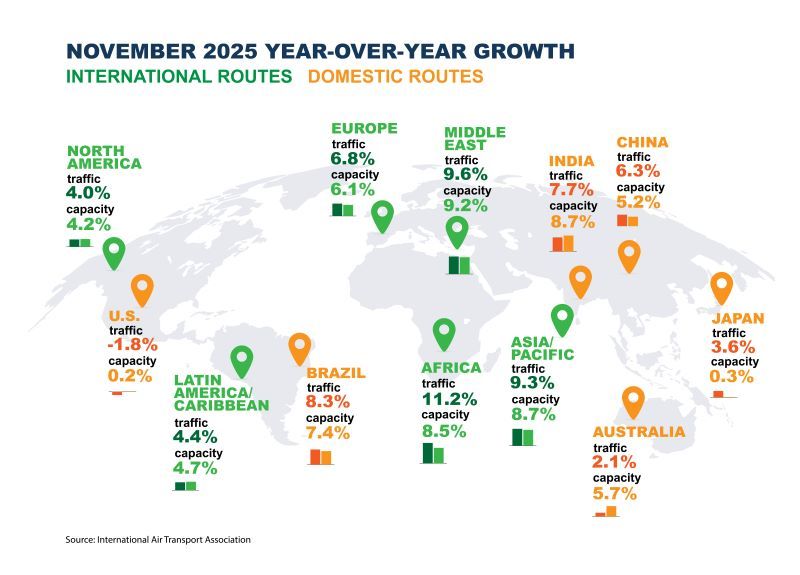
North American and U.S. November air demand and capacity
struggled. Much of the month was affected by the U.S. government shutdown,
which extended through Nov. 12, and the associated government-mandated capacity
cuts that lasted past that date.
North America had the lowest November total traffic and
capacity growth rates of the regions covered by IATA, with year-over-year
increases of 0.1 percent and 1.4 percent, respectively. Global load factor
decreased 1.1 percentage points to 80.3 percent. November was the 10th
consecutive month of year-over-year declines in passenger load factor for North
America, according to IATA.
The region's November international demand grew 4 percent
year over year, while capacity was up 4.2 percent for the period. The North
American domestic load factor declined 0.1 percentage points in November to 81
percent.
November U.S. traffic declined 1.8 percent year over year,
while capacity increased just 0.2 percent. The U.S. was the only domestic
regions with a decline in November demand, and it posted the lowest capacity
growth rate as well. Domestic load factor was down 1.6 percentage points to
79.6 percent, the lowest among the domestic markets.
____________________________________________________________________
RELATED: IATA:
'Strong' Air Demand Growth in October
____________________________________________________________________
Elsewhere, Africa had the highest growth rate for total
November air demand at 12.6 percent year over year. The Middle East led
capacity growth at 9.2 percent for the same period. Europe posted the highest
November load factor at 86 percent, up 0.5 percentage points from a year prior.
Africa also had the highest November international air
demand growth at 11.2 percent year over year, and the Middle East led in
international capacity increases at 9.2 percent for the same period. Asia-Pacific
had the highest November load factor: 85.8 percent, up 0.5 percentage points
from November 2024.
In the domestic markets, Brazil reported the highest air
demand growth rate at 8.3 percent year over year, while India had the highest
capacity increase for the period at 8.7 percent. India also had the highest
November domestic load factor at 88.5 percent, though that represented a
decline of 0.9 percentage points year over year.