September domestic U.S. air demand, as measured in revenue passenger kilometers, dropped for the second month in a row, according to the International Air Transport Association.
The decline "accelerated" to 1.7 percent year over year after dipping 0.2 percent in August. September U.S. capacity, as measured in available seat kilometers, increased just 0.1 percent compared with a year prior. The U.S. load factor also dropped 1.5 percentage points to 80.2 percent and was the lowest of the major domestic markets.
Total global demand, however, increased 3.6 percent year over year, with capacity up 3.7 percent for the period. The September load factor declined 0.1 percentage points to 83.4 percent.
International demand again led the increase and was up 5.1 percent year over year, while capacity increased 5.2 percent. Domestic demand remained soft and increased 0.9 percent year over year, with capacity up 1.1 percent compared with September 2024.
"Solid international demand drove 90 percent of September's 3.6 percent overall growth," IATA director general Willie Walsh said in a statement. "Importantly, the capacity expansion slightly nudged ahead of demand growth at 3.7 percent. With November flight schedules indicating a 3 percent expansion on the previous year, airlines are gearing up for continued growth into the year-end holiday season."
[Report continues below chart.]
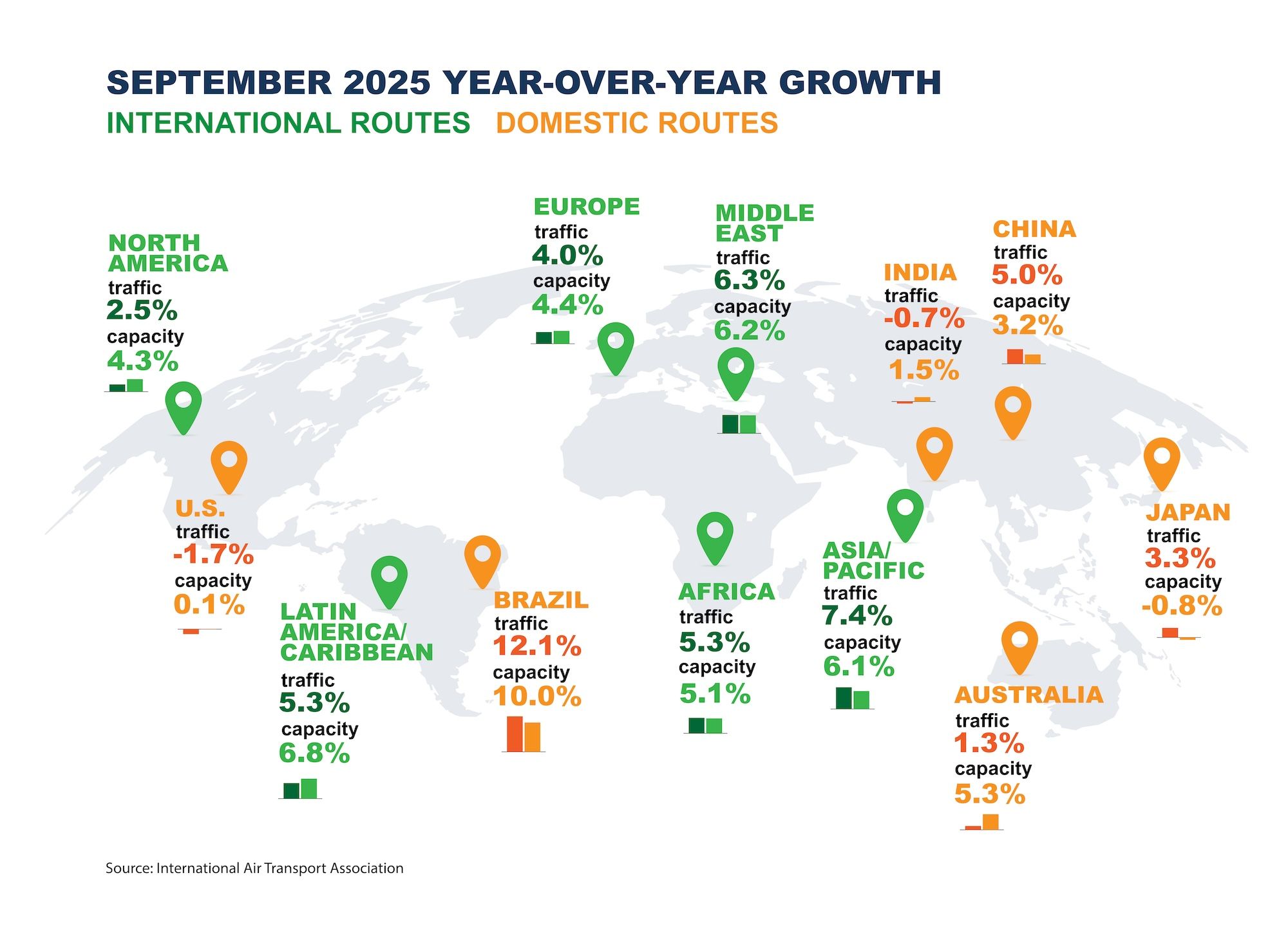
North America was the only region to report a September total air demand decline, at 0.1 percent year over year. Its total capacity growth also was the lowest among the regions at 1.8 percent, and load factor fell 1.5 percentage points to 81.2 percent, the lowest of the sectors.
Europe demand increased 2.9 percent compared with a year prior. The other regions' traffic increased between 5.3 percent and 6.2 percent.
Outside of North America, capacity increased between 3.3 percent and 6.9 percent. Load factors were flat or down, except for Asia-Pacific, where it increased 1.1 percentage points to 83.6 percent.
September international demand growth was the highest among Asia-Pacific carriers at 7.4 percent year over year, followed by the Middle East at 6.3 percent. International capacity increases all were in the mid-single-digit percentages. International load factors declined 0.1 percentage points to 83.6 percent.
In domestic markets, aside from the U.S., India also reported a September traffic decline of 0.7 percent year over year. Brazil reported the largest demand growth at 12.1 percent for the period and the largest capacity increase at 10 percent. Japan was the only domestic market to report a capacity decline, of 0.8 percent compared with a year prior.
Overall domestic load factor declined 0.1 percentage points to 83 percent.
RELATED: IATA August 2025 passenger air performance data