Global February air demand, as measured in revenue passenger kilometers, increased 6.1 percent year over year, a bump up from the 3.8 percent increase in January, according to the International Air Transport Association.
February total capacity, as measured in available seat kilometers, increased 5.6 percent compared with February 2025. Passenger load factor for the month was 81.4 percent, up 0.3 percentage points and the highest February load factor on record, according to IATA.
Domestic February demand recovered, growing 6.3 percent year over year, and for the first time since the pandemic recovery years exceeded international demand percentage growth. That increased 5.9 percent for the period.
Domestic capacity increased 6.2 percent compared with February 2025 and had a passenger load factor of 82.8 percent, up 0.1 percentage point compared with a year prior. International capacity grew 5.3 percent; its load factor was 80.5 percent, up 0.5 percentage points.
"February was a strong month," said IATA director general Willie Walsh, who will depart IATA when his tenure ends on July 31 to become CEO of Indian low-cost carrier IndiGo. "However, without knowing the length and intensity of the war in the Middle East, it is impossible to quantify the full impact that it will have on airline prospects.
"But some things are already clear," he continued. "Fuel costs have risen sharply. With tight capacity and thin margins, air fares are already rising. Capacity deployment is also adjusting, particularly for traffic to, from, or through the Middle East, or in areas where fuel supply is an issue."
Walsh added that capacity growth scheduled for March has eased to 3.3 percent year over year from earlier projections of more than 5 percent.
[Report continues below chart.]
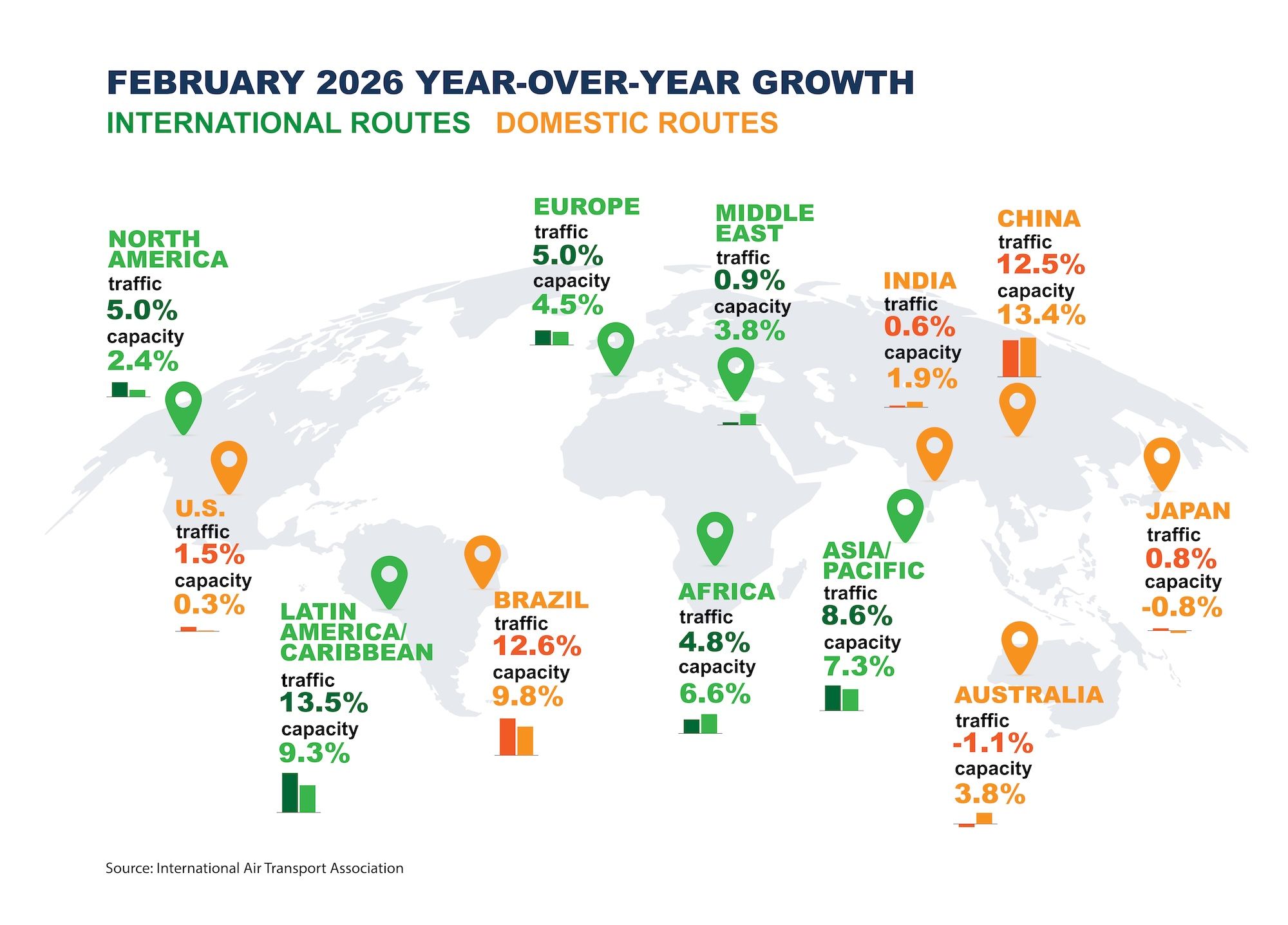
February domestic demand increased in all regions except for Australia, where it declined 1.1 percent year over year. Brazil had the highest growth at 12.6 percent for the period, followed closely by China, thanks to the Lunar New Year falling in February this year, at 12.5 percent.
Domestic capacity for the month also increased in all but one region, Japan, where it fell 0.8 percent year over year. China led with growth of 13.4 percent. Domestic load factors were mixed, with Brazil, Japan and the U.S. increasing, while Australia, China and India declined.
Latin America and the Caribbean led February's international demand by region with 13.5 percent growth year over year. All regions reported increases for the month, but the Middle East had the smallest gain at 0.9 percent.
February capacity increased from the year prior in each of the six regions in the report, with Latin America and the Caribbean the highest at 9.3 percent. The U.S. had the lowest capacity increase at 2.4 percent. Africa and the Middle East reported declines in passenger load factor.
RELATED: IATA: International Air Demand Lifts January Traffic