Most small and midsized enterprises are increasing travel spending, even in the face of conflict in the Middle East and associated rising fuel prices. Nevertheless, cost control remans a primary goal for many SME travel programs, but many travel managers are looking to add structure and formality to those programs to achieve it, rather than cut or cap volume.
Such are the findings of BTN's 2026 SME Travel Management Survey, in which 136 travel managers and buyers from programs with no more than $25 million in travel and entertainment spending in 2025 were surveyed in March and April, weeks after the United States and Israel attacked Iran and Iran's subsequent closure of the Strait of Hormuz.
The findings illustrate a market in which 2025 travel spending increased or stayed the same year over year at a significant majority of SME companies, even in a year marked by macroeconomic turmoil, a trend that has continued into 2026. Still, many respondents, when given the opportunity to cite their biggest travel management priority and challenge for 2026, noted cost control for each.
Spending on the Rise
According to BTN's survey, most SMEs increased their level of business travel spending in 2025. About 45 percent of all respondents indicated their organizations spent more on T&E last year than they did one year prior, and another 32 percent indicated they spent roughly the same level as they did in 2024.
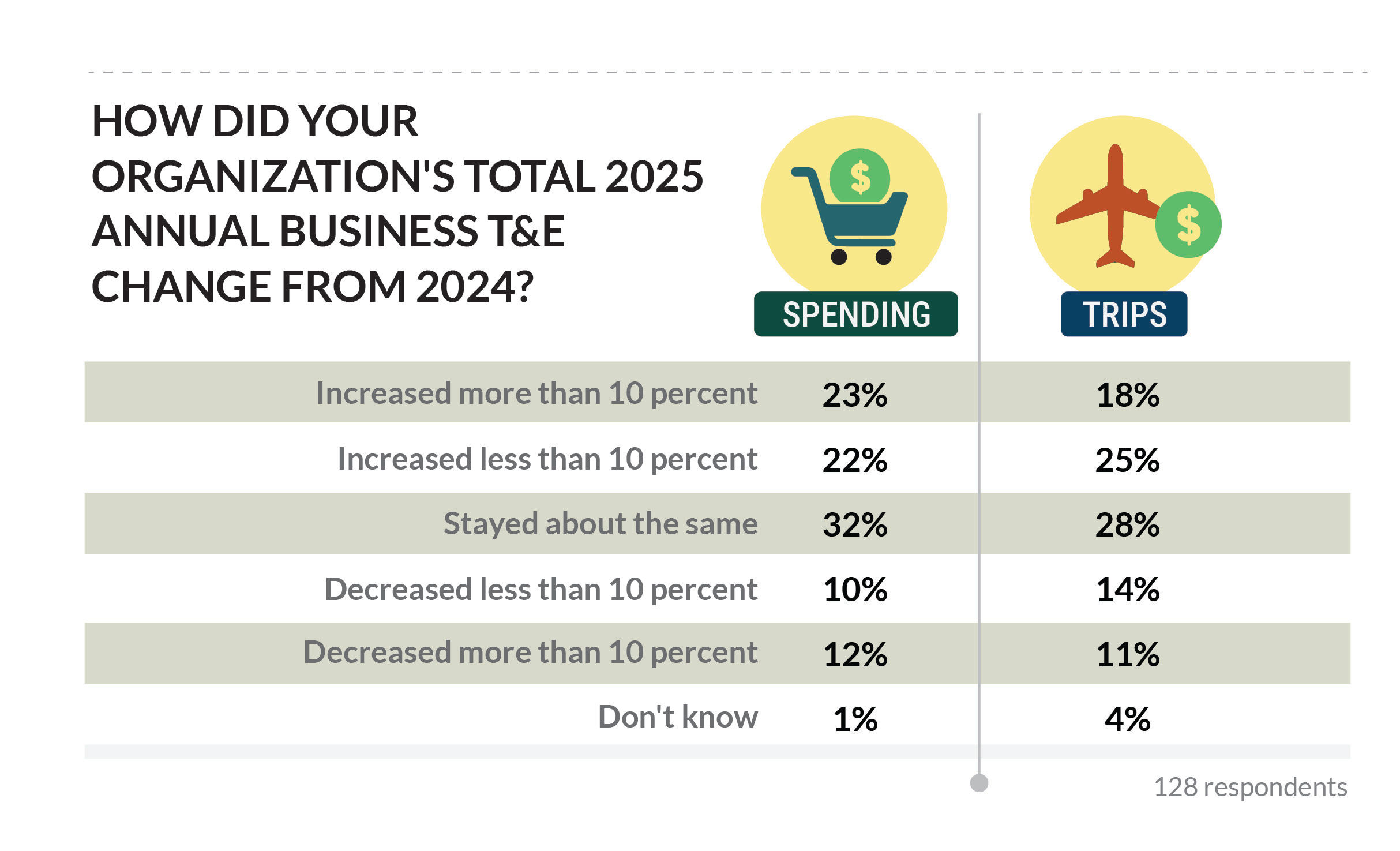
The increase in spending wasn't necessarily due to an increase in travel pricing, especially as such increases last year generally were moderate compared with 2024. The number of SME respondents who reported more 2025 trips year over year closely if not precisely mirrored those who reported higher spending, and only slightly more reported fewer trips than less spending.
It should be noted, though, that there was a significant difference in 2025 spending trends among companies of different sizes in this survey. Among respondents from companies with 2025 T&E spending of at least $8 million—the "midsized" portion of SME, so to speak—56 percent indicated a year-over-year spending increase, compared with 39 percent of small companies, those with less than $8 million in 2025 T&E spending. Additionally, 12 percent of midsized companies reported a spending decrease, but 28 percent of small organizations did.
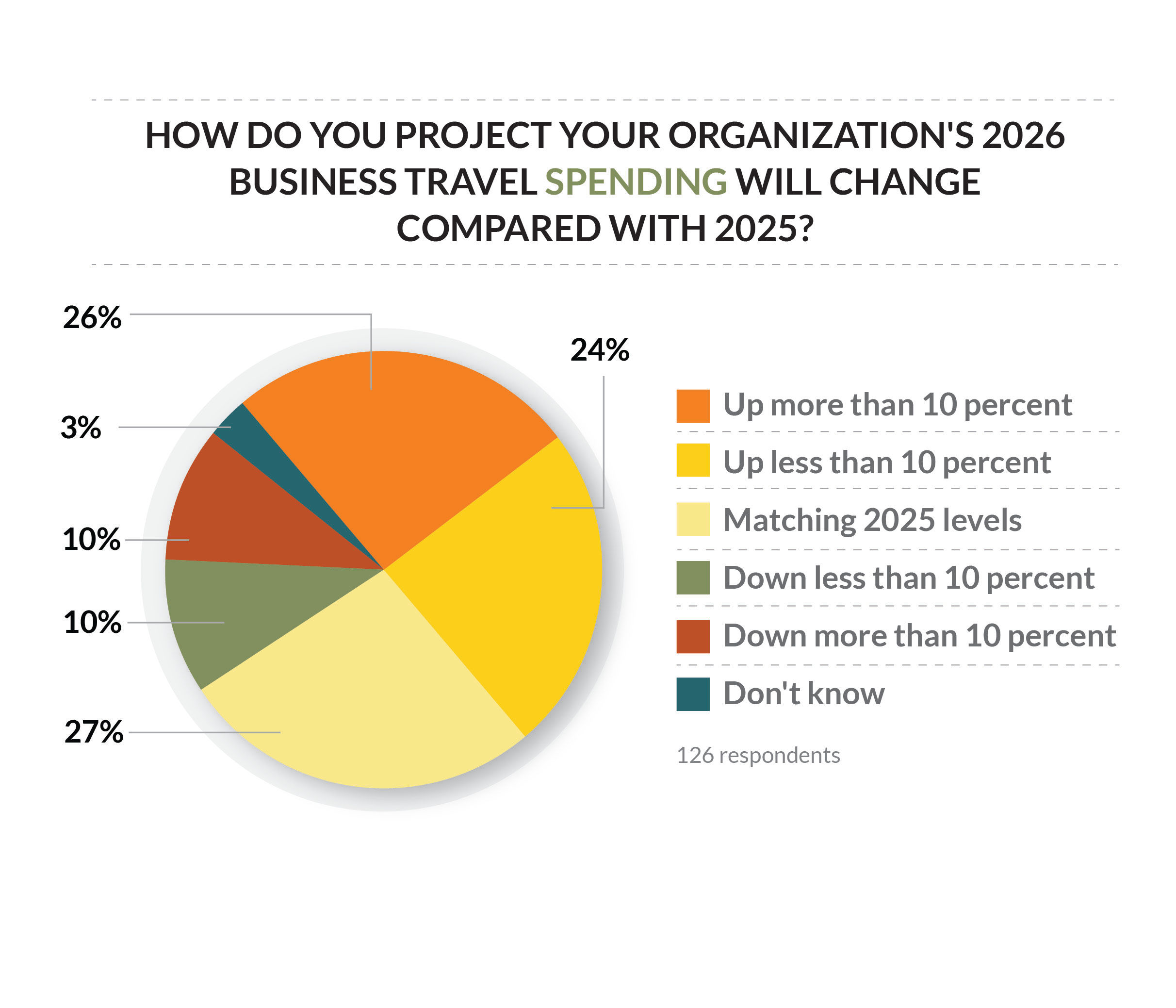
Respondents across the board generally thought it likely that their organizations would at least maintain travel spending this year from 2025 levels—keep in mind, though, that the survey was in the field during the post-Hormuz timeline of increasing fuel prices and rising airfares and hotel rates, increasing the likelihood of travel spending hikes.
Still, half of all respondents projected their organizations to increase 2026 travel spending year over year. About 20 percent of respondents forecast such spending would decline, about half of whom projected it would drop more than 10 percent.
Interestingly, unlike the data on 2025 spending, there was little difference in results from small-business and midsized organizations for their projections. About 53 percent of midsized respondents forecast a year-over-year increase in 2026 spending, versus 48 percent of small-company respondents—and a higher share of small respondents projected an increase of 10 percent or more (29 percent of all small respondents vs. 21 percent for all midsized respondents).
About 17 percent of midsized respondents project 2026 spending to decrease, compared with 22 percent of small business respondents.
Evaluating Current Events
Airfares and surcharges are on the rise throughout the world, thanks mostly to increasing jet fuel prices, but SME survey respondents by and large don't yet consider the effect of the price hikes an overwhelming factor in their 2026 travel spending plans
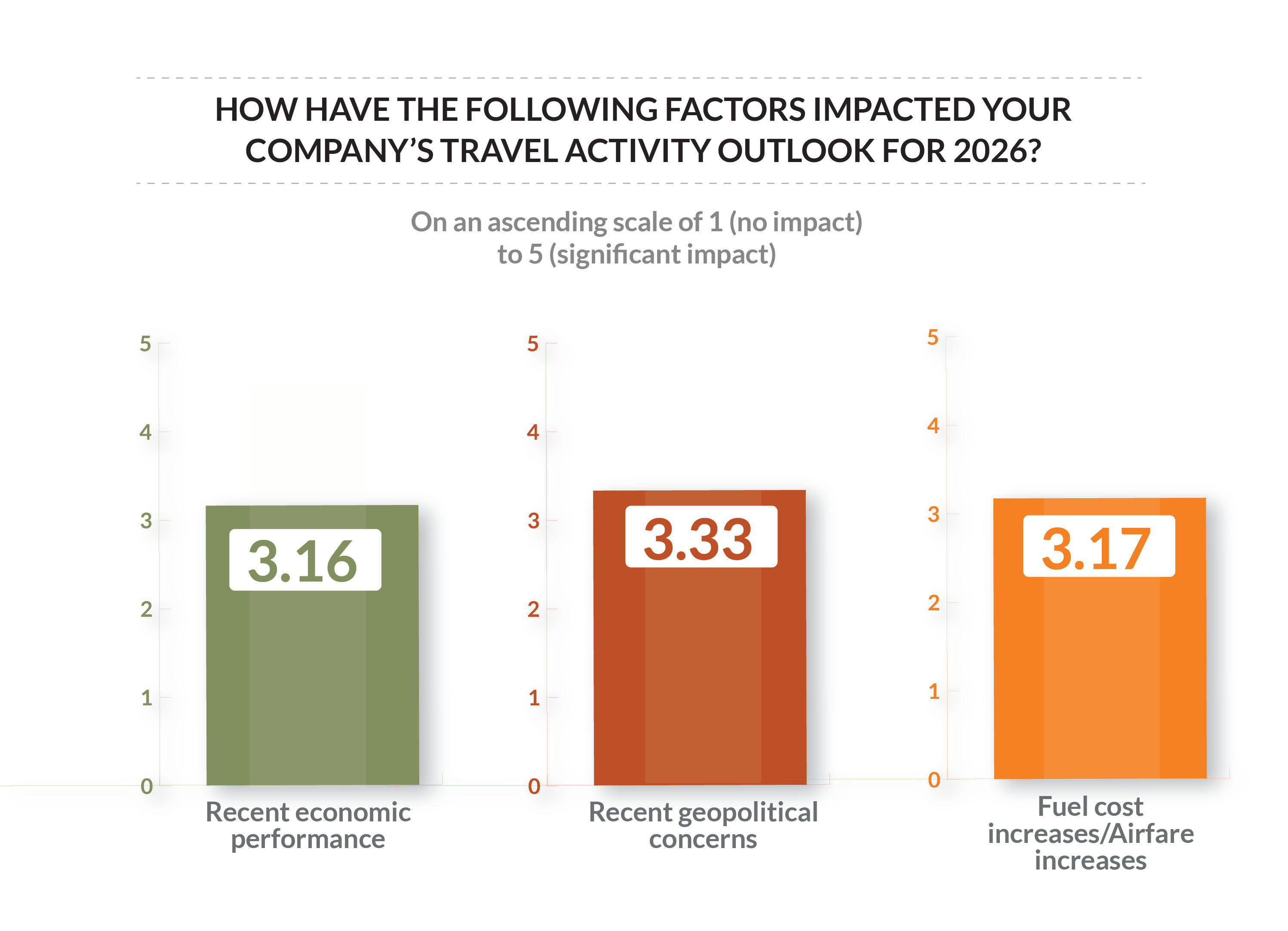
When asked to rate on an ascending scale of one ("no impact") to five ("significant impact") the effect of rising fuel costs and airfares on the outlook for their organization's 2026 travel spending, respondents on average rated it as 3.17—notable, but not necessarily indicative of wide-scale alarm. Respondents from smaller companies with less than $8 million in 2025 travel spending, and inclusive of companies with low airline volume rated its impact even lower, at an average 3.04.
There's of course a direct link from rising jet fuel costs to the conflict in the Middle East, and BTN survey respondents on average appear to consider the latter a more significant factor in their 2026 plans. Respondents rated the effect of "recent geopolitical concerns" at 3.33, with another notable split between midsized company respondents (3.79) and small company respondents (2.97), a population of which likely have less international travel. About 32 percent of the full respondent base indicated that their travel management remit includes the Middle East, incidentally.
Last year's business travel demand, particularly in the spring and summer, was affected notably by uncertain macroeconomic conditions. Those concerns in 2026 appear to have abated somewhat, with airlines and hotel companies in the United States and Europe reporting increasing year-over-year first-quarter business transient travel demand. Still, survey respondents on average rated the impact of "recent economic performance" on their companies' 2026 spending at 3.17, again with a split between midsized (3.39) and small (2.98) respondents.
How to Handle?
Nevertheless, cost control remains high on the list of SME travel managers' concerns. When given the opportunity to detail in open-ended fashion their top travel management priority and challenge in 2026, dozens chose cost control for one or both. Some just wrote "cost" without the need for further detail—justifiably, surely—but others chose to provide a bit more context:
• "Controlling spend as external factors push travel costs higher."
• "Keeping costs down by getting creative."
• "Increased fees and service charges, and newly implemented fees such as seat charges and baggage on Southwest."
• "Rising fuel prices and the effect that is having on our program."
But what's to be done about it? Several airline executives have been clear that airfares aren't coming down absent lower fuel prices, which hardly seem imminent given a lack of resolution in the Middle East. Some respondents acknowledged such, with one citing "external factors outside of the business that we have no control over" as the biggest challenge this year, with another citing "the ongoing conflict in Iran which has rippling effect on our industry," and still another citing "FUEL PRICES AND THE WAR" in all caps.
But since only one in five expect their organizations to cut travel spending this year from last year's levels, how are they looking to offset the higher costs? In many cases, they're looking to strengthen the structure of their managed travel program to drive efficiencies and reduce costs. About two in five this year or last have strengthened travel policy, for example.
Several other respondents detailed their plans to enhance their managed travel program to limit costs without sacrificing service, which they noted as their top priority this year. Some were specific, others listed only general plans:
• "Prioritize a new program that users will want to stay with."
• "Enhance digital travel tools and integrating travel and expense processes to improve efficiency, compliance, and traveler experience. Increase automation and data quality to support better cost control, reporting, and decision‑making."
• "Drive program adoption and engagement while building scalable, standardized policies and processes."
• "Drive cost optimization through stronger supplier partnerships and expanding those relationships across our travel program."
• "Institute travel policy mandate for more visibility of spend and duty of care."
Safety and Risk
Several respondents, in fact, mentioned duty of care or traveler safety as a key 2026 priority. One for example, cited a goal to "consolidate a risk‑based travel management framework that ensures employee safety before, during, and after every business trip."
That stands to reason, as most of the respondent base has international responsibilities. While 92 percent of all respondents have responsibility for travel management in the United States, for example, only 32 percent have responsibility for the U.S. alone.
Only 7 percent of respondents indicated their organizations do not actively manage travel risk. The approaches of the remainder vary.
About 29 percent of all respondents (and 43 percent of respondents with 2025 travel spending of at least $8 million) said their organizations have formal, comprehensive travel risk management programs in place. About 37 percent indicate they have some processes in place, but not a fully developed program. Another 27 percent (and 36 percent of respondents from small businesses) indicate they manage travel risk only on a case-by-case or an informal basis.
Half of all respondents, and 69 percent of midsized enterprise respondents, indicated they work with a third-party provider for travel risk management services.
AI? Eh
However omnipresent the topic may seem in discussions of travel management and processes, very few respondents cited anything to do with AI as a key priority or challenge in 2026. One noted a desire to "leverage AI efficiencies to drive better travel UX, risk mitigation and productivity." Another cited as a challenge "how to incorporate AI into the travel booking process." There were only few other citations.
That could reflect a trend found in separate BTN research conducted earlier this year. BTN's 2026 AI in Business Travel Report fielded in January and February found a notable split in approaches to AI between SME companies and their larger brethren.
In that survey, about 38 percent of SME respondents weren't using AI in travel management at all, compared with 14 percent of companies with 2025 travel spending of more than $25 million. Nearly half of all large-market respondents indicated they are using AI in at least some travel processes (and about a quarter of them have embedded AI across multiple travel workflows) but only 23 percent of SME respondents said they use AI in any functions.
For most SME buyers, it seems, the age of tomorrow will have to wait a day.