The small to midsize enterprise segment has
become an increasingly important battleground for legacy travel management
companies, newer all-in-one travel platforms and technology providers. Buyers,
meanwhile, are becoming less willing to tolerate clunky tools and fragmented
servicing models.
Nevertheless, SME travel programs are still
facing the same realities they always have.
"[Travel managers] have to manage the
second-largest controllable line item, they have responsibility for duty of
care and, oh, by the way, they have to make their employees happy with a
category that's really hard to make employees happy," said Direct Travel
CEO Christal Bemont. "Companies that are larger have dedicated teams doing
that. When you're a smaller company, none of those things go away."
Those resource constraints are also part of
what's made the SME segment increasingly attractive to TMCs and travel
technology providers.
"[We’ve] recognized this SME market is
massive—it has been underserved and undertargeted for a very long time,"
said Krissy Herman, VP of program management at KesselRun Corporate Travel
Consulting. "There are pushes from some of the newer entrants to really
own that market."
One of the drivers behind that push is a shift
in the people running SME travel programs. Gant Travel CEO Patrick Linnihan
said he's seeing travel managers that have worked at large enterprises move
into smaller organizations and bring enterprise-level benchmarks with them.
"They inform their new employer, 'This is
the standard at which we should be able to perform,'" Linnihan said. The
result is an SME buyer with higher expectations and a better understanding of
what modern travel technology can do.
That disconnect shows up in BTN's SME survey
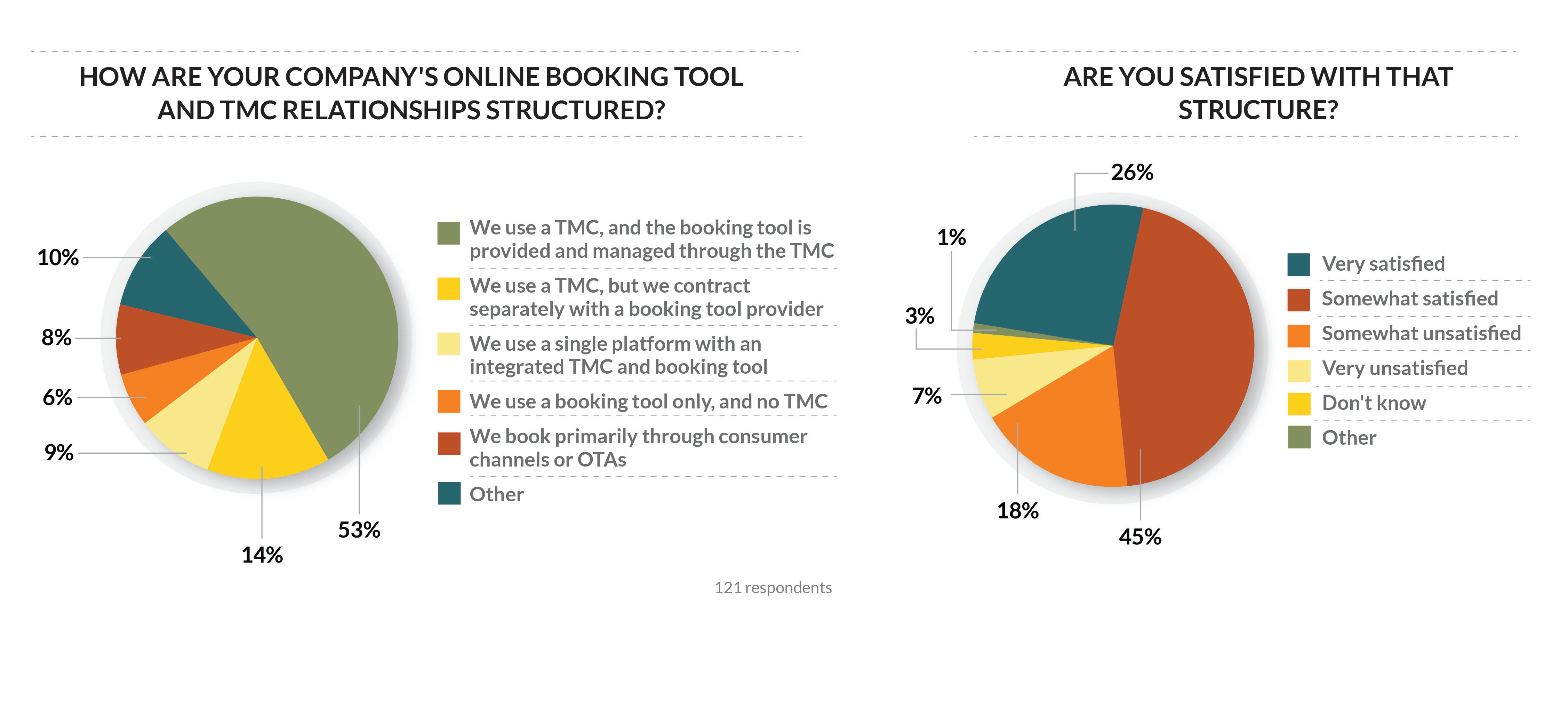
data. Only 22 percent of respondents said they were “very satisfied” with their
current TMC and booking tool arrangement, suggesting many buyers still see room
for improvement. Half (50 percent) said they were only 'somewhat satisfied,'
Unwillingness or inability to change could
account for some of it. Twenty-one percent of respondents said they never use a
formal RFP process to select a TMC, and another 20 percent said they only do so
sometimes—which suggests a substantial portion of SME travel managers may
simply have stuck with whichever agency came with the job.
"The truth of the matter is, nobody wants
to configure a new tool and go through all the change management if they don't
have to," said Terri Moreno, senior manager of travel, expense and fleet
at The Aspen Group.
That relative stasis is also visible in how
programs are structured. Fifty-three percent of SME survey respondents use a
TMC-provided booking tool, the traditional model that has dominated the segment
for years. Only 10 percent use an integrated all-in-one platform of the kind
offered by newer market entrants.
But the pressure to change is building. Legacy
booking tools that once had no serious competition are being measured against
consumer travel experiences and coming up short. The agencies that resell and
manage them are facing similar scrutiny.
"A lot of these programs that have been
more traditional in the past—a Concur Travel, a Concur Expense, insert any TMC
here—they're now hearing from their travelers and their stakeholders, 'I could
do this easier. There has to be a better way,'" said Herman.
The SMEs who do go looking for something better
are finding a market that looks very different than it did five years ago.
_________________________________________________________________________________

Finding Fit: Tech First, Service Second
Company: The Aspen Group
Senior manager Travel, Expense & Fleet: Terri Moreno
When The Aspen Group's Terri Moreno had to select her TMC-OBT
relationship, she focused on the technology first, because "not every
booking tool can do what we need."
The Aspen Group is a national healthcare
organization that provides business support to independent healthcare practices
across more than 1,300 locations. Some quirks of how the company is structured
means that whichever travel tech provider TAG partners with needs to have a
very sophisticated backend.
For example, only a small portion of
employees, approximately 3 percent, are allowed to make their own travel
reservations—the rest flow through Moreno's team. That means that whichever OBT
Moreno selected needed to be able to empower travelers to access and make
changes to their traveler profile without allowing them to self-book travel.
It's a function that Moreno said couldn't be supported by at least one leading
legacy OBT.
Another snag centered around payment.
TAG operates six different brands and within each there are three categories of
travelers: nonprofiled or candidate travelers; "in-the-field"
travelers; and corporate office employees. That necessitates 18 different
virtual card accounts—a complex tech requirement that eliminated a different
market-leading legacy OBT.
In the end, Moreno collaborated with a
newer-entrant OBT specialist that was willing to make changes to accommodate
the complexity of her SME program.
"They were very nimble,"
Moreno said. "You find that with some of the newer companies they are
willing to customize for you. They're hungry."
Moreno then selected a traditional
midmarket TMC who could support her OBT partner. She said she purposely left
out some of the largest legacy agencies from that RFP process.
"We don't want to be the teeny,
weeny fish in the big, big pond where they're not doing what we need and we're
a drop in the bucket to them," Moreno said. "We want to be the bigger
fish and we want a TMC that's going to care if they lose our business."
_________________________________________________________________________________

Finding Fit: Local Everywhere
Organization: Rainforest Alliance
Travel, Safety & Security Manager: Brian Gabriel
Brian Gabriel, manager for travel,
safety and security at Rainforest Alliance has had some "disaster"
experiences with TMCs.
Rainforest Alliance is a global
non-profit organization that partners with farmers, businesses and local
communities to conserve forests and advance sustainable farming practices.
Its organizational structure makes it
difficult to have a consolidated global managed travel program. Rainforest
Alliance does not have a global headquarters. It's registered in 22 countries
and has employees based in several more. The bulk of its travel is in-country,
not cross-border.
There are content issues—travelers most
often need hyperlocal flight options, such as routes between Nairobi and Mount
Kenya, and some countries like Cote D'Ivoire provide substantially lower
preferential rates to domestic agencies. There are safety and security
issues—travelers need to book in-program and all reservations need to be able
to be tracked by Gabriel and risk partner Healix International. There are
invoicing issues—certain countries, such as Mexico,
have strict invoice and tax parameters that mean reservations cannot be
serviced from just anywhere, by anyone.
With previous TMCs, Gabriel ran into
problems precipitated by one or more of these issues, despite making it clear
what the program's requirements were as part of the bid process. With one
leading global TMC, Gabriel also felt misled about the ability to consolidate
reporting between affiliated corporate brands and agency branches within
countries—a shortcoming that meant Gabriel had to consolidate all the reporting
numbers himself.
After conducting an RFP process for a
new TMC, Gabriel selected Navan's all-in-one travel platform. He said he chose
the new entrant for a few reasons.
First, they were up front about what
they couldn't do, not just what they could do—a positive difference compared to
RFP conversations he had with his incumbent TMC about some longstanding pain
points.
"When you tell me you could do
everything, and then shortly after you can't," Gabriel said, "the
whole relationship's messed up."
Second, they use a hybrid global and
local partner model bolstered by API-supported technology. That structure
addresses local content and fares, country-specific tax and invoicing and local
language requirements, and it keeps travelers in-program.
All Rainforest Alliance bookings, both
within Navan and those made through partner agencies, flow back into Navan via
a unified data feed so that Gabriel has a single, consolidated dashboard. The
platform integrates directly with Rainforest Alliance's human resources
information system, so all employee profiles flow into Navan and from Navan
into partner agencies, which avoids "six or seven different integrations
with the HRIS." All itineraries then go to Healix International via a
single API feed, eliminating the need for multiple connections and associated
fees.
Rainforest Alliance has been with Navan
since October. Gabriel admits it hasn't been perfect. The agency setup, though
aided by Navan's technology, has still been complicated and required a lot of
effort on his part. He still had to do an implementation with approximately
seven local agency partners—meet with them, answer administrative questions
with the aid of in-country RA employees, review and localize policy. It's a
process that's ongoing with the last two partner agencies nearly ready to roll
out.
Gabriel has also had to get employees
used to contacting an AI agent instead of sending an email and awaiting an
agent response. It's a change he said should be for the better, particularly
given the very slow response times demonstrated by his previous agency partner.
"I'm trying to get employees to
realize that [the AI agent] is a useful resource," Gabriel said.
"And, yeah, once you need to talk to somebody you can say, 'Connect to a
live agent.'"
_________________________________________________________________________________

Finding Fit: Starting Fresh
Company: Havas UK
Travel Manager: Roberta Iorizzo
When Havas UK travel manager Roberta
Iorizzo made the switch last year from managing travel and expense for one of
the world's largest reinsurance companies to instead oversee the UK travel
program for a global communications and advertising giant, she met with an
entirely new demographic of travelers.
Havas is a creativity powerhouse that
acts as a parent company to a large and ever-growing collection of
semi-independent agencies. Its travelers were younger, more tech savvy and
dynamic. They also weren't keen to comply with travel policy—nearly two-thirds
of Havas' UK travel population wasn't in the program.
"[Havas employees] are not going to
spend half an hour to book a business trip when they can book their holiday or
leisure travel in 10 minutes online," Iorizzo said. "They are not
going to read the thick manual in order to learn how a booking tool works. They
just want something that works, that is simple, that is fast."
The fragmented structure of Havas UK,
with its semi-independent agencies meant that even though there was a single
designated TMC to service employees, there were other TMCs being used in parts
of the organization, too. Iorizzo launched a survey of travelers to better
understand how they were booking, who they were booking through and what issues
they had encountered with the designated TMC and OBT partners.
Though she already had a pretty good
idea of the main problems, Iorizzo said she still found the answers
"enlightening." Some of the challenges revealed by the survey—such as
gaps in lodge card coverage that put employees unreasonably out-of-pocket for
hotel expenses—Iorizzo was able to address right away.
The rest became the basis of a new OBT
and TMC RFP that kicked off with initial conversations this month.
One key requirement is that Iorizzo
wants her TMC and OBT to operate under a single contract—either with a TMC that
resells and manages the OBT relationship or an all-in-one agency with its own
proprietary booking tool.
"If anything goes wrong, we want
one person to go to," Iorizzo said, instead of the TMC blaming the OBT and
vice versa when issues arise.
Iorizzo said she's mentally putting the
TMC contenders into three buckets: the solid TMC with solid service and 'good
enough' technology; the full transformation TMC; or somewhere in the
middle.
It's very early days and, according to
Iorizzo, it's an open field.
_________________________________________________________________________________
How TMCs Are Responding
For SME buyers, the fundamental
questions to TMCs are what they've always been: Can you do what I need? Will
you be a real partner? Will the technology work for my travelers? What will it
cost?
What's changing is the agencies that are
answering them and how differently they're doing it.
"When we work with any client, but
SMEs in particular, it's critical for us to ask, 'What are you after?'"
said Herman at KesselRun. "Are you after self-serve and 99 percent online
adoption? A tool that can do it all? Or, are you looking for phone calls
answered in three rings?"
That's where programs that might have
previously prioritized the latter are now re-evaluating the former, according
to Herman.
"You need to really understand
travel and the [technology] systems in order to make configuration changes on
the back ends of those older OBTs," Herman said. "When you look at
some of the newer solutions, it's very intuitive."
Herman pointed to adding a reporting
field as one action that's more easily done through new-entrant technologies.
"The program owner controls it, can self-service it and [that change] just
automatically goes into place," she said.
Stuart Blake, VP of revenue, North
America at Perk, which fits cleanly in the new entrant TMC category, said
something he hears often from prospects is "this is so much easier to use
than what we're using today."
In 2025, 96 percent of bookings
processed through Perk required no human intervention, according to Blake. He
said the platform's open-API architecture and its early adoption of AI allows
it to accommodate approximately 45 platform integrations and easily build out more
integrations for customers where a business case exists.
Yet, Blake also has to regularly field
prospect questions about service. More specifically: "Please tell me you
still have humans behind the scenes that can help us."
Blake confirmed that Perk does have
human agents to assist with urgent requests. But Perk also acquired Chicago-based
TMC AmTrav in 2024. Blake said AmTrav "serves an amazing
need" for a segment of the market that wants "a little bit more high
touch, more customization" and that Perk intends to further grow the
AmTrav brand.
The service-versus-technology divide is
nothing new in TMC selection. But dissatisfaction with legacy systems is
becoming harder to ignore and it's forcing every player to either pick a side
or get up to speed.
"The new entrants have a level of
digital integration that is really going to challenge the old guard," said
Linnihan. "When you build an entire platform from the bottom up, based on
technology that the standard TMC bolts on, you're going to have a different
experience. The new entrants are going to challenge the ecosystem and require
all current TMCs to infuse technology faster than I think that they would have
without the competition coming."
Linnihan admits it's an unusual thing
for him to say as a member of the "old guard." Yet, he also cites
Gant's acquisition of AI
company Aimendo in 2024 as a positive way the agency has been
able to infuse technology with the service experience.
"We have AI teams that have brought
products to customers that we know are working," Linnihan said. Examples
include an AI email assistant that's reduced handle times and an AI contact
monitoring program to help personnel improve interactions with clients.
Direct Travel is a legacy TMC player
that's sitting squarely in the middle of the tech versus service conversation.
Last year, it released Avenir Travel Edition, a Spotnana-powered booking
platform supported by Direct Travel's agency network.
The primary benefit of Avenir for the
SME segment, according to Bemont, is its single-instance architecture—meaning
it's a truly unified global system rather than a series of separate regional
tools.
"Any other booking tool, if you
have different divisions or different entities underneath one corporate
headquarters or you have different locations, you have to roll out separate
instances to support that," Bemont said.
The more instances, the more
implementations, cost and complexity. That single-instance architecture,
particularly for resource-strapped SMEs, means a single implementation.
"If you start with us and you're an
organization that has a hundred employees," Bemont said, "you grow,
or you get acquired, the ability to grow with customers is super easy."
Avenir also touts a more consumer-like
user experience, self-service travel manager tools and global content coverage.
Nevertheless, Bemont said the agency has
taken a "very strong and very specific" position that service is
still a primary focus "especially when there's chaos or disruption"
and that it should never come as a sacrifice to boosting self-service and
automation.
Finding Value
SME travel managers now have a growing
pool of TMC choices that combine technology and service in different forumulas.
Linnihan said there's "a lot more
sophistication in the SME arena" than many realize. When asked if that rising sophistication complicated partnering with the segment, he said simply, "that's what price is for."
"The more
sophisticated the program and the higher the level of performance that's
requested, the trade-off is those take greater resources on my side and
that will cost more," Linnihan said. "That is very
attractive to have a higher margin company working with us."
For some SMEs, that extra price can be a
dealbreaker and may be what's driving them toward new entrants.
That was the case for Rainforest Alliance, said Gabriel. Despite the fact that the organization's complex set was likely achieveable with a legacy market-leading
TMC—and one seemed particularly good during the RFP process—the pricetag proved too much.
"We then [would have been] paying tons of
money and fees that as a small non-profit we can't afford," Gabriel
said.
For others, the TMC program fees aren't the key decisionmaker.
"Our pockets aren't terribly deep," Moreno said.
"But cost is not the No. 1 factor. As an [SMB] we have more responsibilities
and less resources. So, the thing is, can the TMC be a resource for me?
When you send me my reporting, can it be in a format that I don't have to now
go and redo everything in order to reconcile my expense report, my credit
card?"
Iorizzo, too, said the cost of agency service and support wasn't at the top of her selection criteria.
"The conversation
is changing,"
she said. "Where the travel budget is really hitting corporates, it's definitely not
the cost of the program or the TMC fee."
The
real expense, in Iorizzo's view, is the price of inventory available through corporate tools and
how it stacks up against inventory on brand.com or OTA sites. As an example, she
cited her recent need to purchase a business class ticket to Chicago: Her
current corporate tool offered £9,000 ticket, but the same seat on the same airline's website cost £5,600.
"If my new tool
and my new TMC can give me that [inventory] straight away, but charges me £70 for that ticket," Iorizzo said, "it's
not a problem, is it?"