As small and midsized enterprises continuing to expand globally, many of their travel policies are becoming more sophisticated and in some cases embedded into booking, expense and risk management systems. Some also are becoming more stringent although enforcement can vary, according to BTN's 2026 SME Survey.
Once viewed primarily as compliance documents focused on cost containment, today's SME travel policies are evolving into frameworks designed to support traveler wellbeing, operational agility duty of care and business growth.
Most SME travel programs have mature policies in place, according to Goldspring Consulting partner Neil Hammond, though refinement remains a priority.
"Generally there are opportunities to improve policies by making them more concise and tabular and integrating the content into the process flow—booking tools, mobile apps, expense tools—in order to guide travelers at the right place and time," Hammond said. Hammond added that most companies are projecting modest increases in business travel activity despite geopolitical uncertainty.
Technology firm Dynatrace's policy transformation began when the company launched its first global travel program three years ago. According to Dynatrace global travel manager Virginia Aguirre, implementing a unified travel policy became foundational to creating consistency and visibility across worldwide travel activity. "As part of that effort, we selected a single global travel management company to bring consistency, visibility, and control to business travel worldwide," Aguirre said.
Like many organizations building global programs from the ground up, Dynatrace initially focused on standardizing booking processes and establishing policy guardrails. But as the company expanded internationally, the policy became more adaptive.
"Today, the policy is less about enforcement and more about enablement," Aguirre said. "Helping employees travel smartly, safely and responsibly as the company continues to grow."
Reaching A Tipping Point
That evolution is playing out across the SME market as companies reach growth stages where informal travel management no longer is sustainable. According to Christopherson Business Travel VP of product management Jeffrey Madsen, many SMEs operate with loosely enforced policies until travel volume reaches a tipping point.
"Most SMEs we work with are somewhere between basic and scaling," Madsen said. "They have vendor relationships and some kind of policy, but it's often informal or undocumented."
Madsen added that companies typically formalize policies once annual travel spend reaches roughly $500,000 to $2 million, because manual processes and reimbursement systems become increasingly difficult to manage. "Expense reconciliation is one of the biggest catalysts we see," Madsen said. "At a certain point, the manual lift stops being defensible."
Hammond said SMEs also formalize travel governance once T&E spend reaches $1 million to $2 million, employee count exceeds 100 or revenue reaches a certain level.
At Lineage, a global temperature-controlled warehouse REIT, formalizing a travel policy became necessary as travel volume and operational complexity increased.
"Travel, as both an expense item and a safety consideration, required a formal policy," said Lineage, global travel manager Seth Wood. "By codifying a travel policy, Lineage aimed to empower team members to travel safely and cost-effectively regardless of where they live."
Duty of Care in a Risky Environment
Duty of care has become a defining factor in policy evolution, particularly as organizations expand into higher-risk regions. Aguirre said Dynatrace has adjusted portions of its policy in response to geopolitical risk, especially in the Middle East, where the company moved from minimal preapproval requirements to mandatory prebooking approvals by senior leadership.
Hammond noted that duty of care is now a major strategic driver shaping SME travel programs. "Duty of care is a key strategic driver for travel programs," Hammond said. "This is a key reason to retain control over traveler booking channels." According to Hammond, travel risk management policies increasingly require travelers to maintain complete profiles with updated emergency contacts, use travel risk management apps and ensure itineraries feed into third-party monitoring systems.
Madsen agreed that duty-of-care expectations no longer are limited to large enterprise programs. "Any company with international travelers, healthcare workers in the field, or people in volatile regions now expects itinerary-based tracking, contextual risk alerts and a defined emergency response," he said.
Rethinking Cost Management
Companies continue scrutinizing travel spending amid economic uncertainty and rising supplier costs, though many organizations are moving away from broad travel reductions and becoming more strategic about which trips warrant investment.
"Travel itself isn't being scaled back," Madsen said. "The conversation has shifted from ‘Do we travel?' to 'Which trips actually drive outcomes?' "
That shift has influenced how organizations approach cost control. Rather than relying solely on retrospective audits, many companies are establishing spending limits earlier in the booking process. "We're also seeing a shift toward setting budgets up front instead of reconciling spend after the fact," Madsen said.
Hammond said many organizations are becoming simultaneously more flexible and more restrictive depending on the spending category. "Generally, policies are becoming more flexible in terms of multichannel bookings, use of shared-economy suppliers, inclusion of personal and business travel, and allowing sustainable options," Hammond said. "At the same time, they are becoming more restrictive in terms of hotel and meal caps."
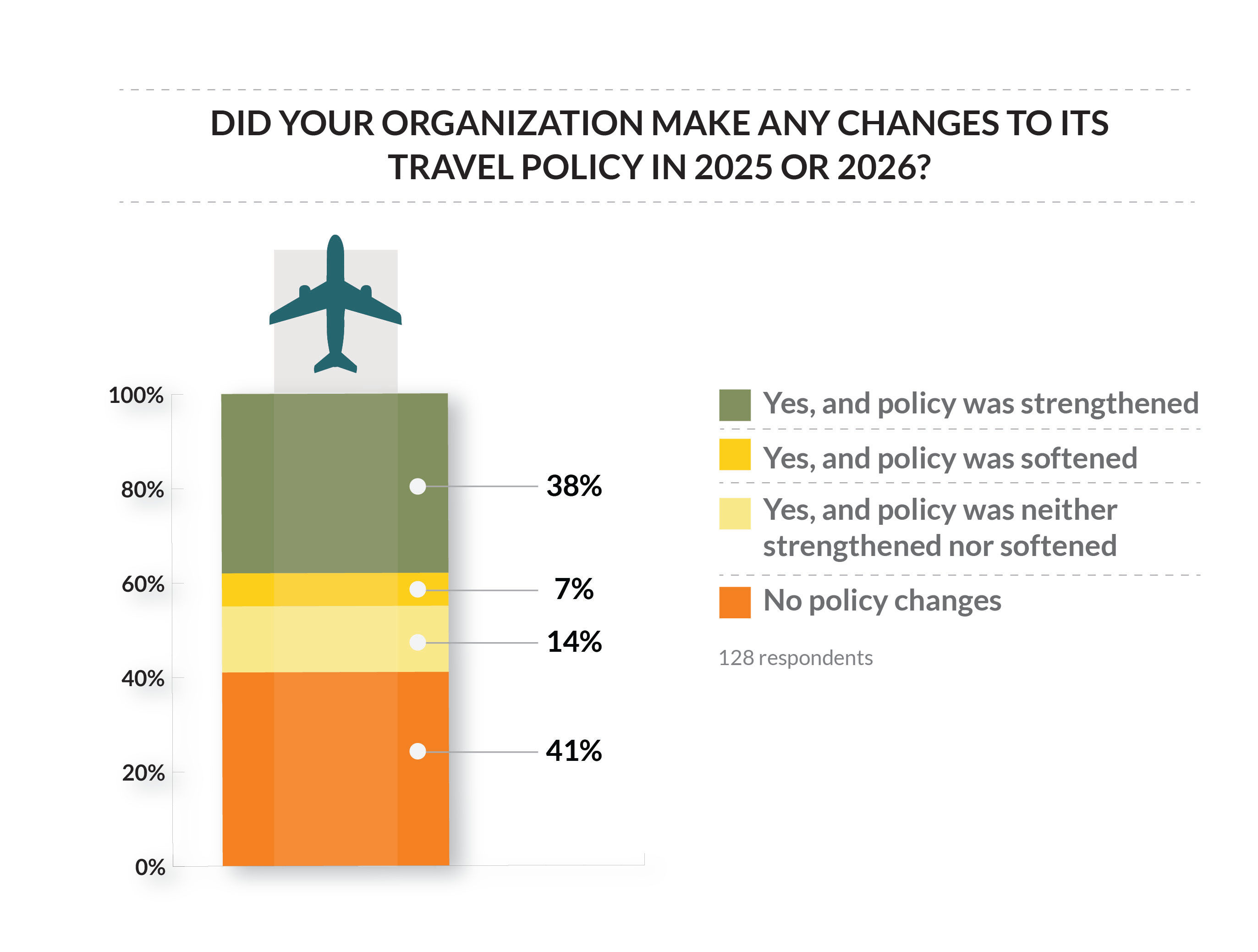
According to BTN's survey, 59 percent of respondents said their organizations either this year or last had altered their business travel policy. Of those who did, nearly two-thirds said that change made the policy stronger, while a bit more than one in 10 said their organization softened policy.
Dynatrace regularly reevaluates policy areas where tighter controls could improve both compliance and cost management. Aguirre said the company would narrow premium-class eligibility primarily to international travel, where longer flight times and traveler well-being considerations have the greatest impact.
Wood noted that many organizations are refining business-class policies to eliminate ambiguity and prevent unnecessary costs. "Eligibility should be based on the shortest reasonable routing rather than an itinerary extended through unnecessary connections," Wood said.
At the same time, companies are trying to create more traveler-friendly experiences. According to Madsen, the most successful travel programs are tightening policies while softening enforcement. "The policy itself is getting tighter," Madsen said. "But the experience around it is getting more flexible."
That balancing act is particularly evident when comparing written policies with actual traveler behavior. Aguirre noted that loyalty preferences and convenience frequently influence traveler decisions, while Wood said booking outside approved channels remains one of the biggest compliance challenges for Lineage because it creates both visibility and duty-of-care concerns.
Tech as Policy Engine
Technology increasingly is becoming the mechanism through which companies shape traveler behavior and enforce policy organically rather than manually. According to Madsen, booking platforms now effectively function as the policy itself.
"Policy used to live in a document," Madsen said. "Now it's configuration."
Hammond said tighter integration between booking and expense systems is also reshaping how companies manage compliance. "The booking and expense tools continue to provide options to display and enforce policy and drive travelers toward compliance," Hammond said. "These are being enhanced by tighter integration between travel booking and expense as well as the application of AI and audit tools to monitor compliance."
At Dynatrace, much of the company's policy is integrated directly into its online booking platform. "The booking experience itself influences behavior by making compliant options clearly visible and less preferred selections more deliberate," Aguirre said.
Lineage has also invested heavily in technology-enabled policy management. The company recently launched an AI-powered chatbot called the Travel and Event Concierge, or TrEC, which provides employees with 24/7 answers to travel policy questions.
"The goal is not to replace human judgment," Wood said, "but to help us be more responsive and improve the traveler experience."