The increase in jet fuel prices since the start of the Iran incursion on Feb. 28 has led to higher airfares and checked-baggage fees. But some airlines have added "carrier-imposed surcharges" instead of raising base fares, frustrating some corporate travel managers.
What irks those buyers is that their corporate discounts do not apply to these fees, thereby lowering their net effective discounts. They're also skeptical, given history, they'll come back down when the international crisis ends.
"This has been on my radar for even longer than they've gone up, because I was starting to document it all because I've been so irritated by how they just keep going up and up and we get no discount off of it," said a West Coast travel manager who asked to remain anonymous. "No one ever talks about it. They tell you that you have a 20 percent, 30 percent, 40 percent discount, and it's not true because that's not off the net cost."
Carrier-Imposed Surcharges
These fees started in the 2000s as a supposedly temporary move during another oil price spike, but over time were renamed and became another way for airlines to manage revenue. They are listed as YQ and YR in ticket line items and technically are called "carrier-imposed miscellaneous" fees. Some refer to them as "fuel taxes," but they are not taxes, are controlled by airlines and can include global distribution system fees and other operating charges, and allow carriers to raise prices without increasing base fares. These adjustable surcharges are more prevalent on international flights and typically increase in amount with cabin class.
"It's quite a quick mechanism to make a pricing change, because it attaches to all the fares rather than having to change all the individual tariffs," American Express Global Business Travel director of consulting strategy Sara Andell said. "It's an efficient way of doing a price increase or decrease."
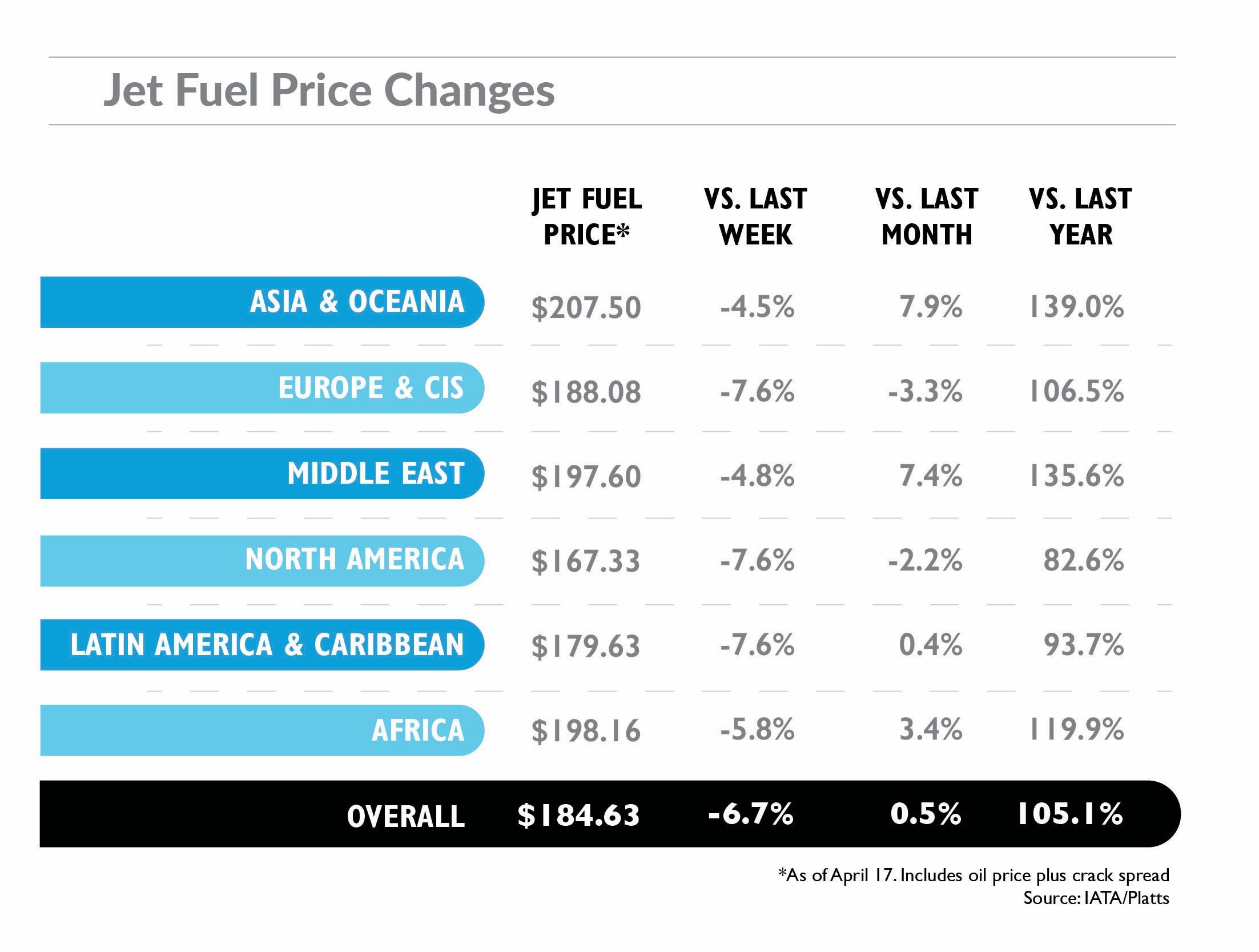
Amex GBT in early April published an analysis on how higher fuel prices could translate into airfare increases, if oil prices hold at $152 per barrel and demand remains steady. The TMC projected business-class airfares on routes from North America to Europe to increase 6 percent to 16 percent and from Europe to North America by 10 percent, and 7 percent on transpacific routes.
Andell added that given what has happened to fuel prices and airfares since the report was created, those percentages are on the low side. She called out business-class fares from Europe to India, projected by Amex GBT to increase as much as 15 percent, noting Air India's recent fuel surcharge increase. "We know that region's being hit quite drastically because of overflying," she said. "So, where we said it was plus 15 percent, that actually year over year translates to plus 32 percent."
"We see more than 80 percent of the airlines [with] surcharges that are YQ and YR," Advito SVP and managing director Olivier Benoit said. "Whether it's called a fuel charge or not, or built into the fare or not, the outcome for corporates is the same: higher ticket costs. That is what we have been observing in March, and that's what our quarterly index for Q2 is showing us." Advito's quarterly Travel Price Index is set to be released this week.
The West Coast travel manager purchased a business-class ticket from Los Angeles to London Heathrow on American Airlines/British Airways on Feb. 27. The YQ fee was $55, and the YR fee was $2,100. This buyer checked again on April 13, and the YQ fee, which on the breakout was listed as "fuel," remained $55, but the YR fee was now $2,750—a $650 increase. The buyer checked two other carriers with comparable flights: United Airlines and Delta Air Lines and its partner, Virgin Atlantic. The fees for each of the three tickets for the same line items matched: $55 and $2,750.
Chevron global category manager for air, ground and travel analytics Alicia King has been monitoring air pricing as well since the start of the Iran War. She provided sample routes that showed combined YQ/YR surcharges. For a business-class fare on Feb. 28 on United between Houston and London Heathrow, those fees were $2,155. They were $2,755 on March 20 and $2,805 on April 17. On a sample fare from Houston to Angola, the surcharges accounted for 28 percent of the ticket cost. To Bangalore? The YQ/YR surcharges were 41 percent of the ticket price, she said.
"In business class, your YQ/YR could represent anywhere from 21 percent to 41 percent of your ticket price that you are not getting a discount on," King said. She has brought up the increased surcharges to her preferred carriers. Their response: "It's out of their hands," she said.
Net Effective Discounts
Benoit added that "fuel-related pricing adjustments are now happening faster and more frequently, and that makes budgeting much more complicated. It makes it more complex for our clients to manage their air spend," he said. "It's the lack of transparency, consistency, predictability and how the fuel charges are applied. … Opacity creates complexity, uncertainty, and they are a bit frustrated because it undermines the trust in supplier partnerships."
Reiterating what the West Coast travel buyer said, "those fees are not commissionable, they're highly volatile, they go up overnight but they are slow to come down, and often it's poorly communicated," Benoit noted. However, he said that scenario does not apply to all airlines. "Some airlines are very good at being clear, saying we are going to increase at this date from this amount to that amount on these travel sectors. It varies by airline, it varies by region, it varies by regulation framework."
This also makes it difficult for travel buyers to explain the cost increases to their stakeholders, to their travelers, to their corporate management.
Buyers of large programs and travel management companies have tried to get carriers to allow for discounts on these surcharges, Partnership Travel Consulting SVP Bob Brindley said, but "the airlines have been pretty steadfast that they're not going to apply discounts to the fees."
"As fees become a bigger part of the ticket and that component is not discountable, your net effective discount against the base fare doesn't change, but against the total fare, it'll continue to go down," Brindley said.
Benoit said clients were already looking at the impact of a lower net effective discount. "What does it mean in terms of performance to the contract?" he queried. "With such a large change in average ticket pricing, in that effective discount, and potentially in servicing, that will impact their ability to reach the goals."
It might get even worse.
Oracle director of global travel sourcing and GPO Rita Visser a few weeks ago had a conversation with a carrier about working on a UATP solution for unused tickets. "When we asked about the fuel surcharge and would it be refunded in the UATP processes, we were told no," she said.
When this was mentioned to a few sources, all said they hadn't heard of that … yet.
"There are some fees that end up not being refundable—an extra fee for booking through the res system, or booking through a GDS, they're not going to refund that fee," Brindley said. "But I wasn't aware that they were trying to do that with the fuel surcharge, because that's such a big-ticket item, I think that would cause a firestorm from buyers, if that was the case."
Still, GBT's Andell said that "it's down to the airline policy and ticket type. If you've got a restricted nonrefundable fare, and you choose not to travel, you won't get that surcharge back, [or] the base fare [or] the bits that are airline revenue, but you'd get all the government taxes," she said. "Be sure about which tickets you're buying in the airline policy."
That advice is especially important now that carriers are micro-segmenting their premium cabins with such nonrefundable fares as "basic business."
Surcharge Decreases?
Do these surcharges go down as fuel prices retreat? Most sources said yes—eventually.
"They tend to come down after the cost pressure has been relieved, but it takes time," Brindley said. "And in that timeframe, the airlines are benefiting from a boost in revenue."
Case in point: During Delta's April 8 first-quarter earnings call, CEO Ed Bastian said he anticipated in the second quarter recapturing 40 percent to 50 percent of the more than $2 billion fuel headwind the carrier expects by June 30, while revenue is projected to grow by a low-teen percentage year over year. Delta, which has its own fuel refinery, is passing on increased fuel costs to passengers, but continues to see demand strength.
Bastian noted that "the higher-end consumer, the premium consumer is candidly immune or becoming immune to the headlines and not delaying their investment in the experience economy. … As difficult [as] it is to see what's going on with the conflict in the Middle East, I'm not sure that our premium customers are feeling affected by that."
"We know a good chunk of that premium demand—yes, there's some luxury leisure in there—but a lot of it is corporate traffic," GBT's Andell said in response to Bastian's comments.
Further, at least one U.S. lawmaker wants airlines to promise to decrease their prices as jet fuel costs abate.
U.S. Rep. Ritchie Torres (D-N.Y.) on April 15 sent a letter to the CEOs of American, Delta, United, Southwest Airlines and JetBlue stating that "if airline pricing is truly tied to global fuel costs, then it must be equally responsive when those costs decline. Pricing cannot be a one-way street. … I call on you to publicly commit to lowering costs associated with air travel should jet fuel prices decline."
Ways to Mitigate Inflated Costs
But prices are not expected to decline anytime soon, especially since some carriers plan to reduce capacity to help cut fuel bills, which will reduce lower-priced inventory and keep prices high, or higher.
What can travel managers do in the meantime?
"Rising airfares and carrier surcharges are adding a whole new layer of unpredictability to corporate travel programs, making it increasingly difficult for businesses to forecast and control spend," Sebastien Marchon, CEO of expense management provider Rydoo, said in an email. "The reality is many organizations are still relying on static travel policies that weren't designed for this level of volatility. As prices shift in real time, predefined travel limits can quickly become outdated."
Benoit agreed that carriers generally won't budge on allowing discounts on the YQ and YR surcharges, but said that buyers from large programs could ask carriers for additional discounting on high-volume routes with high share.
"That could help mitigate the cost of the airline surcharges," Benoit said. "Some [clients] are asking us to look into back-end deals, compensation at the end of the year, or after three months or six months. This is a very tough discussion because the airlines are pushing back. But when you negotiate, you have to open all options."
Some travel buyers are relying more on rate-assurance tools.
"We are looking at air reshopping tools with our TMCs," said another buyer who requested anonymity. "With all the increased fees and surcharges, we are doing everything we can to figure out how to control our costs. I know the reshopping tools have been around for a long time, but they are gaining new relevance. We will have to see if they can actually be effective."
The West Coast buyer recently implemented Emburse, which purchased the reshopping company Tripbam nearly three years ago. The process started prior to the price increases, but "we're already seeing some results," they said. "I think it's going to become a very important part of our program as we move forward."
Chevron's King also uses reshopping tools, and she used to see on average about a 2 percent return. "I'm doing a study right now to see if we should tweak the configuration to manage our spend even more aggressively," she said.
Brindley said the increased pricing will put pressure on trips that may not be quite as necessary, and some companies may have to reel in some of those plans. "It's demand management, but not necessarily a policy change," he said. "We have corporations with a lot of business in the Middle East not flying to the Gulf right now. We have other clients where it's business as usual. It cuts across the board depending on the individual client's situation."
Andell suggested booking in advance to make sure lower-priced inventory options are open, even though that can be tricky for corporate travel. She also said travelers could book premium economy instead of business class, even if just on one leg.
To manage rising costs, King is leveraging her company's Concur configuration to highlight airlines offering more competitive inventory and pricing. Travelers are being encouraged to book further in advance, though this is not always effective as airlines have become increasingly sophisticated in their revenue management and clearly understanding buying behaviors, she said.
King also is trying to promote better buying choices. Her team sends out monthly business-unit scorecards that outline where travelers are not booking in advance, or on markets where they're declining the timing and routing as it relates to the travel policy and leaving money on the table. She also is using the real estate at the top of the online booking tool to provide recommendations. "Please look at airline X … they're most preferred."