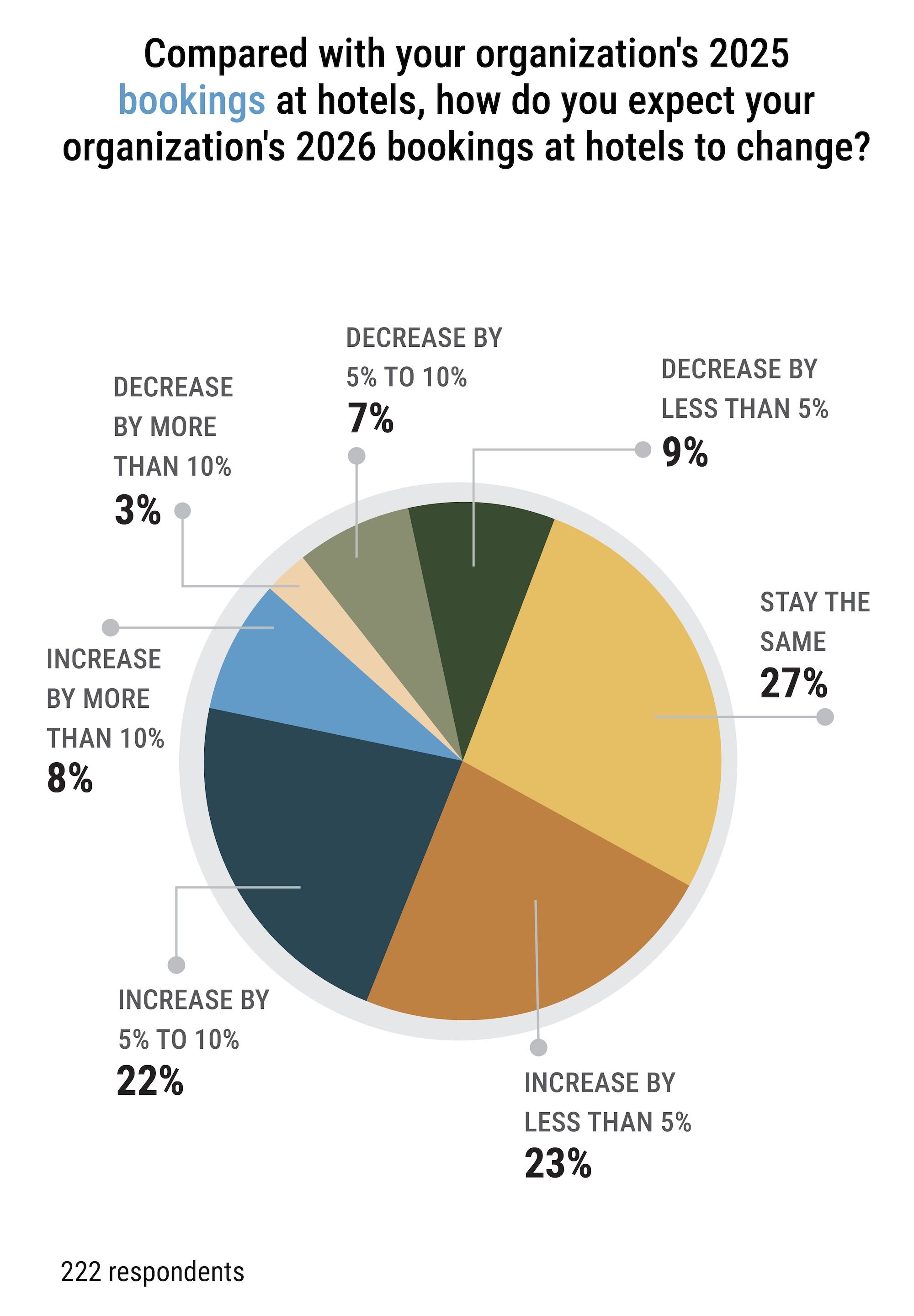
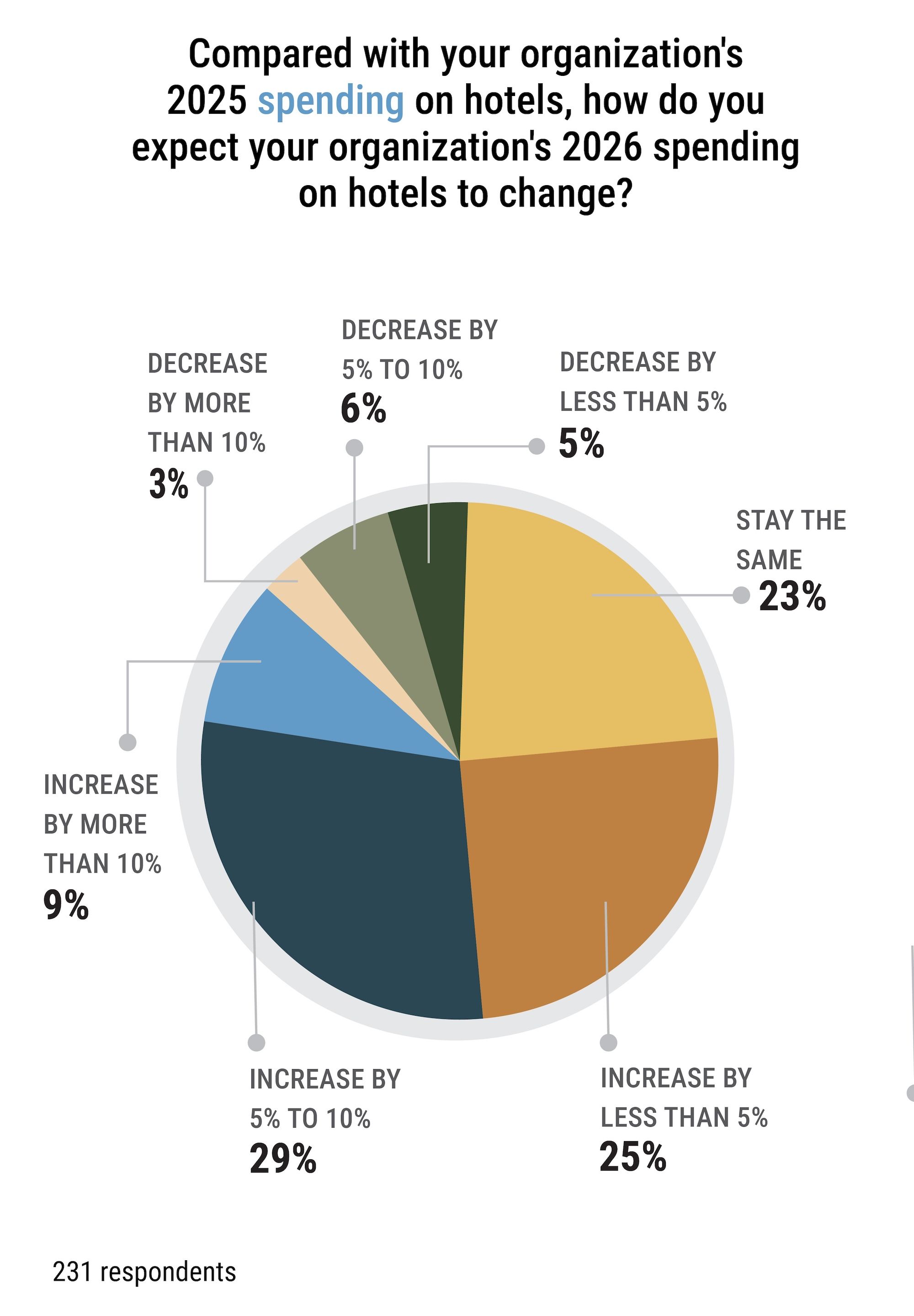
Business travel has rebounded somewhat in 2026, but higher room rates appear to be contributing more to higher spending than rising booking volume. Travel manager respondents to BTN's annual Hotel Survey on the whole expect to spend more on hotels in 2026, but not necessarily book more of them.
BTN in June and July surveyed 231 travel managers and procurement executives about the state of their hotel programs and their expectations for 2026 and beyond. While 63 percent of respondents expect their full-year 2026 hotel spending to increase compared to 2025, only 53 percent expect full-year 2026 booking volume to increase. Some 27 percent of respondents expect their 2026 booking volumes to hold flat year over year.
BTN in the survey offered respondents the opportunity to detail in their own words the major challenges facing their hotel programs. Cost was front and center for many. Here is a sample of responses:
"Rising rates have increased our travel spend with less travel volume."
"Rising costs are a concern as well as meeting business travelers' expectations."
"The increased cost we're seeing in both urban and rural areas."
"Higher prices."
While hotel rates once were projected to rise modestly this year, they so far have grown faster than expected. The most recent forecast from STR and Tourism Economics projects that the full-year 2026 average daily rate at U.S. hotels will grow 3.1 percent year over year—a tripling of the firms' initial 1 percent ADR guidance from January.
During recent second-quarter earnings updates, Marriott International, Hilton Worldwide and Hyatt Hotels Corp. each made upward revisions to their full-year revenue per available room projections, citing business transient and group travel as key growth drivers for the year.
Yet, according to Goldspring Consulting partner Neil Hammond, a true business travel comeback would mean business transient reclaiming its former share of the overall revenue mix, not just paying more.
"I'm not convinced we're there yet," he told BTN.
Indeed, Marriott CEO Anthony Capuano said the company's 3 percent year-over-year business transient RevPAR growth in the United States and Canada during the second quarter was the result of "mid-single-digit [average daily rate] increases offsetting slight declines in room nights."
While rates are expected to rise in 2027, the forecasted increases in most regions are relatively modest, which Hammond said should create a more favorable environment for buyers.
A Dynamic Battle Rages On
Another theme underpinning this year's survey was the continued pressure buyers felt from suppliers to adopt dynamic rates—a set percentage off a hotel's best available published rate on any given day.
Addressing the topic, respondents characterized suppliers' insistence on dynamic discounts as a challenge, with some identifying the reduction of dynamic rates as a key program opportunity. Here is a sample of responses:
"Dynamic rates [are] being offered even though we support those hotels with significant volume."
"Dynamic pricing is not as valuable to our company as static pricing. However, many hotels will only offer this option."
"[The biggest opportunity is to] reduce dynamic rates at properties where we support with significant room nights."
"Getting over dynamic pricing!"
FCM Consulting noted in its recent Global Hotel Insights Report that dynamic rates are often the opening offer from hoteliers during negotiations. According to the report, more than a quarter (27 percent) of proposed rates in the first round of hotel negotiations in 2026 were dynamic, but "many of these were later converted back to fixed pricing through negotiation, demonstrating that buyers still retain leverage where travel volumes are strong."
In the end, FCM found that 23.5 percent of accepted hotel program rates in 2026 were dynamic, up from 22 percent in 2025.
In a recent Global Business Travel Association survey, almost half of buyer respondents from the U.S. and Canada said they had more dynamic rates in their program now than they did a year ago, and 25 percent of respondents said they had fewer static negotiated rates.
The buyers who are able to secure static negotiated rates say getting last-room availability to accompany those rates is its own growing challenge.
One respondent to BTN's Hotel Survey summed it up this way: "I think LRA is a myth."
Potential Sourcing Upheaval Ahead
For now, sourcing 2027 hotel rates hasn't strayed from the traditional playbook. But emerging changes to distribution soon could reshape hotel procurement and program management.
In June, Marriott EVP and chief revenue and technology officer Drew Pinto told BTN the company is considering direct technical relationships with travel management companies and corporate booking tools.
"The state of the content and technology in the hotel distribution space, particularly when it comes to managed business travel, is really messy," Pinto said. "That's why we're exploring every alternative we can find, whether they're established players or new players, to see who has the capabilities to distribute some of this and make that experience great."
In July, Hilton and Navan announced a direct integration that would give the TMC real-time access to Hilton's rates and availability through a booking API linked to Hilton's central reservation system, plus property and room content through a separate content API.
Hilton VP of global business travel sales Christiane Cabot Bini said that Navan is the first TMC Hilton went direct with, but it won't be the last as "we have lots of other conversations going on."
Part of the appeal of direct connections is lowering distribution costs, particularly those associated with global distribution systems.
Hilton CEO Christopher Nassetta told analysts last month that the Navan partnership "bypasses both intermediary connections and other more expensive distribution channels, providing meaningful cost savings for our owners."
DerbySoft head of business travel solutions Nadim El Manawy told BTN that GDS fees can run anywhere from $4 to $5 per hotel booking for market-leading chains and $7 to $8 per booking for midlevel or smaller hoteliers.
Direct connections, El Manawy said, are a more cost-effective way to distribute content and also deliver a better experience. It's the same reason the industry moved toward IATA's New Distribution for airlines.
But direct connections also could alter how corporates source hotels, according to Spotnana partner director of content and distribution Luigi Tiberio. Much in the way NDC has made airline sourcing less fare-centric, removing legacy distribution from the hotel sourcing equation could allow corporates to move beyond room rate.
"You're not negotiating room rates anymore; you're negotiating bundles," Tiberio said.
Such bundles could combine organizational discounts, negotiated corporate rates and individual perks like branded-card offers, along with property-level extras such as early check-in, late checkout or room selection.
There are other benefits that could come from more direct technology integrations between corporates, TMCs, corporate booking tools and hotels, Tiberio said. Centralized rate loading via the hotel CRS could shorten rate loading times, reduce property-level errors and make rate renewal easier. Virtual payments processed via the CRS could reduce virtual card acceptance issues at the property level. Better technology integrations between supplier apps and corporate tools could allow a traveler to book via a corporate tool but make reservation changes via the consumer app.
"If you're a corporate buyer negotiating with hotel chains that have capabilities that they never had before … it opens the door for different conversations," Tiberio said. "You're going to have more volume because the volume that was falling off due to lack of functionality is not going to fall off anymore."
Nevertheless, Tiberio acknowledged that while the industry makes technical advancements, it's too early to tell how the industry will move forward and who will embrace the changes.
"Don't get me wrong," he said, "there will still be the bread-and-butter, midsized corporate clients that don't care about any of this."