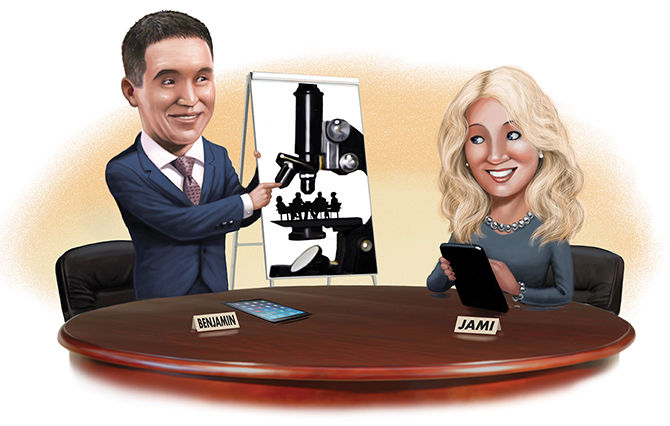
 Credit: Illustration by Scott Pollack
Meetings Mavens Talk Shop
- online booking tools
for small meetings
- transient rates vs. meeting
rates
-
driving small meetings
compliance
Managing small meetings—with as few as 10 people or even as many
as 50—has proven a tough nut to crack for a lot of companies. It feels like they
should be simple, but small meetings still require negotiations, site selection,
terms and conditions, contract signings, food and beverage and travel. Tying those
pieces into an intuitive process that also gives corporations visibility into volume
is, actually, anything but simple. In the past year, however, small meetings technologies
like Bizly, Breather, Groupize and Meetago have been breakout players, each with
a little different value proposition. But managing small meetings isn't just about
launching a tool. Estee Lauder Companies director of global travel and meetings
Jami Stapelmann and Parexel International director of procurement and travel Benjamin
Park spoke with BTN managing editor Amanda Metcalf about their small meetings management
strategies.
BTN: Why do small meetings matter, and what makes
them so hard to manage?
Jami Stapelmann: Companies view small meetings as low
risk, low value, so they don't really look at them. … Because small meetings [aren't
organized] through a formal process, they are also hard to find. [They are] expensed
in different ways. The form of payment could be corporate card, meeting card, purchase
order, purchasing card. But we collected data on our small meetings and found that,
collectively, it was millions of dollars. Consequently, we are launching a small
meetings portal to streamline this process, improve the experience and optimize
our business travel program.
Benjamin Park: We started a couple of years ago just trying
to get the meetings spend data: how many meetings, how much spend, how many contracts,
which hotels. It's really the unknown black box in many companies. We almost gave
up, but then a year ago, we just decided to implement the registration portal. We
said, "Don't change anything the admins are doing. Just tell us where you sign
the contract, give us some basic rough data and send us a copy of the contract.
We're not touching anything in your process, just give us information." That
was just getting the data. For me, the reason it's so hard to tackle small meetings
is that it's decentralized, but also the admins mostly know where they want to go,
and from the travel management or procurement perspective, we cannot add a lot of
sourcing value because [individually] these are not big-dollar amounts. In their
eyes, all we can do is throw process at them, like contract reviews and payment.
In that world, we're just putting additional work to them without adding value.
BTN: But you actually did launch a small meetings
management pilot that is doing more than implementing a process. How is that going?
Park: Yes, about three months ago we launched a small
meetings online booking, contracting, approval and payment tool in Germany, and
we're about to launch in the U.K. and, hopefully, later this year in the U.S. [Meeting
organizers] can see the hotel options online, hotels respond within a day or half
a day [and the] terms and conditions are set up in the tool. The meeting booker
is guided by a system through the whole process from selection, approval, contracting
to payment. It's all transparent online to them. If the approved amount and the
line items on the invoice match the contract items and the total amount of the invoice
is in range... the payment is automatically released.
BTN: How did the meeting organizers react? You had
told them they weren't going to have to change anything.
Park: Our goal was to add value to the process and not
put a lot of labor on it. It's not perfect, but it's a lot better. The admins [kept]
control of what they want, and we can still see it in the background. They don't
need to worry about getting legal, insurance reviews, getting signatures, sending
it back and forth with legal. The payment is done for them, so they don't need to
chase finance [to ask], "Is the hotel paid, and is there a difference?"
Honestly, nobody has complained. We just got thank you notes.
BTN: Jami, you now have a certain amount of technology
behind small meetings, as well, but how are you driving policy and getting meeting
organizers to comply?
Stapelmann: We require registration of all meetings and
events per our policy, but in the past, we thought small meetings were low value,
low risk, so we only required registration for events of 20 [people] or more. Now
we require registration of anything that might be a meeting and then [my team] evaluates
it … and routes it where it needs to go. If it's a big meeting, it might go to a
third-party supplier for sourcing. … If it fits that small meeting requirement,
then we just pass it through so [the organizer] can book the on-demand meeting space.
BTN: About that: You've put some technology in place
so planners can book on-demand meeting space but then hop over to the corporate
online booking tool to book sleeping rooms. Tell me about that.
Stapelmann: In New York and several major cities, we have
on-demand solutions. These are technologies that a personal assistant or admin or
anyone in your organization can access and look at inventory in corporate office
buildings. The company that we work with owns the leases. There's no cancellation
penalty. You pay with a corporate card. You get accurate reporting and metrics,
and they negotiate. So it allows the sourcing process to stay in an admin's hands
but we put compliance around it because we want it to be easy to book, easy to pay,
easy to report. Then, the sleeping rooms [which would be contracted alongside a
hotel meeting space in a more traditional process] just naturally moved into the
online booking tool. That's the part that we're looking at right now. We want to
see which technologies really fit because some of these technologies will feed directly
into Concur. We want to look at something easy that integrates into Concur for booking
the sleeping rooms.
BTN: Ben piloted in Germany, but it sounds like you
are launching globally. Are you looking at a particular type of meeting or group
of meetings that offers a great opportunity?
Stapelmann: Estee Lauder and other consumer products companies
like ours do [a significant number of] training meetings. It's very brand specific
right now and we have 45 brands, but operationally, it's sort of the same thing:
It's a meeting room and a couple of sleeping rooms. We're … looking at how we could
create a center of excellence for these very specific types of meetings and whether
they could, as a group, be centralized and outsourced through a third party to manage
everything with a series contract with hotels and including payment. The internal
staff could then focus on content.
BTN: But it also sounds like you are casting a wide
net in terms of registering anything that "might-be" meetings. How are
you driving organizers to register those small events?
Stapelmann: We have American Express Corporate Meeting
card as the form of payment, and organizers need a meeting ID to expense their meeting
card. So when they go to the reconciliation tool, that's a required field. If they
haven't registered their event, they won't be able to reconcile the charges and
that will delay payment. We also added the meeting ID to the corporate expense tool
because some charges aren't on the meeting card but we want to pull the total cost
of the meeting to that particular event.
BTN: How about compliance for Parexel's small meetings,
Ben? How are you driving that?
Park: We have our policy that meetings above the value
of $25,000 must go through a sourcing process. But honestly, our strategy is that
our policy stays in the background and ideally, we create a system where people
like to use it and don't realize that they are compliant with the policy. If we're
adding value, we don't need to tell them the policy and don't need to flag violators.
... If we're sending out the emails all the time, "Hey, this is the policy,
you need to be compliant," then we haven't done our job right.
BTN: Has any of this changed how you foresee negotiating
rates for your transient travel program or how you incorporate more meetings properties
into your transient program?
Park: As we get more data, we will see which hotel meeting
spaces are used most often and then create preferred meeting locations. But there
could be limits in terms of using transient rates for meetings. I think for up to
20 or 30 rooms you can use your transient travel rate and you don't need to get
a special meeting room rate. We're all trying with these small meetings to basically
push it to a preferred hotel and use our negotiated rate there, which is usually
lower than a meeting room rate, and then basically just negotiate on the conference
room and other amenities. At least it is for me.
Stapelmann: We're optimizing our business travel program,
so it might require negotiating all our rates because we're pushing all of the sleeping
rooms to the online booking tool where they can access preferred rates.
BTN: What have you noticed, good and bad, about the
new tech vendors in the small meetings space? What should others keep in mind?
Stapelmann: Nothing should require training. You should
be able to do anything. You should be able to have 6,000 people access a technology
without any training.
Park: The biggest challenge we face is that none of these
companies, to my knowledge, are really global, which doesn't [have to] mean that
they're in all countries globally. But none of them can cover 70 percent. To get
there, you would have to contact like, three, four, five companies, and that's too
hard to manage.
Stapelmann: We're
seeing a lot of technologies, and we've looked at some and thought, "Oh, these
are good!" and then something else just popped up that's better. The reason
I'm not quite ready to launch my portal is because I keep thinking there could be
another technology come up that's really great. There are just a lot of choices
right now.