Despite headwinds like economic uncertainty, a U.S. election and Brexit, meetings professionals predict steady growth across all meeting types for the fifth consecutive year, according to the 2020 Global Meetings and Events Forecast from American Express Meetings & Events, a division of American Express Global Business Travel. The forecast is based on a June 2019 survey of more than 550 global meetings and events professionals and interviews with industry experts.
Respondents predict modest increases in budgets that in many cases will be outpaced by the anticipated increase in costs, which means planners will continue to be required to "do more with less."
Story continues below.
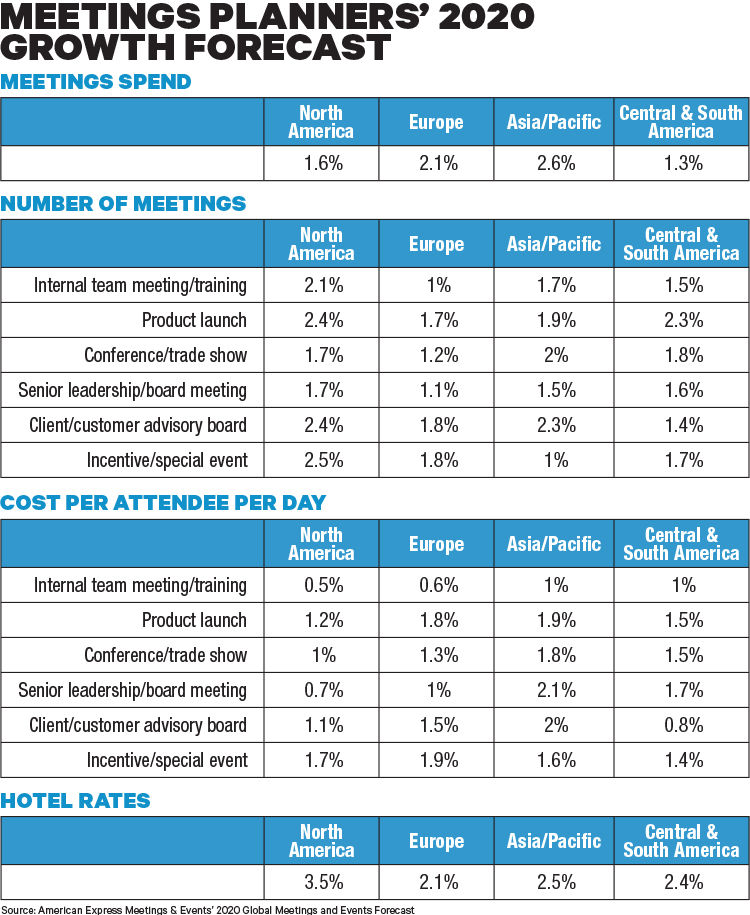
The number of attendees is projected to rise in all regions and for all types of meetings, and days per meeting is expected to tick up nominally. Respondents would prioritize experiential elements over logistics to drive better engagement, and planners are integrating technology in ways that mirror how attendees interact with technology in their daily lives.
Planners expect to see room availability increase by 0.8 to 1.4 percent and available meetings space to increase by 0.8 to 1.9 percent. "Supply and demand is still an issue," said Amex M&E North America VP Yma Sherry. "Planners want to go to the major-tier cities, but because hotel and meeting space availability has not kept up with demand over the last few years, they've been moving to second-tier cities, which are more affordable but also may add to travel time for meeting attendees."
Additionally, hybrid/virtual meetings are on the rise. The share of North America planners who use them in more than 10 percent of their meetings increased from 43 percent last year to 58 percent this year. In Europe, it was an even larger increase, rising from 49 percent to 66 percent.
Meetings policies are becoming more robust as more organizations create strategic meetings management programs or stand-alone policies, but difficulties with compliance remain. "In this age of too much communication and too many emails," Sherry said, "people may not even know that the meeting policy exists, much less what it says."
Globally, safety and security and preferred suppliers are most likely to appear in meetings management policies explicitly. North American respondents are likely to define approval processes, while respondents in Central and South America prioritize policies for social media.
In North America, 73 percent of organizations have formalized their meetings policies, compared with 69 percent in 2018. The percentage of those with an explicitly defined approval process rose from 42 percent to 70 percent. Eighty-two percent have adopted policies that centralize contracting with preferred vendors, compared with 64 percent last year.