As carriers continue to segment their classes of service,
many travel buyers are reviewing premium class air travel policies,
particularly as premium economy cabins emerge, according to a BTN survey of 171
travel buyers.
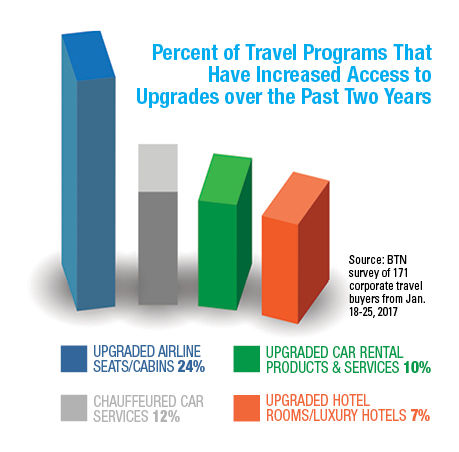
Over the past two years, the travel policies of 24 percent
of travel buyers have allowed more premium class airline products.
Similarly, in last year's BTN Corporate Travel 100 research
on the largest travel spenders, 16 percent loosened their business class
policies while only 12 percent planned to tighten them. It marked the first
time in CT 100 history that more companies planned to loosen such policies
than to tighten them.
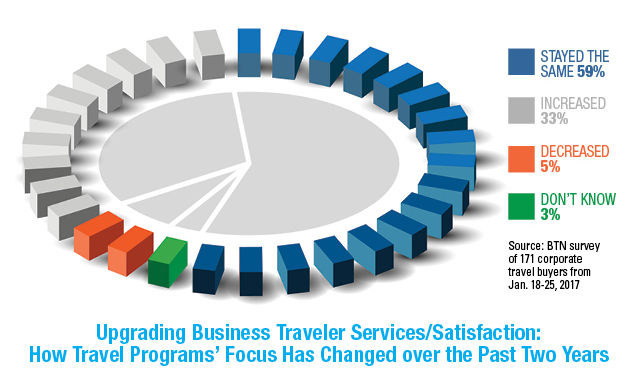
Part of the shift owes to companies upgrading traveler
services and satisfaction. A third of the buyers BTN surveyed had increased
that focus over the past two years; less than 5 percent said it had decreased.
That does not mean budget concerns are out the window,
however. The Association of Corporate Travel Executives surveyed 212 buyers
last summer and found that discounts were still the top priority for a vast
majority. "Upgraded travel products always equal upgraded cost, so we don't
explore it at all," one buyer in BTN's survey said. "The upgrades
that our travelers do earn are because they are already elite status due to
their inherently high travel levels, but I have no interest in increasing
upgraded products to the occasional traveler." With hotels, in fact, more
premium class policies are tightening than loosening.
The AIG effect, which became common parlance after the
insurance firm received an $85 billion federal bailout and then held an event
at a luxury resort, might seem like ancient history, but public perception
still factors into companies' premium travel policies, particularly in certain
industries. One buyer in BTN's survey said their pharmaceutical firm had banned
travelers from using Amtrak's Acela Express service, favoring instead the
cheaper Northeast Regional service. "Given the public furor around the
price of drugs, there is pressure to rein in expenses and there also is a
perception issue," the buyer said. "For example, the public might be
upset by seeing pharma meetings in luxury hotels and resorts or the use of
limos, believing this to be a cause of their high drug costs."
Buyers are exploring creative ways to add premium options
for air travel, beyond simply loosening the purse strings for business class
flights. Premium economy likely will become a bigger disruptor to U.S. travel
policies this year.
The three largest U.S. carriers all have offered seating
with extra legroom at an extra cost for several years, but now they are
beginning to offer premium economy as its own distinct cabin on select flights,
as some European and Asia/Pacific carriers already have done. Late last year,
American Airlines began flying Boeing 787-9 Dreamliners with Premium Economy
cabins on some long-haul international flights, and Alaska Airlines will expand
Premium Class seating on Boeing 737-800s and 737-900s this year. Delta plans to
debut a premium economy cabin on international flights this year, and JetBlue
continues to expand its premium Mint product.
About half the buyers in BTN's survey have altered or plan
to alter their policies based on premium economy offerings. More than a quarter
have made or are making more travelers eligible for premium class travel, while
only 15 percent have bumped down business class-eligible travelers to premium
economy.
Kalviny Man, travel and operations manager for online real
estate company Zillow Group, said his company updated its premium economy
travel policy last year. It had allowed upgrades on international travel but
the majority of Zillow's travel is domestic, so the company decided to
reimburse employees as much as $75 for premium economy seating. The policy came
from a company Zillow had acquired, and it seemed like a good idea to adopt it
companywide, he said. "We wanted to make it easier for those road
warriors, who are doing us a service by traveling," Man said. "We
were seeing it more and more on expense reports, where they had tried to
expense it, so we decided to reimburse everyone up to that dollar amount."
Similarly, premium economy options have allowed FINRA to
move some domestic travelers out of economy seats, said corporate travel
services manager Carol McDowell. For long-haul international travel, the
nonprofit's policy allows travelers to upgrade to the cabin above economy, be
it premium economy or business class. But as with Zillow, most of FINRA's
travel is domestic, she said. As such, on domestic flights of at least five
hours, FINRA travelers now can upgrade seats within the economy cabin.
McDowell
would like to cut that threshold down to three or four hours but needs better
ancillary spending analytics to determine whether it's economically feasible.