Business
travel's share of domestic U.S. trips decreased from 14 percent in 2011 to 11
percent in 2016, according to a U.S. Travel Association analysis of travel data
from public and private sources and survey data collected by TNS
TravelsAmerica.
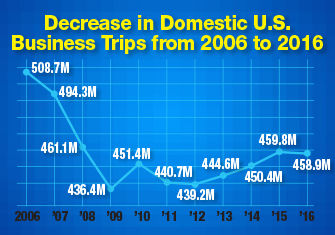 Sources: U.S. Travel Association & U.S. Department of Commerce
The
report defines a trip as any journey in which an individual or members of a
household traveled 50 miles or more from home one way or spent one or more nights
away from home. A business trip is defined as any trip with the primary purpose
of general business, an employee training or seminar, a client or customer
meeting or service, an internal business meeting, sales and marketing, an incentive
or reward, international operations or equipment repair or service, a convention
or tradeshow or a conference or seminar.
Total
domestic trips rose by 27.8 million trips, or 1.3 percent, from 2015 to 2016 to
reach 2.2 billion. However, that growth came entirely from leisure trips, which
grew by 28.6 million trips, or 1.7 percent, to 1.75 billion. Business trips, on
the other hand, fell by 800,000 trips, a 0.2 percent drop, to 459 million.
The
report noted that from 2006 to 2016, the number of domestic business trips
declined by 9.8 percent and business trips' share of total domestic trips fell
18 percent. David Huether, senior vice president of research at the U.S. Travel
Association, cited the sluggish recovery from the Great Recession, the advent
of information technology and higher worker productivity as reasons behind the
fall in business trips' share of domestic trips.
Demographic
& Behavioral Findings
Average general
business trip spending increased by 43 percent from $699 in 2011 to $999 in
2016. Average convention trip spending hit $1,113 in 2016, matching the figure
from five years ago.
The
report found Millennial business travelers were more likely to extend business
trips for leisure compared to other generations. Twenty-three percent of Millennials
took bleisure trip extensions, compared to just 17 percent of business
travelers overall.
Business
travelers also are getting younger. The average age of a business traveler was
42.9 years old in 2016, compared to 46.5 in 2011, and 36 percent of business
travelers were under 35, compared to 22 percent in 2011.
.jpg "Sources: U.S. Travel Association's Travel Forecast Model, U.S. Bureau of Labor Statistics, U.S. Department of Labor, U.S. National Travel & Tourism Office, Bureau of Economic Analysis, U.S. Department of Commerce, Tourism Economics") Sources: U.S. Travel Association's Travel Forecast Model, U.S. Bureau of Labor Statistics, U.S. Department of Labor, U.S. National Travel & Tourism Office, Bureau of Economic Analysis, U.S. Department of Commerce, Tourism Economics
Sources: U.S. Travel Association's Travel Forecast Model, U.S. Bureau of Labor Statistics, U.S. Department of Labor, U.S. National Travel & Tourism Office, Bureau of Economic Analysis, U.S. Department of Commerce, Tourism Economics
Bright Outlook for Business Travel
In a
newly released U.S. Travel Outlook Summary, the U.S. Travel Association's outlook
for business travel from 2017 to 2020 is optimistic. Business travel is expected
to grow faster on a year-over-year basis than leisure travel in 2018 and 2019,
with 2 percent compared with 1.8 percent, respectively, in 2018 and 1.9 percent
compared with 1.8 percent in 2019. In 2020, the forecasted number of domestic U.S.
business trips is 490 million, near its pre-recession level of 494.3 million.
Huether
cited the recently passed U.S. federal tax cut plan as a major reason for the forecasted
turnaround in business travel. The tax cuts will make "U.S. corporations
more globally competitive and encourage business investment," he said. "These
two things will accelerate business travel."