Despite week-over-week occupancy improvements for the past two months, the demand for U.S. hotels is not expected to recover to pre-pandemic levels until 2023, according to a revised forecast from STR and Tourism Economics.
"Compared with our last forecast, we actually improved our [year-over-year] demand projection for 2020 from -45 percent to -36.2 percent, but we expect it to take 11 quarters for the number of room nights sold to rise to the corresponding levels of 2019," said STR SVP of lodging insights Jan Freitag. "Similarly, it will take until 2023 for occupancy to reach the 20-year historical average."
[Report continues below chart.]
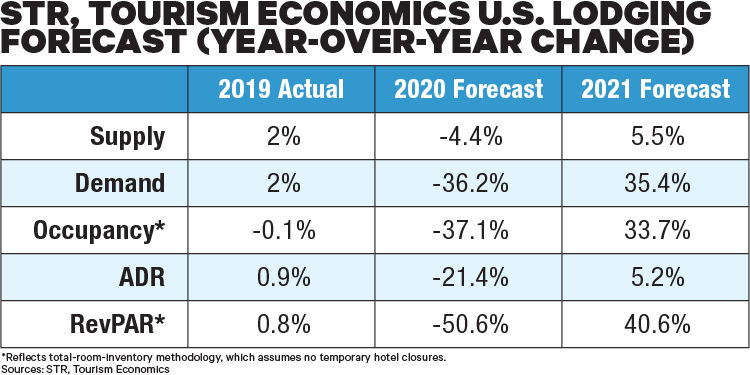
With lower occupancy levels, and the likelihood of hoteliers discounting room rates to compete for market share, "average daily rate could show a slower recovery timeline even with more normalization each quarter," Freitag said, noting that the 2021 ADR projection actually improved to 5.2 percent year-over-year growth from 1.7 percent in the prior forecast. "Despite this better growth rate next year, we do not see ADR recovering to pre-2020 levels in the next five years."
Overall, the outlook for 2020 has improved slightly, while the projected recovery in 2021 likely will be slower than previously anticipated. The previous forecast projected a year-over-year revenue per available room decrease of 57.5 percent for 2020 and growth of 48 percent for 2021. The update shows there to be less of a RevPAR decline in 2020 (down 50.6 percent), but also slower growth in 2021 (40.6 percent).
STR's most recent weekly report, for the week ending June 20, showed the average occupancy level for U.S. hotels up week over week for the tenth consecutive week, to 43.9 percent. Year-over-year weekly ADR declined 31.7 percent, while RevPAR was down 60.3 percent.
RELATED: STR, Tourism Economics Further Downgrade U.S. Hotel Forecast