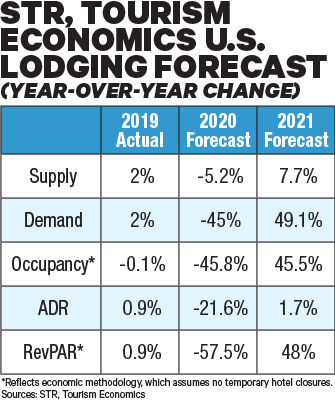
Revenue per available room for the U.S. hotel industry in 2020 is projected to decline 57.5 percent year over year, then increase 48 percent in 2021, according to a revised forecast from STR and Tourism Economics, released Monday. The previous forecast, from late March, anticipated a 2020 RevPAR decline of 50.6 percent and a 2021 increase of 63.1 percent.
The new forecast projects occupancy levels at 35.8 percent for 2020 and 52.1 percent for 2021, compared with 66.1 percent for 2019. Average daily rate is expected to decline 21.6 percent in 2020 to $102.83, from $131.11 in 2019, and is anticipated to increase slightly in 2021 to $104.58.
"Performance levels are dismal from every angle, but at the very least, weekly data through May 9 indicates that the industry has already hit bottom and begun a steady ascent," said STR president Amanda Hite. "The rate of recovery will be slow even as distancing measures are eased and most of the country reopens. Concerns around the safety of travel and leisure activity will dictate how long it takes the industry to regain its footing. Regardless of timing, the leisure segment will be the first out of the gate, especially from drive-to sources."
Tourism Economics president Adam Sacks agreed, adding that business and group travel recovery will lag behind leisure, and "it may take until 2023 to recover to 2019 peak demand levels."
In aggregate, the top 25 markets are expected to perform worse than the rest of the country, with New Orleans with the lowest projected 2020 occupancy at 28 percent, and San Diego the highest at 41.1 percent.
As of May 14, STR's database showed a total of 3,141 temporary U.S. hotel closures, with 1,842 hotels reopened. "Temporary closures came in at a lower number than we anticipated based on information back in March," Hite said. "The properties offline will reduce national supply in several months, but we do not anticipate a significant number of permanent closures."
RELATED: STR, Tourism Economics: 2020 U.S. Hotel RevPAR to Drop 50.6 Percent