Gateway cities in the United States wrapped 2024 with
historically high hotel rates. Going into the first quarter of 2025, several
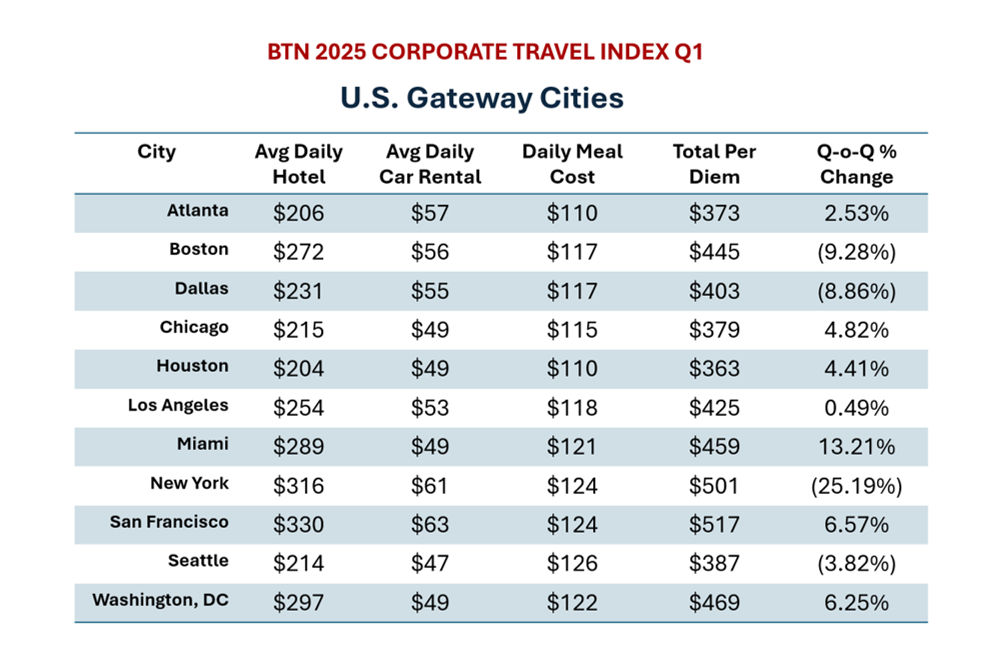
cities have seen those rates moderate, but not all. Looking at BTN’s 11 gateway
cities as a whole in Q1 2025, per diems were slightly down compared to the
prior quarter. Business travelers, however, aren’t traveling to a conglomerate
“average” location, and each city on the index has its own cost profile. Seven
cities saw per diem increases, while four showed declines—some significant.
Here are some highlights, and you can do your own analysis of 200 global cities
with BTN’s
Corporate Travel Index Calculator.
[Editor’s note: Hotel and car data is updated quarterly;
meal data is updated annually]
New York Takes a Break After Hosting Holidays
New York’s precipitous drop from its Q4 per diem countered
several cost increases from other cities. Including New York in the average mix,
per diems for U.S. gateway cities were down by 2.3 percent. If you exclude New
York’s 25 percent drop, however, the average per diem in gateway cities
actually increased 1.4 percent.
Fourth-quarter 2024 hotel occupancy and rate in New York
spiked as early as October and just kept rising through peak holidays in
December. BTN’s Corporate Travel Index data for Q1 2025 corporate hotel
bookings fell by approximately one-third in the city compared to the previous
quarter, according to booking data from BTN partners Advito and Prime Numbers.
Dropping demand—and rates—for car rentals also helped scale down the per diem.
Meal costs, however, were running slightly higher than in 2024, up by about 6
percent in New York.
San Francisco Is Costliest City for Business Travel in Q1
Embattled San Francisco, which has been slow to recover from
the pandemic and in 2024 was beset by continuous hotel labor strikes and vocal
picketing throughout the fourth quarter at Hilton, Hyatt and Marriott
properties, looks to have reset its hotel pricing in Q1. Hilton workers, the
last to come to the table, ratified on Christmas Eve a new hotel contract
brokered by Unite Here Local 2 union, securing wage increases across the life
of the contract, healthcare benefits and workload limitations.
Whether those improved contracts immediately impacted hotel
pricing isn’t clear, but average corporate hotel bookings in the city rose by
nearly 7.5 percent in the first quarter. Meal prices were up by about 4.5
percent. Falling car rental rates took some of the edge off the increases, but
San Francisco surpassed New York in Q1 as the costliest city for business
travel in the United States.
BTN Releases Annual Corporate Travel Index Per Diem Meal Data
 Credit: Generated with AI
Come and get it! BTN's annual study of meal costs in 200 cities around the globe is now available. Prices are on the rise in most cities and while the U.S. dollar started the year strong, recent volatility has weakened its buying power in recent weeks. That's reflected in some international cities where meal costs have increased significantly.
Find the new meal data here: BTN's Corporate Travel Index Calculator.
Snowbirds Spike Miami Per Diems
Annual migration to Miami in the winter months showed a
significant impact on hotel pricing in the city. Add spring breakers to that
mix, and you get a 16-plus percent rise in the average daily hotel rate for
business travelers to the city during the first quarter. Car rental rates were
fairly flat, but a 7 percent rise in meal costs also contributed to the 13
percent rise in daily costs.
Inauguration Pricing Hits D.C., But Then What?
All aspects of business travel in Washington D.C. rose
relatively evenly across the board in Q1 averaging just over 6 percent. But the
picture may be mixed in the city as previous inauguration pricing has commanded
increases of more than twice that percent across first quarter pricing as
crowds convened both prior to and after the inauguration proper. More recent
reports on the city’s hospitality industry point to trouble on the horizon in
the wake of government travel freezes and layoffs of government workers as the
Department of Government Efficiency—or DOGE—has slimmed the ranks of numerous
federal agencies. Across the entire quarter, hotel rates for business travelers
were up just over 6 percent, car rental rates were up 5 percent and meal costs
were up a little over 7 percent. Corporate Travel Index data for Q2 may reveal
a deeper impact of those official actions.