Full-year 2020 global air traffic plummeted 65.9 percent year over year from 2019, the sharpest drop in traffic in aviation history, according to the International Air Transport Association. Full-year global capacity dropped 56.5 percent year over year, and load factor plummeted 17.8 percentage points to 64.8 percent. "Last year was a catastrophe. There is no other way to describe it," said IATA director general and CEO Alexandre de Juniac in a press release.
December's global air traffic was down 69.7 percent year over year, broadly in line with declines in November and October, according to IATA. "What recovery there was over the Northern hemisphere summer season stalled in autumn, and the situation turned dramatically worse over the year-end holiday season, as more severe travel restrictions were imposed in the face of new outbreaks and new strains of Covid-19," said de Juniac.
Full-year crossborder air traffic dropped 75.6 percent year over year, and capacity dropped 68.1 percent. Load factor was 19.2 percentage points down, hitting 62.8 percent.
For 2020, domestic air traffic was down 48.8 percent year over year, and capacity dropped 35.7 percent. Load factor was 66.6 percent, down 17 percentage points.
[Report continues below chart.]
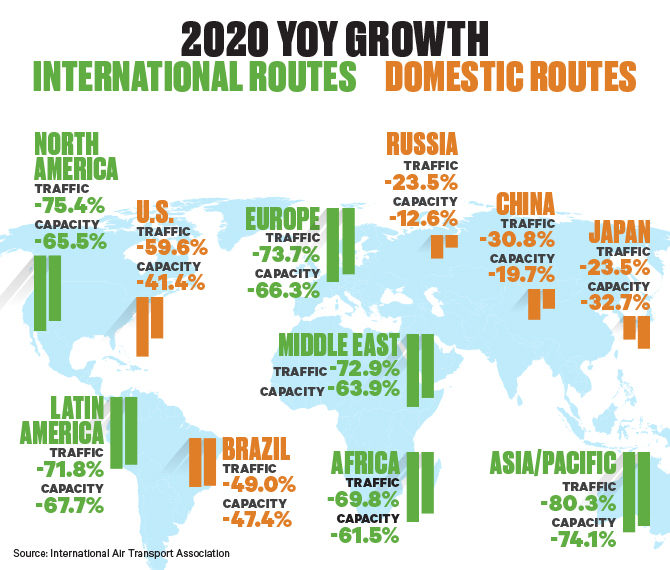
December's crossborder air traffic dropped 85.3 percent year over year. Capacity fell 74.5 percent year over year, and load factor was 47 percent, down 34.7 percentage points. In December, domestic air traffic fell 42.9 percent year over year, and capacity fell 25.7 percent. Load factor fell 19.1 percentage points to 63.7 percent.
A Rough Start to 2021
Air bookings in January for future travel were down 70 percent year over year, which could further pressure airline cash positions and impede the timing of the recovery, according to IATA.
IATA projects global air traffic in 2021 to be 50 percent year over year higher than in 2020, bringing it to 50.6 percent of its 2019 level. However, if more severe travel restrictions are put in place in response to new Covid-19 variants, IATA forecasts 2021 traffic to be only 13 percent higher than in 2020, leaving the industry at 38 percent of its 2019 level.
"Optimism that the arrival and initial distribution of vaccines would lead to a prompt and orderly restoration in global air travel have been dashed in the face of new outbreaks and new mutations of the disease," said de Juniac. "The world is more locked down today than at virtually any point in the past 12 months, and passengers face a bewildering array of rapidly changing and globally uncoordinated travel restrictions. "
Similar to a recent Global Business Travel Association statement, IATA called for a more balanced, collaborative and consistent approach to handling the pandemic while enabling international travel. "We urge governments to work with industry to develop the standards for vaccination, testing and validation that will enable governments to have confidence that borders can reopen and international air travel can resume once the virus threat has been neutralized," de Juniac said.
Amid the continued sluggish recovery, de Juniac also reiterated the need for "continued financial support from governments" for the airline industry in order to remain viable."