To hear some travel managers and industry consultants tell
it, corporate travel data isn't merely insufficient. It's flat-out useless.
Perhaps there is too much data. It might be trite or wrong. Basically, it doesn't
help solve problems.
Yet, Business Travel
News found a mixed view in a survey of nearly 300 respondents identifying
themselves as travel managers or buyers. In some categories, as many as one in
six travel buyers said they were not at all satisfied with the data they
receive and use for policy creation and negotiations. But most seem to think it's
good enough.
Why this disconnect between buyers who provide anecdotes at
events and a broader sample of the industry? It's tempting to think that it
depends on the size of the travel management program, a criterion often
conflated with the program's sophistication. However, BTN's poll shows that the size of the travel budget is more closely
correlated with the types of data services firms seek, or can afford, than it
is with their satisfaction.
A more likely explanation seems to be that some travel
management departments want to do more with the data than others. "More"
could mean all manner of new and different analyses, challenging travel
management companies and providers of data management services to bring the
data to life in a more consultative and flexible way.
"The conversation needs to change to, 'What are you
trying to do with your program?' " US Foods corporate travel meetings and
expense manager Jennifer Steinke said last September at The Beat Live
conference in Las Vegas. "We need to look at how we reward good behavior
and good decisions that our travelers are making. How do we highlight good
things that are happening within the program? How do we show the value of a
managed travel program?"
Steinke joined other buyers on a panel discussion in which
they all criticized the typical reporting they get from TMCs. TMC executives
tend to say they're doing the best they can, but the data coming out of various
back offices is difficult to consolidate.
"The challenge with data is not showing you where you
spent your money—that's easy," according to Protravel COO Tony Shepherd,
also speaking at The Beat Live. "The challenge is showing you why you
spent the money the way you did. There are so many subjective reasons that go
into why a traveler selected a specific flight or specific hotel or manages the
itinerary the way they do. It's important for TMCs to try to get inside your
mind a little bit and understand clearly what you are trying to do with the data
we give you."
Many agree that a big part of the solution is to look for
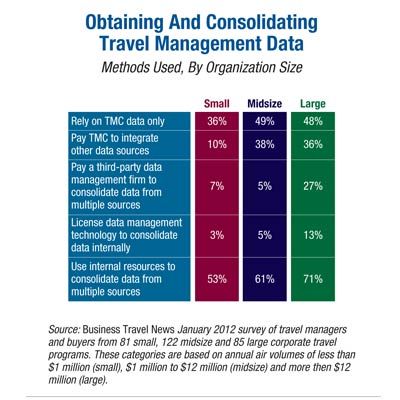
data beyond the TMC. Upwards of half of the buyers responding to BTN's poll indicated they rely only on
TMC data, but in doing so they cannot compare what was booked against what was
purchased—a major hole in assessing program effectiveness. The survey showed
that most buyers, including those at about three-quarters of represented large
companies, do not use a third-party firm to consolidate data from multiple
sources, such as from credit cards and expense systems. Generally they try to
do this consolidation themselves.
 Third-party data management service providers in recent
years have sought to help TMCs and travel buyers simplify and tool up with
modular displays, mini-apps or utilities and tablet-based dashboards—but what's
new at data management firms goes well beyond the interface. Two of the largest
providers, Cornerstone Information Systems and TRX, recently launched efforts
to take the analysis of data to another level.
Third-party data management service providers in recent
years have sought to help TMCs and travel buyers simplify and tool up with
modular displays, mini-apps or utilities and tablet-based dashboards—but what's
new at data management firms goes well beyond the interface. Two of the largest
providers, Cornerstone Information Systems and TRX, recently launched efforts
to take the analysis of data to another level.
Automating The Manual
This year will mark the six-year anniversary of TRX's
acquisitions of data consolidator Hi-Mark Software and data analyzer Travel
Analytics. With TRX's exit from the call center business largely behind it, and
the recent sale of its online booking solution, the company is focused on a
smaller set of services including its data management offering.
After asserting a more substantive role in TRX by buying a
large chunk of its shares in 2010, executive vice president Kevin Austin,
previously president of Hi-Mark, last year led the integration of services from
Travel Analytics with the Traveltrax (formerly Hi-Mark) automation, starting
with hotel data. He said air is next up, this quarter. The goal is to bring
efficiency to data consulting services and make them more affordable for
smaller programs. The reorientation also has transformed how TRX sells its data
solutions.
"As a software developer I was always like, 'Look at
what it can do—isn't it cool?' " Austin said during a January interview. "One
thing I learned from [former Hi-Mark sales exec] Tim Fahy, who is now with ITA
Software, is that we should be less about the features and more about solving
problems, asking buyers, 'What are your problems?' instead of selling data or
reports or so-called back office reporting, GDS pre-trip reporting, credit card
reporting or expense reporting. Companies don't have a 'back-office reporting'
problem. What they do have is a finance and audit need, or a program management
need, a negotiation need, a duty of care need or a sustainability need.
Regardless of scale, the same needs are at every company."
TRX now markets to clients discrete data and services
packages targeting certain problems, say online booking leakage or lack of
hotel compliance. Fees are based on transaction volume.
"Traditionally the typical way of solving this problem
is a labor/time-and-materials consulting-type approach," Austin said. "But
now six-plus weeks worth of consultant billing and engagement to process data
and prepare everything can be generated in about 10 minutes on our platform. A
lot of companies have their own experts, but they need the data."
TRX is hoping this combination of automation and consulting,
resulting in a lower price point, will appeal to a wider swath of the market—perhaps
thousands rather than hundreds of data services accounts. "Once we answer
basic questions, clients often want to consider deeper questions which require
a lot of knowledge and understanding of them and their business," said
Austin. "That's where we see expanding the Travel Analytics-style
consulting that was more focused on air and hotel sourcing into other areas."
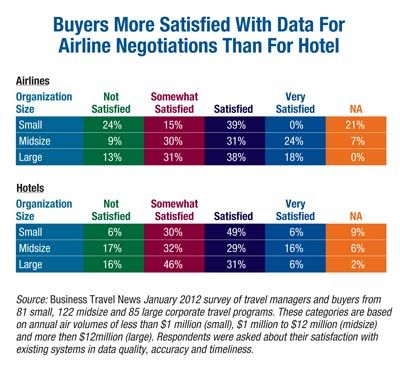
Data consolidation experts generally agreed that the most
holes are outside of air travel. For midsize and larger buyers, at least, BTN's poll found satisfaction with hotel
data was weaker than with airline data.
"The industry has a real issue in reporting hotels and
cars," said CrossFire Systems Inc. president Richard Law. Clients often
want to know "where an overnight stay was required but no hotel was booked
[but] it's an issue of data quality and completeness. Or if I book air and
hotel, and then later change the hotel, there's generally no way to get that
change into the reporting process because the only way is through an invoice."
The Good, Bad And
Fixable
In announcing last summer a suite of data analytics and
scoring tools, Cornerstone Information System tailored its first direct
corporate travel product offering for larger firms that use multiple travel
management companies. Although some buyers even have trouble with global data
quality from a single TMC, the use of multiple TMCs is a commonly cited cause
of bad data. "Say you use Amex, but book in Brazil," said Cornerstone
senior vice president of marketing Alan Minton. Amex's Brazilian partner "Flytour
puts data in different places."
The C3 product is "on schedule," according to
Minton. "We signed two significant corporate clients by the end of 2011
and are on schedule to bring on three more in the first quarter of 2012."
Supporting the notion that some buyers don't trust the data
itself, Minton noted that Cornerstone's Data Confidence Index, which analyzes
the good and bad of data, has been the most popular element of C3. "There
is still significant dissatisfaction from corporations with the quality of data
they receive," he said.
The DCI "measures 51 unique data points and organizes
them into four categories to give you an extremely accurate picture of your
data quality at the source level, and it provides you with an objective plan to
make corrections to improve the data," according to Minton. "We apply
[Ruesink Consulting Group founder] Tom Ruesink's scoring methodology to these
metrics and produce a single score for a trip, similar to producing a credit
score or a [baseball] pitcher's earned run average. This way you can compare
trips, travelers, costs centers, etc., on an apples-to-apples basis related to
your travel policy and objectives."
Cornerstone also plans to offer a consulting service that
helps clients determine what program fixes to make based on the results.
This report
originally appeared in the Feb. 6, 2012, edition of Business Travel News.