The closer we get to the present moment, the less “perspective”
I feel confident in giving from a proverbial 32,000-foot view. As an industry,
we still experience the reverberations of the pandemic and we still catch one another
referring to “before the pandemic” and “after the pandemic” as this tectonic
shift in history. Which, of course, it was—especially in travel.
The business travel industry was in a state of cautious and often
erratic recovery in 2021. I believe BTN wrote more stories in 2021 than in any other single year in the outlet's existence. We remained digital-only until July 2021, and temporarily returned to print until 2023.
Businesses wanted to run fast and BTN coverage followed them. But as an industry we
couldn’t outrun the realities of Covid-19 variants that would rise in waves and
take confidence out of the travel recovery, and BTN covered the contours of every wave. There were moments when both
leisure and business travel saw the glimmer of demand recovery on horizon and pushed
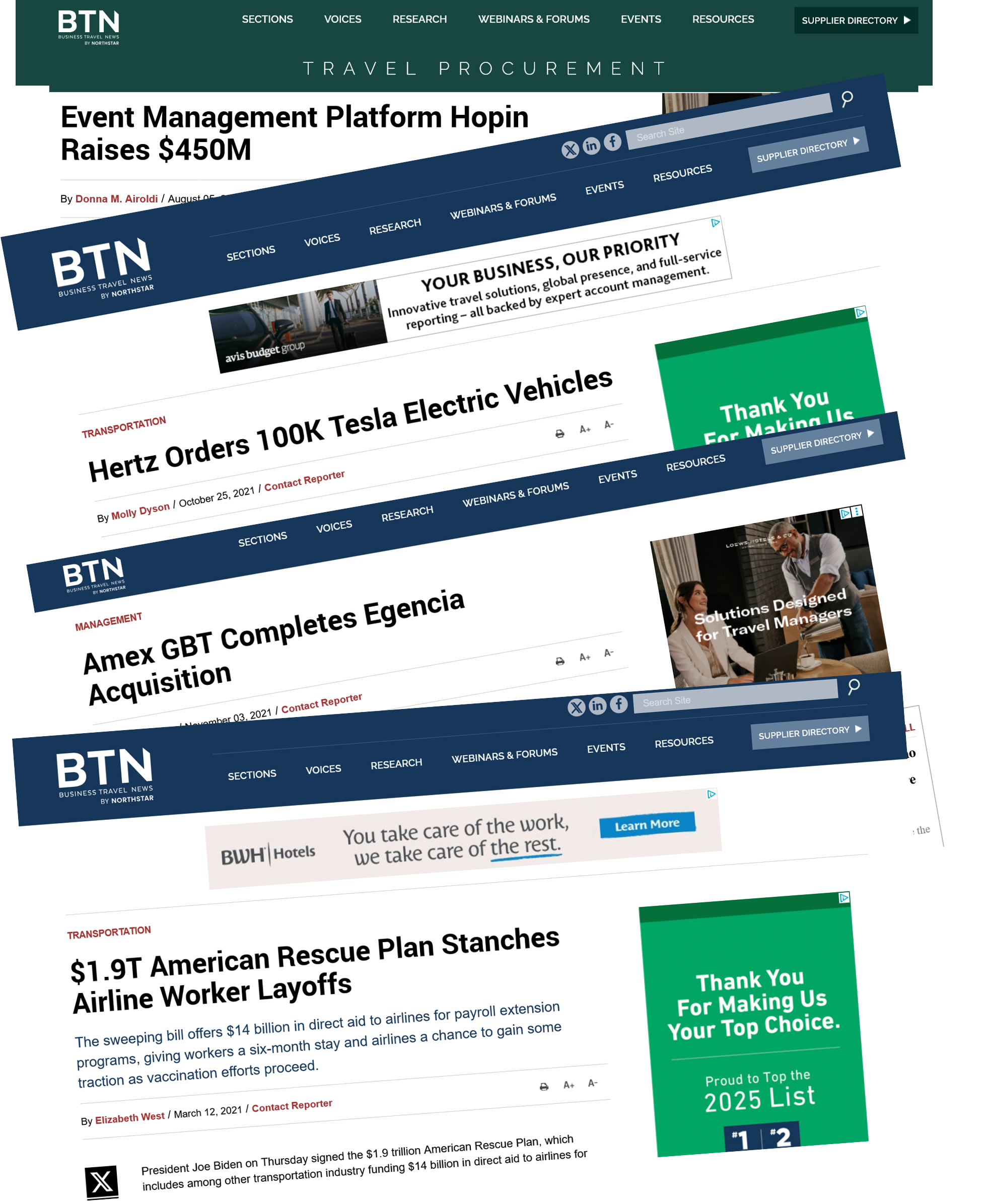
hard toward those opportunities. The long lists of archived articles below reflect the tireless efforts of BTN's editors, and it's only one-tenth of what we produced that year.
Domestic travel experienced a surge in demand in the first
quarter. But remember, international travel was in lockdown. There was very
little travel across oceans unless passengers were willing to quarantine for at
least two weeks in their destination markets before being released to their
final locations. Reducing and removing those quarantines was among the highest
priorities to get the travel industry back in motion.
Trend 1: The Health & Safety Imperative
2021’s headlines reflect widespread efforts and adoption of
new technologies and policies designed to rebuild traveler confidence. Vaccination
was chief among them. Vaccines had rolled out in late 2020 and during the first
quarter of 2021 U.S. and European citizens were being urged to get in line for
their “jabs.” Sometimes vaccinations were mandated: Companies were requiring
workers to be vaccinated in order to return to their offices and other places
of employment—many required vaccination in order to travel, even domestically.
Airlines and hoteliers, certainly, began to mandate vaccination. Delta and
United went so far as to enforce penalties (up to and including layoffs) for
those who refused. Hotel companies were requiring vaccinations for workers as
well.
Hygiene protocols continued into 2021. Covid testing kits
and services were being offered as both requirements and assurances in order to
get travelers back on the road. In some cases, these new requirements created
strategic partnership opportunities and even brought together interesting
technology combinations, particularly as international markets began to open up
with a dizzying variation of entry, testing and documentation requirements. Some
countries retained quarantine requirements well into 2021, even after vaccines
and testing were well in place.
Contactless processes became a strategic imperative for many
suppliers. Hotels in particular were looking to develop mobile check-in and
check-out procedures, and the pandemic provided the ultimate justification for
mobile room keys. But even car rental and other service providers were hyping
no-contact processes.
Q1 Selected BTN Articles
Trend 2: Strategic Response to Recovery
As travel began to restart, companies and suppliers made
strategic moves to position themselves for a new market. Many travel suppliers
found themselves dealing with the beginnings of a worker shortage. Careers in
travel were on a rollercoaster in 2021—with airlines, in particular,
furloughing and laying off workers and offering early retirement. Much of the
ups and downs in travel employment coincided with whether suppliers would get
government subsidies to keep people employed. The Fed, under a new Biden Administration
since January, re-upped industry support a couple of times with the $1.9
trillion American Rescue Plan in March and again with Biden’s Infrastructure
Bill that pushed investment toward transportation.
Still, the business travel industry was on tenterhooks in
2021. There was an active merger and acquisition environment, especially in the
TMC space—with plenty of bargains on the market. American Express Global
Business Travel acquired Ovation Travel early in the year and then
announced in the summer that it would also acquire Egencia away from its
Expedia owner. TravelPerk purchased NexTravel and Click Travel and Frosch acquired Valerie Wilson Travel in the first of a
string of acquisitions.
Airline and global distribution partnerships began to change
in 2021 as well. The promise of New Distribution Capability was in the air, and
a number of airlines wanted to come out of the pandemic with a better retailing
and loyalty strategy than they had going into it. Sabre, Travelport and Amadeus all signed agreements with numerous airlines that included
NDC content parameters. That also spread to the idea of continuous pricing,
though it was still an exception for business travel. Southwest bucked
the trend in 2021 and went full tilt into the GDS, including with Sabre which
had been its one holdout in the previous year.
Another strategic shift happened in 2021 and that was the
realignment of business offerings to serve small and midsize companies. Hilton,
Marriott, TripActions and others in 2021 began to see a clear trend of SME
companies returning to transient business travel at greater speed and with move
robust volumes than their large-market counterparts. Amex GBT brought
its SME-focused spend tool to the U.S. and Corporate Traveler rolled out
its SME-focused booking platform Melon. Amex GBT bought Egencia to go after the small and mid-market segment, to be sure.
The business traveler was not lost in the mix of this strategy. Both airlines and hotels showed keen awareness of their loyalty programs and the long-standing business travelers among their memberships. United, Delta and American each extended loyalty status to cover those members as they hoped to return to travel in 2021. First, they added bonuses or adjusted the qualification requirements. With the return to travel getting bumpier throughout the year, airlines extended status to some of their most coveted loyalty members even into January 2023. Hotels, too, saw the wisdom of retaining loyal business travelers: Many hotel companies had been quick to the draw on this front in 2020, but in 2021 Hilton extended its expiration for loyalty points from 15 months from previous activity to 24 months and made that change permanent. Accor launched a new loyalty program in 2021.
Q2 Selected BTN Articles
Trend 3: Meetings & Events Come on Strong
A strange thing happened in the Covid-19 recovery that no one
going into the downturn would have expected: Meetings and event travel emerged
faster from the travel hiatus than did transient business travel. Even as
gatherings were strictly limited, the time spend away from co-workers and clients
created voids in collaboration despite the speed and robustness of the digital
platforms that improved quickly and dramatically to keep people connected in
the pandemic. That need for in-person events ran deep, and even as early as the
first quarter of 2021 hotels reported strong growth trajectories for business
groups even if they were smaller and more localized.
The concept of hybrid events
flourished, seeking to bring smaller groups together in person while allowing a
diaspora of attendees to participate in an online format. Marriott, Hilton,
and Accor introduced new hybrid meeting solutions. Virtual platforms like Hopin saw massive funding rounds and major players like Cvent quickly
diversified their offerings to meet the moment. Still, in-person meetings were
subject to health and safety protocols. Many chose to hold events outdoors to
avoid indoor mask mandates, but those that demanded indoor accommodations
executed social distancing and masking protocols—and largely required
participants to show proof of vaccination.
The market for meetings and
events eventually heated so far that bookings into 2022 started to create
market compression in certain cities, especially as some hotels had temporarily
closed and as worker shortages challenged the market to get back to scratch to
serve both transient and group business. Still, the reality was patchy. Covid
variants posed an existential threat to in-person events. The Global Business
Travel Association was forced to postpone both its U.S. and European
conferences in 2021, though both eventually took place.
Q3 Selected BTN Articles
Trend 4: Sustainability Becomes a Core Priority?
With travel in hiatus, many companies and travel managers launched
their most fervid efforts ever around sustainability. The regulatory market in
Europe was forming new requirements around emissions reporting—including those
specifically for business travel. And even in the U.S. there was a cultural movement
toward carbon reduction as the Biden administration put U.S. efforts back into
the Paris Accord and invested in numerous green initiatives including electric
vehicles and the charging grids that would support their sustained adoption and
function.
In the travel space, environmental responsibility
transformed from a "nice-to-have" to a "must-have" for many
travel programs and for many suppliers. Headlines reveal a strong focus on
sustainable aviation fuels, carbon offsetting, and a new emphasis on
sustainability in hotel procurement.
Airlines like United,
American, Lufthansa and JetBlue made significant investments in SAF
and formed alliances with corporate customers to fund its development and
purchase. Southwest rolled out a SAF program for its corporate clients;
United began its funding program for sustainable innovation in 2021.
Hotel sourcing processes began
to integrate environmental considerations—at least as checkboxes in the request
for proposal. Headlines about Amex GBT and Cvent adding CSR
questions to RFPs and Marriott and Accor participating in the
HRS Green Stay Initiative showed movement toward this cause. Some companies
dove deep into sustainable travel initiatives, but it was easy given the lack
of travel at the time.
Since 2021 and 2022, carbon
emissions for travel have naturally increased for many companies now that travel
is back on the calendar, even as they have doubled down on carbon emissions
control. The European market has proved more committed to sustainable travel
efforts, though even that market has stepped back from its most aggressive
regulatory requirements—at least temporarily. The U.S. market with its
political whiplash has changed course dramatically. While corporate strategies
may still include sustainability, many fewer are leading with that fact.
Q4 Selected BTN Articles