The global economic downturn precipitated by the banking and
subprime mortgage fiascos in 2008 hit business travel very hard in 2009. Not
only economically, but also from a regulatory standpoint with the Troubled Asset
Relief Program bailouts and that program’s requirements for financial
disclosure for companies that touched business travel—in particular, meetings
and incentives—thanks in large part to the media frenzy around an expensive AIG
program at the St. Regis Monarch in California that took place after the insurance
company took bailout money from the government. The backlash became widely known
inside and outside the industry as the “AIG Effect.” It pushed the Obama
administration to task the Treasury with defining what should be “luxury
expenditures” for TARP companies, and such moves combined with the flailing economy
developed into a low point for meetings hotels and resorts.
Meetings Miasma
Companies—TARP recipients or not—downsized or scrapped meetings,
events and incentives to avoid public scrutiny. Often, they were willing to
endure massive cancellation penalties rather than suffer public ire.
High-profile cancellations have included Primerica
Financial Services' 55,000 delegate event in Atlanta in June, a State Farm
Insurance agent convention set to bring 17,000 people to Las Vegas in October
and more than 160 AIG conferences and events that reportedly were to cost $8
million, but were axed as part of AIG's agreement with New York's attorney
general. Wells Fargo CEO John Stumpf took out full-page ads in major newspapers
to report that he reluctantly canceled employee recognition events for the rest
of the year. "Who loses beside our team members? The workers who depend on
our business," the ad stated. One of its canceled meetings was in Las
Vegas, where more than 30,000 hotel room nights booked for meetings and
conventions have been canceled at a loss of more than $20 million to its
economy this year, according to city officials.
The damage sustained by the meetings and incentives industry
drove associations and new coalition Meetings Mean Business to defend the value
of their existence by defining the benefits of meetings and incentives not only
to the businesses to host them but to the local and overall U.S. economy.
Scrutiny on meetings expenditures was just one element of
the economic downturn and scrutiny on corporate travel activities, but it was
high profile. One positive for corporate folks was the emphasis it put on
strategic meetings management to track meetings spend integrate meetings
management tools back into finance. You’ll see Siemens getting on top of that
in 2009. NBTA rolled out an SMM certification program and the drive to manage
meetings accelerated tremendously in 2009 into 2010.
Corporate Travel Craters
In survey after industry survey, buyers said their companies
were cutting back on travel because revenues were down, full stop. Trip
pre-approval was huge, and easy to pass muster with executives.
Cisco System’s Telepresence had a big moment, with Marriott
and Starwood installing the platforms in special Telepresence rooms in hotels
in gateway cities around the globe. Forty-five percent of travel managers
surveyed by Business Travel News said their companies were requiring remote
conferencing strategies in lieu of some portion of travel.
The result of the cratering corporate travel on airlines was
stark. Of course, the drop in leisure travel also contributed, but U.S.
airlines had their worst performance to-date across several metrics (remember,
we haven’t met Covid-19 yet). Total passenger revenue fell 18 percent in 2009
versus 2008. That exceeded the 14 percent decline in 2001 after the 9/11 terror
attacks iced aviation.
But airlines had a new revenue strategy. Remember a couple of blogs back,
the word “unbundled” was first uttered by Spirit Airlines. Well, all the
airlines were on board with this idea by 2009—with American Airlines perhaps
the most bullish about it and few airlines ever looked back after tasting the
approximately $13.5 billion in ancillary revenue they gained (collectively) in
2009. In 2023, that number sat somewhere around $54 billion. These numbers come
from different sources and include different U.S. airlines so look at them as
estimates… but still. We all know ancillary revenue changed the industry for
good, and in 2009 that trend was just getting started.
What also started in 2009 as a result of ancillary revenue
streams and the resulting merchandizing strategies were new battlegrounds for
distribution contracts. Here’s an excerpt from a Travel Procurement article
from 2009, penned by executive editor David Jonas (note: BTN wouldn’t acquire
Travel Procurement and The Beat for two more years, so this article is a bit of
a cheat to include in BTN’s history if you want to be technical, but we’re not
going to get so technical today that we overlook a great explainer opportunity):
Though most current distribution agreements between
airlines and global distribution systems won't expire for at least two years,
recent developments and industry commentary point to how the next set of deals
may be negotiated and structured. American Airlines, for example, expects that
the technological capabilities of GDSs—and their willingness to collaborate
with third-party technology providers—on optional services, ancillary revenues
and other airline merchandizing strategies will play a central role.
Increasingly popular among airlines, those strategies
include a la carte pricing, branded "fare families;" unbundling of
such services as baggage handling, seat selection, inflight meals and priority
check-in; and add-ons from hotels and others.
"The past couple rounds of GDS negotiations have
really been around economics," said AA managing director of distribution
and merchandizing Suzanne Rubin in an interview last week with The Beat.
"This time, it will be much more about the ability to deliver products and
services in a way that generates the kind of customer interaction and revenue
streams that we are able to get through our other channels. The rules of
engagement are changing."
By the end of 2009, payment companies were working on ways
to parse out ancillary airline spend on corporate cards and provide detailed
reporting. Whether corporate travel buyers would ever be able to negotiate
those ancillaries was emerging as a big question—and one that we are still
working on today even with New Distribution Capabilities.
ACTE-NBTA Merger Drama
With so many travel suppliers and travel agencies hemorrhaging
revenues, the pressure to support two industry associations became a hardship. To
ensure the existence of a strong association, the supplier community made it
know that it was looking to support a single entity and the two associations—one
solidly configured for the U.S. (NBTA) and the other with a more international
structure and member base (ACTE)—should talk about a merger before it became
untenable for one or the other to survive.
Discussions began in earnest in April, led by president Doug
Weeks and treasury secretary Mary Ellen George at ACTE and Kevin Maguire and
Scott Solombrino on the NBTA side. A handful of board members contributed to a
preliminary integration plan that would retain the ACTE name in some way for
two years, establish an International Leadership Council via ACTE’s network and
structure and replace the executive director position with a new leader.
The plan did not pass the two-thirds required votes from the
ACTE board of directors, scuttling the tie up in June. However, after the
resignation of both Weeks and George, ACTE reactivated AirPlus’s Richard Crum
as president. Crum re-grouped the merger concept and by early August had
presented a new plan to NBTA for consideration. The fact that ACTE presented
the proposal to NBTA along with a press release announcing it didn’t sit well
with the NBTA team. The latter organization iced any prospect of a deal,
claiming ACTE refused to participate in a due diligence process. But even as
late as December 2010, when BCD Travel exec Chris Crowley was identified as the
incoming ACTE president, talk of a merger was still at hand.
The two organizations never merged. ACTE ceased operations
in 2020, at the height of the Covid-19 epidemic. GBTA (the current iteration of
NBTA) bought the ACTE brand and some assets in a $35,000
transaction.
_______________________________________________________________________

_______________________________________________________________________
JANUARY
U.S.
Department of Treasury infuses American Express with $3.39 billion of new
capital as part of the $700 billion financial bailout program. The government
on Dec. 23 approved American Express' participation in the Troubled Asset
Relief Program Capital Purchase Program.
Without a successful round of fare increases since July
2008, U.S.
airlines kept the most deeply discounted leisure tickets out of business
travelers’ hands through Saturday-night stay and other restrictions. The
average one-way leisure fare the week of Jan. 12, 2009 was $99; the average
business fare the same week was $531.
MasterCard
acquires Orbiscom for “one-time-use” card capabilties. Today, we would call
them virtual cards. Royal Bank of Scottland was the first user of the platform
in 2008.
Buyers and consultants report success in staving
off increases in domestic hotel rates, as hoteliers faced a “bleak demand
outlook of indeterminate length.”
Trend toward heavier TMC data and reporting comes with
rising costs; with travel transaction volume down, TMCs look to ancillary
revenue stream to stanch losses. TMC execs said there was no “across the board”
effort to raise data costs.
U.S. Transportation Security Administration preps passenger
pre-screening Secure Flight program for takeoff—eight years after the 9/11
terror attacks, which initiated the study to implement stronger protections.
February
The U.S.-EU Open Skies agreement's capacity gains are being
undone by a slow demand environment. Transatlantic airlines lower capacity,
especially in premium class travel, which suggests weakening pricing power
and gives buyers more negotiating leverage.
Due to economic pressures and shifting buyer goals, many TMCs are revising their technology product development
plans, reallocating resources, and some are even holding R&D budgets flat.
For the first time in the company’s history, Southwest Airlines seeks to cut its annual capacity. The carrier is looking at a full-year
reduction of 4 percent in available seat miles for 2009.
The U.S. hotel industry is reducing capital expenditures to their lowest levels in years, but
analysts believe travelers will not experience severe amenity cuts.
The extended-stay hotel segment, previously dominated by
smaller brands, faces new competition. In December 2008, Holiday Inn
set up its first Staybridge Suites property, while Hilton announced
its plans for Hilton Residential Suites a few weeks later.
March
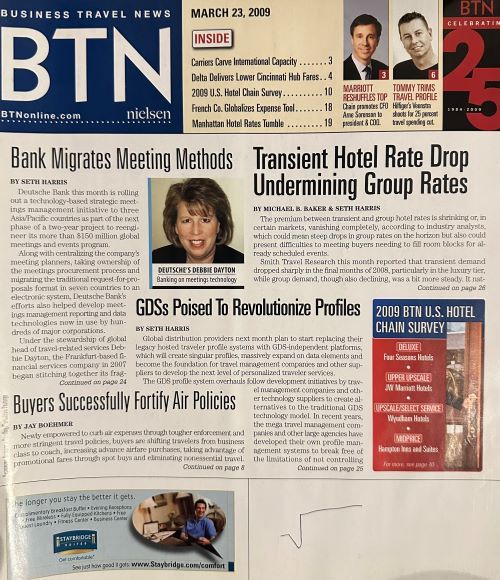
Industry analysts think that the gap between transient and
group hotel rates is narrowing, or in select markets fully
disappearing. This could lead to significant drops in group rates but could
also create issues for buyers trying to fill room blocks for upcoming events.
Amid economic struggles, travel buyers enforce stricter policies to curb air expenses. Their solutions
include moving travelers to coach, increasingly purchasing tickets in advance,
applying promotional fares, and getting rid of nonessential travel.
Next month, global distribution providers aim to
replace their legacy hosted traveler profile systems with GDS-independent
platforms. This will create singular profiles, massively expand on data elements, and
offer more personalized traveler services.
Marriott International promotes its CFO Arne Sorenson to president and COO.
April
Travel buyers are having a tough time assuaging the
cost of checked-baggage fees in negotiations with their preferred
carriers. More of them want to include that in their 2009 corporate contract
discussions.
Some hotels have adjusted their corporate rates according to the shrinking market. Analysts
continue to predict a buyer’s market, with hotels expected to see their biggest
price drops in decades.
Huge travel volume declines have affected travel program back-end revenue streams like corporate card rebates, hotel
commissions, and VAT reclaim.
Interest in sustainable travel management allegedly didn't falter
despite economic lows and rising focus on budgeting.
The International Air Transport Association changes
its projected 2009 global airline losses from $2.5 billion to an almost
doubled $4.7 billion.
Concur introduces a mobile version of its travel and expense management tools,
enabling travelers to manage itineraries and expense reports with a BlackBerry or
Windows Mobile phone.
May
Global distribution systems and travel agencies rush to
comply with new U.S. TSA requirements under the Secure Flight program. Through which, airlines would
request passenger data like their full name, date of birth, and gender.
There are growing industry concerns that antitrust-immune alliances will impact buyer leverage for
negotiating transatlantic deals and force companies into alliance agreements.
Airlines and technology providers plan to soon test new technology that would let airlines generate
expenditure reports and settlements for ancillary and unbundled purchases.
GetThere's recent move to bundle its demand
management application suite and assess a per-user profile fee on top of
transaction fees has been criticized by some buyers, as OBTs move further away from the direct transaction
model, creating opportunity for higher online booking service costs. Other
OBTs have established pricing structures that may protect them from
depending on the travel transaction.
British Airways has gone back to offering incentives to British TMCs on transatlantic routes. The
carrier paused incentives in 1999 after being fined €6.8 million by the
European Commission for what it ruled as abuse of a dominant position in
its home market.
The National Business Travel Association’s lobbying
efforts focus on industry issues like travel guidelines for companies
getting funds under the Troubled Asset Relief Program and travel in the
time of swine flu.
Recent airline traffic reports displayed signs of improvement.
Executives noted stabilization in revenue and demand declines, but the
corporate travel segment remained weak. Buyers do not express
much willingness to modify their budgets or policies.
Chinese tourism and travel terms soften, allowing
foreign TMCs to own more than 51% of a Chinese agency and open
local branches. Reduced entry capital requirements make it easier for
foreigners to get international ticketing licenses, though they remain mostly
restricted from owning domestic ticketing licenses.
BCD Travel gets a $50 million cash infusion from its
parent BCD Holdings. Principal owner John Fentener van Vlissingen said a small portion of it
went to a major stake in the third-largest Singaporean TMC and more
Asia/Pacific investment is expected. Most of the funds went to the business’
debt relief. Despite the harsh economy, BCD remains steadfast in its
acquisitions and long-term growth.
JUNE
The NBTA board of directors on June 18 voted unanimously to continue to pursue
the merger discussions with ACTE after
an initial effort failed to pass the OK of the associations’ respective boards.
After the merger rejection, however, president
Doug Weeks and treasurer-elect Mary Ellen George resigned.
American Express Business Travel and Maritz Travel announced
plans to
pool people, customers, technology and resources for a strategic alliance MaXvantage
to provide end-to-end strategic meetings management services to support meeting,
event and incentive travel portfolio.
U.S. Department of Transportation sends a troubling signal
to the airline industry by delaying
final approval of antitrust immunity for Star Alliance members United
Airlines, Lufthansa, Air Canada and incoming member Continental Airlines.
Additional concern is fueled by a House approval of a bill that would allow the
Transportation Secretary to sunset ATI for partnering carriers.
JULY
Special 25th Anniversary Issue
AUGUST
Siemens
deployed in the United States an end-to-end meetings management platform to
integrate meetings payment with automated planning and booking processes to consolidate
meetings spending data and gain visibility into actual meeting costs.
The Department
of Transportation approval of Star Alliance carriers—fortified by a joint
venture with United, Air Canada and Lufthansa—finally came on July 10, more
than a month past deadline, and with some caveats stemming from Justice
Department opposition, signaling a new temperament in Washington toward such
deals.
A BTN survey of 196 corporate travel buyers found that six
in 10 respondents had cut travel costs through boosting remote conferencing use
in the past 12 months. Forty-five percent were requiring use of remote
conferencing in lieu of travel in some cases. Starwood and Marriott each launch
Cisco Telepresence.
Hilton
Hotels director of global travel management Craig Banikowski succeeds
University of Texas Athletics travel buyer Kevin Maguire as NBTA president and
CEO.
ACTE
reverses its stance on a merger with NBTA and re-opens a shaky negotiations
led by ACTE president Richard Crum. The new proposal crafted by ACTE was communicated
to NBTA along with a press release. GBTA ultimately rejects the proposal and
the merger wholesale, reversing its own initiative to continue to pursue the merger.
NBTA claimed that ACTE refused a due diligence process.
Buyers approach the negotiation table for 2010 largely amenable
to dynamic pricing deals given the economic conditions and rock-bottom
hotel rates that have driven multiple rate-renegotiations in 2009 to keep corporate
rates in line with the market.
Expense management technology supplier Concur
announced it acquired European competitor Paris-based Etap-On-Line, provider
of the Ulysse Travel & Expense Tool, doubling its European operations.
SEPTEMBER
NBTA names Mike
McCormick executive director; Craig Banikowski was elected president and
CEO. Outgoing president Kevin Maguire iced ACTE’s revitalized merger proposal,
suggesting the smaller firm refused a due diligence process.
Global
distribution system providers “finally deploying new desktops;” Amadeus
Americas and Travelport begin testing new agent point-of-sale desktop tools
that feature graphical interfaces instead of green screen. Meanwhile Farelogix
was poised to release its first multi-source agent desktop.
After four years without a specialized meetings fare discount,
Delta
Air Lines launched a renewed Delta Meeting Network based on the (acquired) Northwest
Airlines’ meetings product.
NBTA
announces it will launch a Strategic Meetings Management certification developed
by SAIC’s Lee Ann Adams Mikeman, Xerox’s Tracey Wilt, KK Strategic Solutions’
Kari Knoll Kessler (Wendell) and PWC’s Debi Scholar.
OCTOBER
Business
travel industry tries to define business trip ROI. The National Business
Travel Association and the U.S. Travel Association recently released studies
that measure the return on investment of business travel and indicate how
business travel spending can impact revenue generation.
With hoteliers more flexible in negotiations during a
buyer's market,
travel buyers find success with alternatives to the standard negotiation
strategy, including reverse auctions, block space programs, capped dynamic
pricing and consortia negotiations.
Travel
management companies HRG and BCD Travel find success with advanced hotel rate
auditing tools; at the same time, the audits are turning up savings with consumer
rates in a depressed economic climate, complicating automated audits.
Sen.
Barbara Boxer (D-Calif) and Sen. Olympia Snow (R. Maine) inch an airline
passenger bill of rights closer to reality, with several once-opposed travel
industry groups now in favor of the bill. Even airlines appear to be softening
stances on tarmac time limits.
Percentage
of companies with pretrip approval requirements passed thoroughly into the
majority by the end of 2009, underscoring the level of scrutiny corporates
continued to place on business trips in this challenging year.
NOVEMBER
BCD
Travel executive Chris Crowley takes accepts role as president-elect at ACTE,
succeeding the interim president Richard Crum who stepped in after Doug Weeks
departed role in June in wake of failed merger talks with NBTA. ACTE executive
director Susan Gurley resigned.
Google’s
Michael Tangney outlined at the Europe ACTE conference the company’s policy-light
travel program. It became a beacon for companies to “trust their employees”
in stark contrast to the current cost restriction and approval-heavy travel
environment. The program would be referenced for years in companies looking to
reduce policing of travelers.
DOT, as it did with Star Alliance members, misses
its statutory deadline to approve antitrust immunity status for Oneworld
members American Airlines, British Airways and Iberia. Airlines, however,
remained confident they would gain the same rights as Star and Skyteam.
DECEMBER
Payment systems AirPlus International and MasterCard
Worldwide develop a solution that would enable
travel buyers to report ancillary airline charges, but it won’t debut for nearly
a year.
Meanwhile, American Express said it is pursuing an ancillary fee-reporting
solution with a large U.S. carrier.
DOT
issued "precedent-setting" fines against Continental Airlines, Mesaba
Airlines and ExpressJet totaling $175,000 for their involvement in an
August delay that left 47 passengers stranded in an aircraft overnight on a
runway in Rochester, Minn. The fines represent the first time DOT has penalized
a carrier for its role in subjecting passengers to extended tarmac delays.
Expense managers tighten policies in response to the
economy, including more thorough audits and stricter requirements for receipt
submission, according to Business
Travel News' 2009 Expense Manager Survey.
Timeline produced this week by AI and BTN editorial content and engagement manager Gianna Song
_______________________________________________________________________

Elizabeth West is the editorial director of the
BTN Group. She has reported on the business travel and meetings industries for
24 years. Beth was editor-in-chief of Meeting News from 2006 to 2008 and
director of content solutions for ProMedia Travel from 2008 to 2011, when
ProMedia was acquired by Northstar Travel Media and merged with BTN. She became
editor-in-chief of BTN in 2015 and editorial director of the BTN Group in
2019.
_______________________________________________________________________