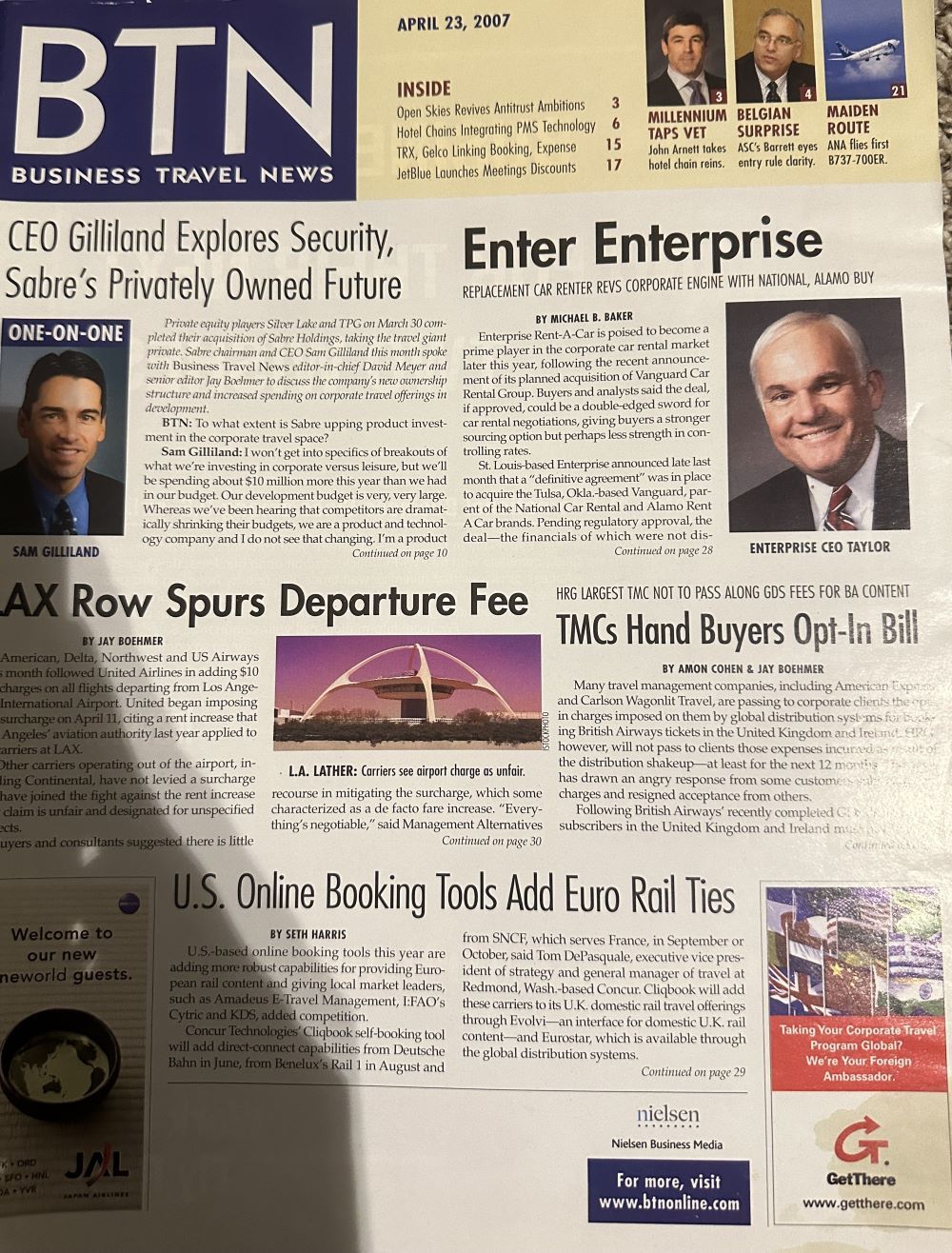
As usual, there’s a lot going on in travel in 2007. Travelport
announced its acquisition of Galileo in December 2006 but spend the first half
of the following year defending the merger against European regulators. Delta
emerged from bankruptcy early in the year, after fending off a hostile takeover
bid from US Airways (The former would merge with Northwest in 2008).
Airlines, even with rising financial fortunes, were looking for ways to increase revenue. I don't know whose Big Idea it was first, but Spirit in March 2007 said the magic word that would change airline tickets forever: unbundling. Air Canada, Ryan Air and Spirit Airlines were all on the unbundling wagon as early as 2007. It looks like Southwest may have considered it, but never pulled the trigger. It would be a year or two before legacy carriers would robustly follow suit. GDSs began in 2007 to try to figure out how to deal with the carriers' new merchandising models.
There’s
so much more activity in 2007, particularly with big travel mergers and acquisitions.
The Blackstone Group bought Hilton Hotels Corp. in a deal
valued at $26 billion. Enterprise—until then primarily an off-airport,
insurance-driven replacement car rental provider—shifted hard into corporate
travel and on-airport locations with a surprise acquisition of Vanguard Car
Rental, the parent company of both National and Alamo. Avis took a 45 percent stake in black car provider Carey International.
In managed travel, specifically, Concur continued to
consolidate its position in 2007. After acquiring Outtask in 2006 largely for
its booking tool Cliqbook, Concur rolled out an integrated booking-and-expense platform,
which was adopted by the likes of Adelman Travel Group, Advantage Travel
Management, Balboa Travel Management, Casto and Directravel and others by mid-2007.
Concur also acquired a declining competitor, Gelco, midyear—taking yet another expense
provider out of the picture.
Management Technology in the Limelight
Command and control was in the air in 2007—it was a trend
that had been building for several years, since the passing of the
Sarbanes-Oxley Act in 2002 that put strict guardrails around public companies
to document finance and accounting processes and corporate expenditures, including
travel and meetings, in the wake of the Enron accounting scandal in 2001.
A BCD Travel report from August 2007 showed that among its
own clients 44 percent of travel managers were reporting into procurement. That
was a 33 percent rise year-over-year in travel managers within that line of
command. The impact from that shift was apparent in evolving travel management
priorities in 2007: gain control over costs, document contracting processes
with multiple bids, drive compliance to travel policies and gain visibility
into travel activities.
As a result, the promise of end-to-end management of travel
shopping (with contracted preferred suppliers), travel booking (gaining visibility
into what is chosen and why) and all driving toward accurate expense reports that
demonstrated cost control was a kind of holy grail that had been pursued as
early as 1998, with the rollout of online booking. It had a resurrection of
interest in 2003, with a handful of large corporates internally integrating disparate
tools. In 2007, however, end-to-end travel management was gaining a different meaning—and
tech providers were showing turnkey solutions.
“What I'm trying to get across in expanding the Ariba spend
management philosophy to travel and expense [is] really expanding the
definition of end to end,” said Charles Brossman, at the time the travel and expense solution line manager at Ariba
(acquired by SAP in 2012). “We feel the definition of end to end should be
everything involved from purchasing to reimbursement, including reimbursement
of suppliers" and auditing, read a July BTN report from demos shown at the
National Business Travel Association summer convention.
Ariba wasn’t the only one doing demos at NBTA. A spate of partnerships
in 2007 promised better integrations and more meaningful
results. Ariba was punching out to KDS for its first travel integration.
Hotshot newcomer Rearden Commerce, which had gotten a big
investment from American Express Corporate Travel in 2006, announced the
creation of an Open Expense Network. The company promised an "ecosystem of
leading expense management vendors, including CyberShift, ExpenseWire, Gelco,
Databasics and Expensewatch.com." They all came with discounts.
DataBasics announced plans to integrate with TRX Resx. It had
an existing integration with nuTravel. "We think the value will come from
the reporting," said Databasics director of sales Chris Harley. Gelco
announced integration with Rearden as well as Travelocity Business (it would be
acquired by Concur before it could deliver on either).
Concur Smart Expense
One player went for the full platform, not with a
partnership, thanks to its previous acquisitions.
Concur at the July NBTA convention offered a glimpse of its
Smart Expense integration. It included booking, electronic receipts, credit
card charges and expense reporting. The company expected to deliver the
integrated application in October. Then-Concur president Rajeev Singh said end-to-end
is called the "Holy Grail, but that implies that it can't be found."
It's already here, he said.
Beyond traveler convenience and speed of reconciliation,
Singh said, the integration of "three sources of data [booking, payment,
expense] that can't be tampered with" would streamline and automate expense
report auditing. "Over 70 percent of your transactions are now fully
trusted, within policy and fully verified," he added.
While those may have been outsized promises at the time, the
vision was effective. Concur hit CNN’s 100 Fastest Growing Companies for the
first time in 2007 at No. 80. (NutriSystem was No. 1—thanks, Marie Osmond!—omg.)
In 2008, Concur would rise to No. 54 on the list, with more than 7,000
customers.
Today, Concur claims 48,000 customers and is owned by SAP
(acquired in 2014 for $8.3 billion). Concur co-founder Steve Singh, however, is
back in the managed travel business, as part of an investor group that acquired
Direct Travel and as an investor in and chairman for several new entrant tech
players.
Don’t Discount the Meetings Angle!
While I haven’t covered meetings management very much in
this archive series, 2007 was a critical year for it—as procurement teams were
looking to control meetings costs and processes in similar fashion to how they
were managing travel.
OnVantage and Starcite had merged in 2006 and a number of
players—including Sabre with DirectMeetings—were rolling out small meetings
technologies that catered to the corporate meetings and events sector. Starcite
launched EasyBook. A little firm called Worktopia threw up a market signal with
a big vision for small meetings and a $5 million funding raise. While these
tools likely made it easier to manage attendees and allow them to register—and possibly
book their travel, some of the platforms required the meeting to be pre-contracted.
Worktopia was an exception, but the tech also wasn’t fully baked. So the
options for meetings management weren’t exactly an all-in-one play, but the
pieces were coming into view.
There was one platform revving up its engines again in 2007
after nearly going bankrupt in the dot.com bust of 2002. Cvent launched the
Cvent Supplier Network in 2007, adding the supplier distribution angle to its
attendee management tools.
Cvent’s early struggles have been well documented, but the
company was laying a foundation in 2007 that would grow into a public company
in 2013, go private again with Vista Equity in 2016, go public again in 2021
and return to private ownership with Blackstone as the lead investor in 2023 in
a $4.6 billion deal.
Throughout that journey, meetings management platforms
actively acquired and merged with one another—often at the hands of one
powerful investor group. Starcite would be acquired by Active Network in 2012. The
following year, both Active Network and Lanyon were acquired by Vista Equity
and merged under the Lanyon name in 2014. Vista Equity’s acquisition of Cvent
in 2016 brought all the meetings tech together under the Cvent name to produce
the meetings management giant we know today.
That's all future tense in 2007, but the foundations were going into place. For now, take a look at
BTN’s 2007 timeline to get additional details about managed travel dynamics
that year.
_______________________________________________________________________
This article used edited excerpts from a number of
2007 BTN staff reporters and contributors, mainly Mary Ann McNulty and Corrie Dosh. Thanks for being great reporters, women!
_______________________________________________________________________

January
US Airways increases its bid for Delta Air Lines, while AirTran ups its offer for Midwest Air Group. The list of possible airline merger candidates continues to grow.
Despite uncertain pricing benefits and carriers’ antitrust issues, major alliances OneWorld, SkyTeam, and Star Alliance have signed a growing number of corporate contracts.
TravelPort CEO Jeff Clarke sits down with BTN to discuss December 2006’s agreement to buy privately held Worldspan for $1.4 billion and blend tech infrastructures and sales teams.
The U.S. Department of Transportation grants United Airlines the authority to add nonstop service between Washington, D.C., and Beijing, after several major domestic airlines launched bids in late 2006 for the only available U.S.-China slot.
Ovation Travel is first American TMC to help buyers offset their travel-generated carbon emissions. It partners with Carbonfund.org for these efforts.
Delta secures $2.5 billion in exit financing to emerge as a stand-alone carrier. US Airways remains unsure about merging with Delta while it is under bankruptcy protection.
February
Free Internet access, already a standard offering in major U.S. midprice brands, makes its way into upscale hotels. At this point, only Omni, Radisson and Kimpton have adopted that standard brand-wide, but a few individual upscale properties have also followed suit.
2007 looks to be favorable for the industry adoption of meetings technology, due to a convergence of new market entrants and tech enhancements. Suppliers work on products that facilitate online booking for small, ad hoc corporate meetings.
British Airways, with its distribution deals about to expire, said renegotiated agreements could lead to booking surcharges for corporate clients. Many travel managers pay close attention to BA's renegotiations, which they believe will spark changes to European corporate travel distribution.
March
After a Valentine's Day storm that caused flight delays and cancellations for over 100,000 customers, JetBlueAirways issues what it calls its Customer Bill of Rights and shares contingency plans for similar cases in the future. Other carriers are expected to offer similarly upgraded policies.
British Airways' contracts with global distribution system providers end without service interruption or the airline immediately pursuing a totally new course. The Business Travel Coalition, the U.K. and Ireland's Institute of Travel Management and U.K.'s Guild of Travel Management Companies urge BA to consider its customers when coming to new GDS terms.
The latest data from PricewaterhouseCoopers shows an increased willingness by travel managers to trade down in price point within their hotel program in high-volume cities, hoteliers and analysts said. To others, the data suggests that firms are gaining better control over existing programs.
The Queensland state government in Australia takes the delivery of HRG Online, a fully integrated online booking and expense management tool created in-house by HRG. Paul Saggar, the TMC’s director of technology product development, expects it to be offered to U.S. clients by no later than Q3 of 2007. Other global TMCs (American Express, BCD Travel and Carlson Wagonlit Travel) said they have no intention to launch anything similar.
Increasing fleet costs and uncertainties in the U.S. car manufacturing industry reignite merger speculations between Dollar Thrifty Automotive Group and Vanguard Car Rental Group.
The U.K.'s Department for Transport approves roughly $200,000 to fund Project Icarus, an effort of the U.K. & Ireland's Institute of Travel Management to help organizations make their travel programs more sustainable. February’s Business Travel Show in London had no shortage of suppliers, buyers, and exhibitors presenting their latest green credentials.
Air Canada starts to sell unlimited-travel passes between the U.S. and Canada for a flat monthly fee. Spirit Airlines says that it will unbundle fares in June 2007, allowing passengers to add or remove services like checked baggage or inflight beverages typically part of airfares.
April
European Union transportation officials approve an Open Skies agreement set to liberalize transatlantic air travel.
JetBlue examines a more flexible stance toward corporate discounts, refundable tickets and preferred seating for high-yield and last-minute bookers. This follows its move in 2006 to relist in all the major global distribution systems.
Starwood Capital, Starwood Hotels, InterContinental and Fairmont have plans to construct green hotels or modify their current ones to meet eco-friendly standards.
Carlson Wagonlit Travel president and CEO Hubert Joly talks to BTN about demand, service, savings, security, and a new management information tool.
TMCs like American Express Business Travel and CWT are passing to corporate clients the opt-in fees imposed on them by global distribution systems for booking British Airways tickets in the U.K. and Ireland. HRG does not intend to pass those fees to clients.
Enterprise Rent-A-Car acquires Vanguard Car Rental Group, parent company of National Car Rental and Alamo Rent A Car.
Gelco Expense Management partners to integrate data from TRX's ResX online booking tool, available to clients in late 2007.
May
Carriers become more receptive to domestic corporate discounts. Many airlines and analysts expect domestic airline demand to soften in the coming year. The anticipated descent results in bigger discounts for travel buyers, though airlines continue to publish aggressive fare hikes.
Delta officially exits over 19 months of bankruptcy court protection. Under the restructuring, it centralizes its corporate sales team, pushes global expansion and initiates reinvestment efforts.
Communications providers and airlines gear up to offer wireless inflight Internet and other onboard connectivity services within the next year.
Southwest Airlines signs a 10-year distribution contract with Galileo, offering its published fares and inventory—excluding exclusive Web fares—to the GDS’ subscribers.
Hyatt introduces three new brands: Hyatt Place, Hyatt Summerfield Suites, and Andaz. The company is also placing more focus on international expansion.
TRX presents new metrics and practices for business travel professionals to calculate and offset the carbon emissions from air travel.
Airline Reporting Corp'sCorporate Travel Department accreditation, slows to a trickle; yet those involved with the program don't see the CTD structure going away.
A seller's market and a shortage of available meeting space result in ancillary fees for meetings that prove hard to negotiate out of contracts. Buyers are also being charged extra fees for the meeting room rental.
June
The BTN archive is missing the June 2007 issue.
July
The Blackstone Group is set to buy Hilton Hotels Corporation. The deal foreshadows more ownership changes in the hotel industry and offers Hilton further expansion opportunities, according to industry analysts.
Southwest plans to temper capacity growth in 2007 and 2008, to increase profits amid a slowing U.S. economy.
The U.S. and European Union’s new contract that enables airlines to transmit European passenger name record information gets harsh criticism from the official European data protection supervisor. The deal allowed the U.S. to access fewer fields of PNR data than did a previously denied agreement, but to keep it for a longer stretch of time.
The transatlantic battle intensifies as extra capacity and frequency from Eos, Maxjet and Silverjet—the all-business-class airlines serving the New York-London route—have grown to significant proportions to affect corporate pricing and market share.
Global distribution systems upgrade hotel offerings, like greater participation from hoteliers worldwide, better rate parity, higher-quality content for business travelers and enhanced tech to ease rate-loading.
Amadeus and Worldspan align with BookingBuilder Technologies, which supplements GDS content with Web-only fares, in separate partnerships to offer preferred pricing to subscribers and tighter integration between systems. Meanwhile, Southwest and BookingBuilder plan to have a connection between the carrier's Swabiz booking portal and online corporate booking tools in August 2007. These collaborations occur amid a feud between Sabre and some software developers, which started this year when Sabre began charging the likes of BookingBuilder to tap into its system. Sabre has also cut off BookingBuilder's GDS access and released a similar offering called NetCheck.
Travel industry organizations say that the European Commission is trying to make its own revision of its code of conduct governing GDSs. They claim the Commission's Directorate-General for Transport and Energy is preparing to redefine what constitutes airline ownership of a GDS. In effect, Amadeus would no longer be considered to have any parent carriers.
Amadeus, Galileo, Sabre and Worldspan work to enable airfare unbundling and other travel merchandising options. Airlines like Air Canada, Ryanair and Spirit Airlines have introduced such pricing models, diverting from total airfare fees for services like checked baggage, assigned seating and frequent flyer points—but those carriers have offered those pricing options solely via their websites.
Virgin America prepares to fly as the U.S. Department of Transportation has greenlit its application to start selling tickets. Its inaugural flight is slated for August 8, 2007.
August
The Transportation Security Administration plans to test the newest version of its Secure Flight passenger-prescreening program in the fall of 2007. Through it, the government instead of carriers would check passenger data against their watchlists to strengthen air travel security. TSA hopes to finish the domestic portion of the program in the first year after approval, and the international one in the next year.
Concur announces its pending purchase of Gelco Expense Management. Some professionals in the industry fret about the pricing impact of consolidation in expense platforms.
At the National Business Travel Association International Convention & Exposition in July 2007, buyer direct members named director of travel for the Expedition Development Co. Kevin Maguire the association’s president for the next two years.
Fuel surcharge price-fixing judgments against British Airways and Korean Air become part of a larger ongoing U.S. Department of Justice inquiry into airline antitrust activities. Several class-action lawsuits followed and were consolidated.
BCD Travel pursues a super passenger name record platform that will allow it to create its own aggregation point for data and travel distribution content. HRG also plans to develop similar capabilities later in 2007. While architecturally distinct from the American Express TravelBahn DS and Carlson Wagonlit Travel's Symphonie, the two new platforms will have some of the same functionality.
September
Starwood Hotels & Resorts Worldwide appoints Coors Brewing Co.’s Frits van Paasschen as its new CEO.
American Express Business Travel says that in January, it will start a broad implementation to provide clients with e-folio data from Starwood, the biggest remaining multi-brand U.S. hotelier that had yet to sign such an agreement with a corporate card supplier.
After completing the sale of Red Roof Inn, Accor focuses on its Motel 6 brand development. The hotel company strives to open over 200 Motel 6 properties in the U.S. and Canada by 2010.
October
President George W. Bush has Transportation Secretary Mary Peters working with the aviation industry to develop air congestion solutions by the end of the year.
Regulators tentatively approve carriers to add 16 more U.S.-China routes and 107 weekly frequencies through 2009, almost doubling the current 109 to 216. Travel buyers praised the U.S. Department of Transportation and China's Civil Aviation Administration for the route awards, as corporate demand from the U.S. to China stays strong.
Eurostar plans to negotiate for European rail services with U.S.-based travel buyers, while the newly launched Railteam alliance of several national rail lines creates common reservation and booking systems, and intends to provide more inventory to GDSs, align schedules for cross-border travel and slash travel times. Buyers expect larger discounts.
U.S. businesses are increasingly implementing sourcing practices for travel management and relying less on supplier relationships, while also balancing service levels.
Travel buyers negotiating for 2008 hotel rates face a heavy cost to last-room availability in key markets, while hotels are getting more questions on their environmental policies.
Air France and Delta sign a transatlantic joint venture set in two phases starting next April and to be completed by 2010. The carriers expect to share a common bottom line for transatlantic operations, align transatlantic sales strategies and expand routes.
Dealing with more complex hotel negotiations and an extensive request-for-proposals process, some buyers try negotiating off-season rates or enacting multiyear agreements with hotels.
Best Western president and CEO David Kong gives updates on the hotel chain's drive to reclaim corporate marketshare, its Asia expansion, corporate interest in the midprice tier, and the new Best Western hotel prototype.
November
Avis Budget Group acquires 45% of chauffeured transportation supplier Carey International for about $60 million in cash. Carey made around $250 million in revenue in 2006.
Southwest continues to court corporate travel buyers by modifying its fare structure. It also introduces a new frequent flyer program, boarding process, further GDS participation and more corporate discounting.
December
BCD Travel hires former World Travel BTI president Danny Hood as BCD president of the Americas.John Snyder becomes global president and COO. Louise Miller becomes EVP global business solutions, sales and marketing.
Wal-Mart is first company to settle non-U.S. airline transactions (in Mexico and Canada) through a U.S. point of sale, overcoming logistical issues with the support of American Airlines, ARC, Sabre and Universal Air Travel Plan. Wal-Mart thus consolidates all North American transactions with its major network carrier into one settlement data stream.
Wyndham Hotel Group actively promotes the brand to compete with the likes of Marriott, Hilton, and Starwood in the corporate travel market and reports increased buyer interest.
A rising number of travel buyers have updated their 2008 budgets to account for worsening economic conditions, including the home mortgage crisis, volatile trading markets and the weakening U.S. dollar. Some have adopted new measures to reduce their 2008 travel expenses.
AirTran becomes the first carrier to display seat maps via Sabre's Extensible Markup Language interface. It plans to have additional booking options through the GDS in early 2008.
Amadeus migrates the 75,000 hotels on its GDS onto a new platform to improve search capabilities and enable a new user interface with a best available rate and global commission mechanisms.
American Express Business Travel wants to bring Asia-Pacific into its global plan to offer standard processes and service through new service centers, development of profile tools and implementing a quality-of-service scorecard system now used for agents in North America and Europe. It is also working on solutions within an integrated end-to-end technology service environment, and forecasts a record year in new business sales in 2008. The company recently launched a 160-seat service center in India, and aims to open more in the region.
Timeline produced this week by AI and BTN editorial content and engagement manager Gianna Song
_______________________________________________________________________

Elizabeth West is the editorial director of the
BTN Group. She has reported on the business travel and meetings industries for
24 years. Beth was editor-in-chief of Meeting News from 2006 to 2008 and
director of content solutions for ProMedia Travel from 2008 to 2011, when
ProMedia was acquired by Northstar Travel Media and merged with BTN. She became
editor-in-chief of BTN in 2015 and editorial director of the BTN Group in
2019.
_______________________________________________________________________