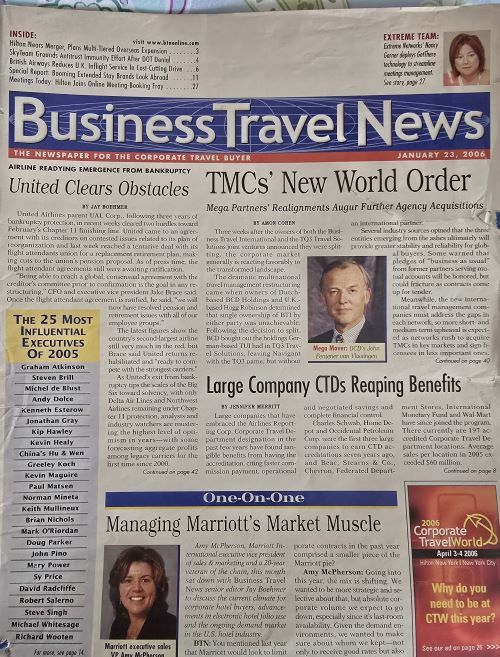
2006 saw massive upheaval in global TMC realignment. The
consolidation resulted in what has largely been the shape of the mega-TMC
environment we have known since then—with one major getting bought out since. In
2025, however, as the industry waits with much uncertainty for the regulatory
outcome of the proposed tie-up between American Express Global Business Travel
and CWT, the dramatic recombinations across the 2006 TMC environment are timely
as a study of a changing marketplace.
The stage for TMC consolidation was set in 2004, when CWT
acquired the corporate travel business of Maritz, but did not take on its
international partner TQ3 Travel Solutions. As a result, TQ3 shifted its
alliance to Denver-based Navigant, then the second-largest TMC in the United
States and, like No. 1 Amex, a publicly traded company.
Financial woes, however, quickly became clear for Navigant,
driven by lagging technology solutions. Leading TMCs were shifting significant
percentages of online bookings through agent-free “touchless” environments,
while Navigant in an earnings call in late 2004 revealed it had only 2 percent
to 3 percent of transactions going through a touchless environment. In July 2005,
the company was de-listed from the Nasdaq exchange, due to lack of proper
financial filings, and ceased trading on August 6. The company was reinstated
in January 2006.
But there was blood in the water, along with an appetite for
change brewing within TQ3 parent company TUI and across the European joint
venture partners—Netherlands-based BCD Holdings and UK-based Hogg Robinson
Group—that had been jointly managing a disparate set of agencies known as BTI
Partners, the largest of which was operating in the United States as BTI
WorldWide and owned by BCD Holdings.
By 2005, HRG and BCD Holdings had developed different ideas
about how the TMC market was developing and where a strategic path forward for
the joint venture should lead. The breakup came on Jan. 3, 2006; the companies
announced they would no longer move forward as a joint venture.
BCD Holdings, which also owned BTI partners the Netherlands, Belgium and a
handful of Latin American countries, bought out TQ3 parent company TUI, which
owned 50 percent of the TQ3 brand, managed TQ3 at the global level and also
owned TQ3 partners in about 20 countries. Another 20 TUI-owned agencies in
mainly leisure destinations were TQ3 licensees transfered their allegiance to
BCD's new network. BCD also bought a 20 percent stake in British travel
management company The Travel Company, which eventually led to a full merger.
The new entity, by the close of all the transactions in March, became known as
BCD Travel.
Hogg Robinson, which was BTI's managing partner, continued with the BTI name in
20 countries where it owned or controlled the BTI partner. Hogg Robinson also
owned Sea Gate Travel Group in the United States, but was not allowed to use
the BTI name in the region. It maintained licensees in around 70 countries as BTI
partners. Hogg eventually dropped the BTI name worldwide to become Hogg
Robinson Group. (HRG would be acquired by American Express Global Business
Travel in 2018 for about $530 million).
Navigant International, for its part, assumed what remains of its licensee
network in roughly 50 countries. It ploughed forward with the TQ3 name still a
part of its brand, but without the platform itself, “largely due to the public
nature of the company,” according to executives at the time. While it had a
strong position in the U.S., Navigant had only smaller offices in the United
Kingdom, Germany, France, Brazil, Australia, New Zealand and Canada. The plan,
according to CEO Ed Adams at the time, was to acquire agencies in key global markets,
but ultimately that did not come fruition for the company.
Instead, Navigant may already already have been in talks
with CWT, which announced in April it would acquire the Denver-based TMC for
$510 million. That means the second largest travel agency in the world (since
its Maritz acquisition) would purchase the third largest agency. At the same
time, CWT announced it would buy out Accor’s stake in the agency in an effort
to control its destiny. It did so with the help of private equity firm One Equity
Partners, resulting in a majority stake for Carlson at 55 percent and 45
percent for the PR firm.
The CWT deals had significant implications for the global
travel management market, which became clearly more consolidated than at any point
business travel history. The global realignment resulted in four leading
players, all of them wholly or majority-owned: American Express, Carlson
Wagonlit, BCD Travel and HRG. A potential fifth force in the form of wholly
owned Australia-based FCm Travel Solutions was emerging in Asia-Pacific, as the
market was ripe for global programs that were neither headquartered in the
United States nor Europe.
In the U.S., however, where HRG was a small player despite sizeable interests
in almost all other key markets, CWT’s Navigant acquisition meant greater
polarization than ever between the big three—American Express, Carlson and BCD
Travel—and the rest of the field.
Distribution Deals Cost Corporates
In the midst of the TMC upheaval, major changes in
distribution cost dynamics were roiling the industry in 2006. Sabre led the way
with what it called an “opt-in” Efficient Access program that would ensure TMCs
received full airline content for the next 5 to 7 years, but their GDS
incentives—long (and still) a major revenue source for TMCs—would be reduced by
80 cents per segment.
The change was a trickle down effect from the ongoing distribution
battle between airlines and distribution systems. As airlines looked to balance
their books after years of internal economic woes and external market share
pressure from low-cost carriers, they were reaching for distribution levers
again in an attempt to increase margins by pushing corporates to lower cost
channels. They began leveraging access to “full content” by tying it to
discounted distribution fees. Some airlines, however, also put an agency penalty
on the other side of the equation. Bookings through GDSs that didn’t
participate in such contract terms, would incur a $3.50 fee from the airline,
ensuring that agencies contracted with such “non-preferred” channels would
consider shifting their business elsewhere.
As Sabre CEO Sam Gilliland put it, at the time: “As part of
those agreements with those airlines, we have agreed to provide discounts on
their booking fees and in return those airlines have agreed to provide certain
benefits and protections to travel agencies that participate in our Efficient
Access Solution program."
Amadeus, which had not agreed to such contract terms, sued
American Airlines and Northwest for discriminating against its agency partners.
By the end of August, however, U.S. courts had ruled against the GDS in the
suit with American. Amadeus then halted its suit with Northwest, absorbing the $3.50
fee for bookings on these airlines until it would eventually come to content
terms with both.
CWT was the first to shift the fee onto corporate customers,
rolling out a $2 GDS fee in August. It certainly was not the last. Indeed, TMCs
up and down line from large global TMCs to major regionals were forced to levy
flat fees or renegotiate fees with their corporate clients. Some, like Travel
& Transport, chose to break out the fee as a separate line item. Others,
like Gant Travel, chose to unbundle other services to spread the cost across
its overall service menu.
American Express seemed to be the only agency exempt from
the fee. And that was because it operated a direct connect option called TravelBahn,
established as early as 2002, which bypassed the GDS and was attracting more
airlines to its system during this time. It’s not clear to me what happened to TravelBahn
or, in the end, how effective it was. If anyone knows, I’d love to get a note
about it ([email protected]).
CWT had a direct connect option via its Symphonie platform, but it’s quick move
to the $2 fee may have signaled the level of participation there.
BCD Travel moved quickly in 2006 to get on the direct
connect train, working with Farelogix which was pulling together “all the links
to the sources of content—GDS, Web, direct connect and the private fares
engine—and they're integrating it with their selling or booking platform,” then-CEO
of Farelogix Jim Davidson told BTN at the time.
Outside of the megas, however, contract renegotiations would
linger into 2007 and most agencies would have to find a way to pass the charges
to clients. And the story wasn’t over. By April 2007, international carriers would
get on the “opt-in” for content train, and those airlines were not covered by Travelbahn,
Symphonie or other GDS bypass technologies. Amex and CWT would pass those
charges to clients, perhaps realizing once again that finding a substitute for
GDS technology wouldn’t ever be a piece of cake.
_______________________________________________________________________
This article used some edited excerpts from a number of
2006 BTN staff reporters and contributors, namely, Amon Cohen, Jay Boehmer and Jennifer Merritt.
_______________________________________________________________________
Editor’s Note & Thanks: In BTN news for 2006, a young
reporter named Michael B. Baker joined the ranks. Today, Michael is our executive
editor, having covered payment, hotel, air, car rental and technology beats for
BTN over the last 19 years. Thanks for sticking around, Michael! And it is also
courtesy of Michael’s personal archive of BTN print issues that we are able to
bring this timeline to you today. 2006 was lost from our centralized storage,
thanks to our hasty Covid relocation.

January
Business Travel International and the TQ3 Travel
Solutions joint ventures had recently decided to part ways. From the
remains of BTI and TQ3 emerge three entities: 1) BCD Holdings, owner of the BTI
partners in the United States (WorldTravel BTI), the Netherlands, Belgium and
several Latin American countries, 2) Hogg Robinson, which was BTI’s
managing partner, and 3) Navigant International, which later in the year
is acquired by CWT. All the industry’s restructuring signals a new landscape
for travel management companies.
After three years of bankruptcy protection, United Airlines
parent UAL Corp.clears two hurdles toward February's Chapter 11 finishing
line. United comes to an agreement with its creditors on contested issues
related to its restructuring plan and reached a tentative deal with its flight
attendants union for a replacement retirement plan.
Hilton Hotels Corp. nears a deal to acquire the
lodging assets of Hilton Group plc. In addition, the company has its eye
on overseas expansion in the high-end and limited-service categories.
Six carriers from the SkyTeam alliance cease efforts
toward antitrust immunity, after the U.S. Department of Transportation denied their
request.
Concur TechnologiesacquiresOuttask Inc., provider of booking tool
Cliqbook and expense application Vinnet. This is at the time Concur’s first big
purchase since Captura Software. Cliqbook eventually becomes Concur Travel.
US Airways follows Northwest Airlines' lead of
signing Sabre Holdings' global distribution system to a five-year pact
through which it will provide full content, representing the first new Direct Connect Availability agreements in the
deregulated U.S. GDS environment.
February
WorldTravel Meetings & Incentives discontinues
its own Plan2Attend tool and instead adopts StarCite.
With the intent to speed travelers through airport
checkpoints, Hyatt Hotels & Resorts announces it will offer free Verified Identity Pass smart cards to its Gold Passport
Diamond tier members. This at the time represents the largest single purchase
of Registered Traveler cards. Hyatt becomes the first supplier to offer free
membership to such a program.
March
Corporate air spending rises in the U.S. and U.K., as
companies ramp up the number of flights employees take and pay a higher fee per
ticket, especially on long-haul routes.
Amadeus and Sabre sign an agreement that would
allow each global distribution system to leverage the other to access
nonparticipating carriers' fares. Some carriers—led by American Airlines—said
the deal goes against existing content agreements, giving rise to the possibility
of legal disputes.
Chauffeured transportation firms notice a spike in requests for proposals they get from corporate travel
buyers, as more businesses move the service into a managed program. Note: this
is BTN executive editor Michael B. Baker's first ever cover story for BTN!
Rival GDS owners Sabre and Cendant begin to
roll out new integrated platforms that have the look and feel of
their online travel agency offerings, Travelocity and Orbitz, over one year
after they said they would change the interfaces of their corporate booking
tools, GetThere and Travelport. Industry executives said these UX improvements
are bound to raise the number of online hotel and car rental bookings.
April
Continental Airlines and Northwest Airlines offer a new service for business travelers that lets them track
flight delays and mishandled baggage in real time.
Gordon Bethune, former CEO and chairman of Continental
Airlines, joined Cendant Corp. as chairman of Cendant's Travel
Distribution Services (TDS) division, one of four spin-offs the company expects
to complete early in Q4 of 2006. Not long after, Cendant considers selling TDS, which includes major brands like
Orbitz and Galileo.
May
Carlson Companies takes a majority stake in Carlson Wagonlit Travel and buys
rival travel management company Navigant International for $16.50 per
share.
Surging jet fuel costs prompt more local airfare hikes and
new long-haul fuel surcharges. Carriers see that the high fuel prices affect
their profit, so they increasingly share the cost with corporate buyers.
Some hotels are pushing toward a dynamic pricing model for
2007 negotiations. This leaves many buyers not liking the thought of updating hotel programs to account for fluctuating rates that may be
higher than fixed, negotiated prices and that are tougher to estimate and
budget.
BCD Holdings chairman John Fentener van Vlissingen says that his group plans to
sign more travel management company deals to fill regional gaps for the new BCD
Travel and consider a corporate card program.
Branding itself as a low-cost carrier since its 2005 merger with America West
Airlines, US Airways notably reduces the number of contracts offered to
corporations and heavily slashes its salesforce.
Some U.S.-based travel buyers look into the environmental impact of their organization's travel and
reviewing their suppliers' operations. They predict environmental concerns will
become a bigger theme in travel management and overall business.
June
Sabre Travel Network launches an optional fee-based Efficiency Access Program that
grants subscribers access to full airfare content and immunity from airline
service charges.
Industry viewpoints differ as to whether hotel rates will rise dramatically or be similar to what
buyers saw in 2006. Some hotel executives say the changes will be manageable,
while buyers and analysts continue to be wary of even more rate hikes.
Airlines continue to mitigate fuel price increases through fuel-hedging, efficient fleet
deployment and more fuel surcharges and fare hikes.
TSA's Registered Traveler program launch date of June 20 passes
with no new airports in operations, final rules for providers yet to be made,
and the nationwide interoperable program for which TSA laid out its vision
still months away.
Cendant sells Travelport to an affiliate of The Blackstone Group for an estimated $4.3 billion. The deal is completed in August 2006.
July
As the end of its content agreement with Sabre nears and a
marketing agreement with the GDS already expired, American Airlines notifies agency and corporate clients that come September it would charge $3.50
per segment on transactions booked via nonpreferred distribution channels,
including Sabre and Amadeus.
The U.S. Department of Justice and the U.K.'s Office of Fair
Trading investigate British Airways for possible price fixing on transatlantic and other long-haul passenger
services.
Star Alliance gears up to launch a corporate online booking tool to compete with
supplier-agnostic ones like GetThere, KDS and Amadeus E-Travel Management.
With American Express, BCD Travel, Carlson
Wagonlit Travel and HRG Worldwide aiming for a position in the global travel management consulting arena, industry
observers want to see how each TMC differentiates itself and how the
competition will fare in the market.
CWT starts telling clients it will charge $2 per airline ticket, in an effort to offset the costs
created by global distribution systems' opt-in programs, slated to begin
September 1.
August
TRX acquiresTravel Analytics Inc., a developer of
reporting and expense management technology. The deal’s terms were not disclosed.
StarCite Inc. and OnVantage Inc. announce a complete merger that took the industry by surprise. The
newly formed entity would integrate OnVantage's technology platform with
StarCite's brand.
The transatlantic travel market encounters tough competition, as airlines
ramp up service offerings and route expansions to address the growing
demand.
Domestic carriers, with the advantages of capacity and
demand, push through a series of fare hikes. Besides published fares growing by double-digit
percentages, buyers face resistance among carriers on striking contracts that
mitigate the increases.
September
After weeks of back and forth, American Airlines and Sabre come to terms with a new content agreement. The deal places Sabre among American
Airlines' preferred distribution channels, while giving Sabre American's full
content. Travel agencies adjust to the new distribution models by restructuring operations or
going to suppliers directly, as typical commission-based structures shift.
Hogg Robinson Group announces plans for a public
offering on the London Stock Exchange that it expects to initially raise around
£ 190 million ($362 million). This would better equip HRG to make TMC acquisitions. A month prior, HRG acquired British
consulting firm Ian Flint & Associates, naming founder Ian Flint as head of
global consulting.
Hertz Corp. upgrades its fleet with a "green collection" of over 35,000
cars with fuel-efficiency ratings of at least 28 miles per gallon. This
includes models like the Toyota Camry, Ford Fusion, Buick LaCrosse and Hyundai
Sonata.
The Transportation Security Administration plans
to implement new fees for Registered Traveler programs, affecting those
part of the expedited security screenings.
Many business travel buyers are in the process of talking
with hoteliers to negotiate 2007 rates. Hoteliers push buyers to prove they
can shift share.
Lockheed Martin breaks off from legacy travel
management company CWT to instead employ Internet-based TMC Travelocity Business. BTN
reports, however, that ITMCs have been slow to take on large organizations.
Delta Air Lines and its main GDS Worldspan make a seven-year agreement wherein the carrier will offer its full content
to the GDS's subscribers. Meanwhile, Amadeus joins the trend of having
an opt-in model.
Corporate travel buyers are open to more options with their
RFPs for hotel contracts, as they face pressures to accept dynamic
pricing amidst a negotiating climate that favors hoteliers.
Virgin Atlantic leads the charge against reducing carbon dioxide emissions among transportation
industry players.
TSA goes back on its proposed Registered Traveler
screener fee.
American, Continental, Northwest and United accelerate campaigns to gain nonstop route authority between the U.S. and China. In
2006, the U.S. Department of Transportation expects to allocate one slot to an
airline to launch service in 2007.
Through its Corporate Pass, Air Canada offers corporate clients
prepaid flight passes as the sole way to get its best negotiated prices.
Use of automated expense tools picks up for U.S.-based businesses.
Buyers at BDO Seidman, Logitech, International Sematech and Sybase,
among other companies, see increased efficiencies from adopting these tools.
Delta and Northwest expand their transatlantic coverage, as they continue trying to come out
of their respective bankruptcy protections.
International carriers like Air France, Austrian
Airlines, Czech Airlines, and more roll back their fuel surcharges as fuel prices fall.
November
Travel buyers are still vying for last-room availability, despite being ready for increased
premiums or limited availability in high-demand markets.
While JetBlue welcomes global distribution systems, it’s not the same case for
fellow low-cost carrier Southwest.
American Express Business Travel predicts higher travel costs across the board for 2007.
Farelogix and BCD Travel work together to
build a content-sourcing engine for BCD’s clientele of travel
management companies.
December
InterContinental Hotel Group sets sights on providing
e-folio data from over 2,600 of its U.S. properties.
Buyers await the outcome of a proposed merger between US Airways and Delta.
The creation of the International Air Transport
Association's "flex fares" enable travelers to keep interlining among IATA carriers in 2007. The new fares go
into effect on Jan. 1, 2007, when tariff conferences can no longer be held for
intra-European Union flights for use starting March 1.
American Express Business Travel heavily invests in
the Rearden Commerce platform. It launches a new Web-based marketplace powered
by Rearden, buys a minority equity stake in the product, puts COO Priyan
Fernando on Rearden's board, and forms a senior-level council to develop the
product further.
Timeline produced this week by AI and BTN editorial content and engagement manager Gianna Song
_______________________________________________________________________

Elizabeth West is the editorial director of the
BTN Group. She has reported on the business travel and meetings industries for
24 years. Beth was editor-in-chief of Meeting News from 2006 to 2008 and
director of content solutions for ProMedia Travel from 2008 to 2011, when
ProMedia was acquired by Northstar Travel Media and merged with BTN. She became
editor-in-chief of BTN in 2015 and editorial director of the BTN Group in
2019.
_______________________________________________________________________