 Credit: Adobe Stock generated by AI
New Distribution Capability is just the first part of a larger vision of an airline retailing standard as proposed by the International Air Transport Association. The bigger picture is IATA’s One Order—and, like its NDC forebearer, it’s making slow progress.
But what is it, and why does it matter to travel managers?
"NDC really tackles the distribution part. One Order really tackles the airline IT part. But together, they enable airlines to move to a world of using capabilities of offer management and order management," IATA director for distribution Yanik Hoyles told BTN. "It's thanks to that, that they'll be able to unlock the agility that typical retailers have."
Agency Offer vs. Airline Offer
Traditional air offers and bookings initiated through agencies use a protocol called EDIFACT that relies on global distribution system technologies including the Passenger Name Record, which is the core record of a booking that gets augmented by agents via mechanisms like passive segments and electronic miscellaneous documents. The original offer to attract the booking is created from filed fares and product types that airlines input into a third-party fare filing system called ATPCO. While ATPCO has made some great innovations to promote better understanding of air offerings, including seat features and amenities, it remains (for a number of reasons) limited in terms of the actual fares offered.
Airlines want to control what is offered to potential customers even when made through agencies, without fare or product limitations. They also want to combine or recombine offers and fares according to the habits and opportunities a particular customer presents. IATA’s One Order is an XML-based standard that aims to achieve that—supporting more customer data analysis and more granular airline product and fare data, while phasing out what is currently stitched together in most agency bookings from PNRs, EMDs, etc.
In the world of offers and orders, an airline would construct the offer within its own ecosystem for all channels, including the travel agent channel, and make it available to anyone who connects to their system to ask for content, according to Hoyles.
The types of connections would include website direct; agents connecting directly via an airline API; agents connecting to an existing aggregator, such as Travelfusion or Air Gateway; and agents connecting to a GDS which will act as an aggregator—meaning the GDS will connect to the airline NDC API and aggregate the content from several airlines and present the options to all their travel agents. “However, the GDS will no longer construct the offer on behalf of the airline,” Hoyles added. This essentially means the phasing out of EDIFACT.
One Order Roadmap
Travel shoppers—including business travelers who often are required to book through a designated third-party agency or booking tool—want a personalized, modern retailing experience. They also want their product and service providers to offer intuitive, interoperable access and changes. They don’t always get that today—either a third party cannot access an airline-direct booking, or an airline cannot service a third-party booking. Other issues like commercial arrangements across the suppliers and between the supplier and the customer also complicate matters. Offers and orders is looking to untangle those issues.
But the effort will take time.
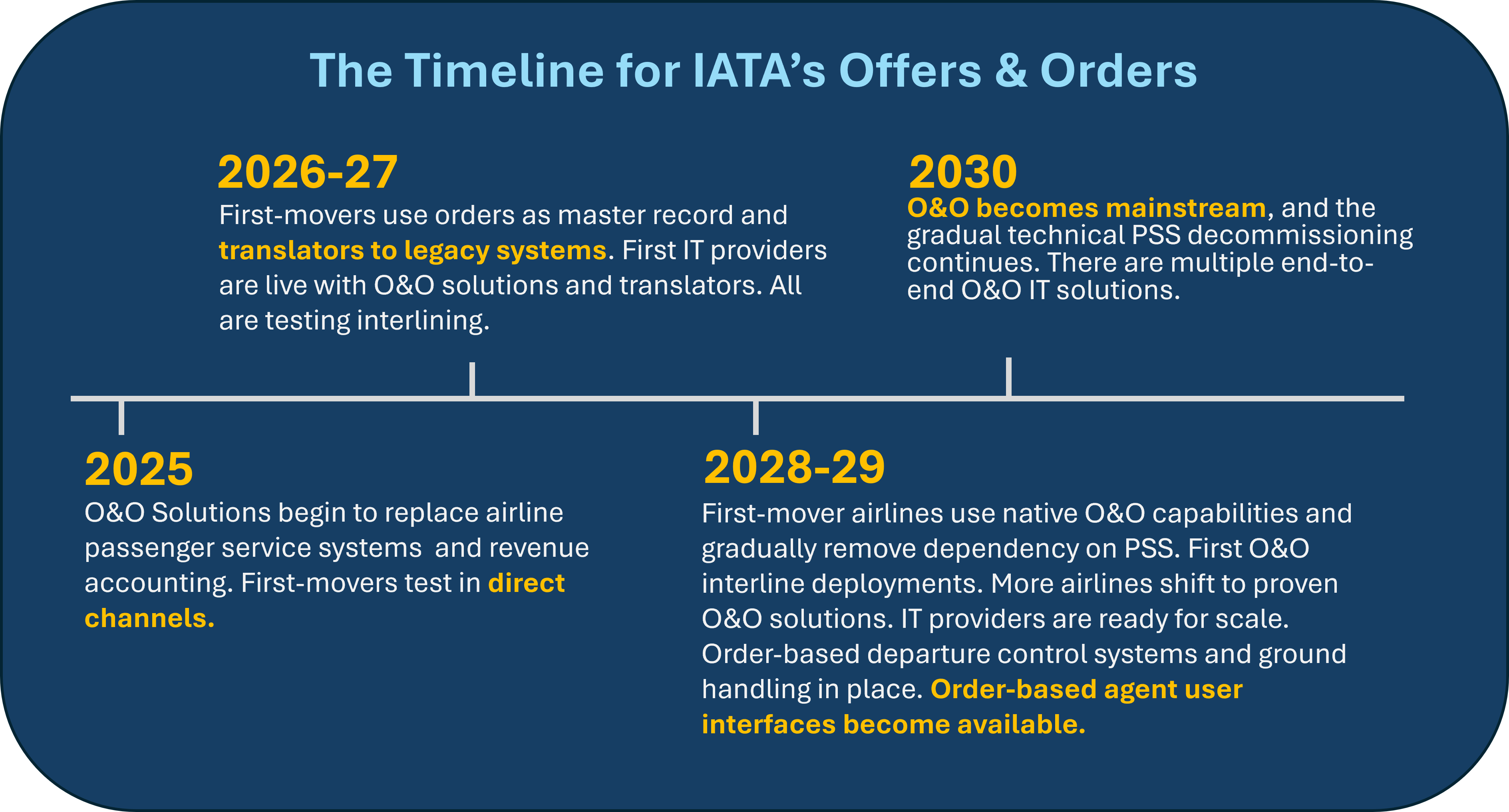
Given how long it has taken NDC adoption to accelerate, the above timeline might seem aggressive.
Who Benefits?
Why make the change? Transitioning to an offers and orders management system requires large investments. Will there be enough of a return on investment?
Different stakeholders are expected to reap different benefits of transition to a One Order system. Below are a few of the beneficiaries noted by IATA.
Airlines' increased value includes the development of new offers combining flight and non-flight products, which allows for optimized sales opportunities through dynamic offers. Carriers could then distribute through a wider mix of channels, and with a single reference number for all service providers, it allows for better customer targeting and servicing, according to IATA. One Order also could optimize sales and execution across airline groups, joint ventures and alliance partners, delivering a consistent customer experience. It also can simplify the revenue accounting and fulfillment of complex offers, as well as leverage data and optimize IT needs. IATA projects this would also lower operations costs.
Travel management companies and corporate travel buyers would see a simplified duty of care, with access to the same delivery information of flight and non-flight services in the single order. One Order also could streamline back-office processes "by providing combined and structured data of the complete journey information," according to IATA.
Hoyles noted that one complaint heard from travel buyers is that even with NDC, they have not seen a significant amount of creativity in the types of offers that have been made available to them. The move to orders will unlock a lot more capabilities for airlines to provide offers that serve business travelers. "It will also [improve] tracking and duty of care," he said, and the consumption of the order through the entire process. "Today, buyers have told us we are blind as to what happens on the day of departure, whereas in the world of orders, you will be able to have that consumption. [Airlines] will be able to give them a lot more data than they had in the past."
Customers would have a single reference number when checking in or making changes to their itinerary, which can simplify and "enhance the passenger experience," particularly during disruptions.
Accounting providers would have simplified functions by moving away from processes based on tickets and ancillaries and toward accounting of payment for services ordered, according to IATA. These can include airport parking, lounge access or fast-track security.
Delivery providers, such as ground handlers, will have complete information about the passengers and their services to be delivered. New providers, such as those servicing lounge access or parking, can "streamline their relationship with airlines in terms of delivery and accounting processes without the use of paper-based constructs and processes."
One Order Challenges
Hoyles said airlines must articulate the value, because the biggest hurdle is the significant investment needed. "You need to be able to describe what the benefits are going to be both for your customers and for your airline," he said.
As with the adoption of NDC, the fact that One Order implementation can vary by airline is another challenge, and that carriers will be in transition for some time. But "ultimately, it's in the interest of everybody that the whole ecosystem moves as much in sequence as possible," Hoyles said. "Like any big transformation, to get the maximum efficiency, you want everyone to be in the same world."
Eighteen months ago, Hoyles also would have said, "you need solutions to be out there, you need tech providers to invest.” Now, he says that's definitely happening, “which is very, very good news.”