Scores increased across all categories of the chauffeured and ride-hailing segments of the 2026 BTN Car Rental Survey & Ground Transportation Report for each ground transportation provider type, reversing last year's downward trends.
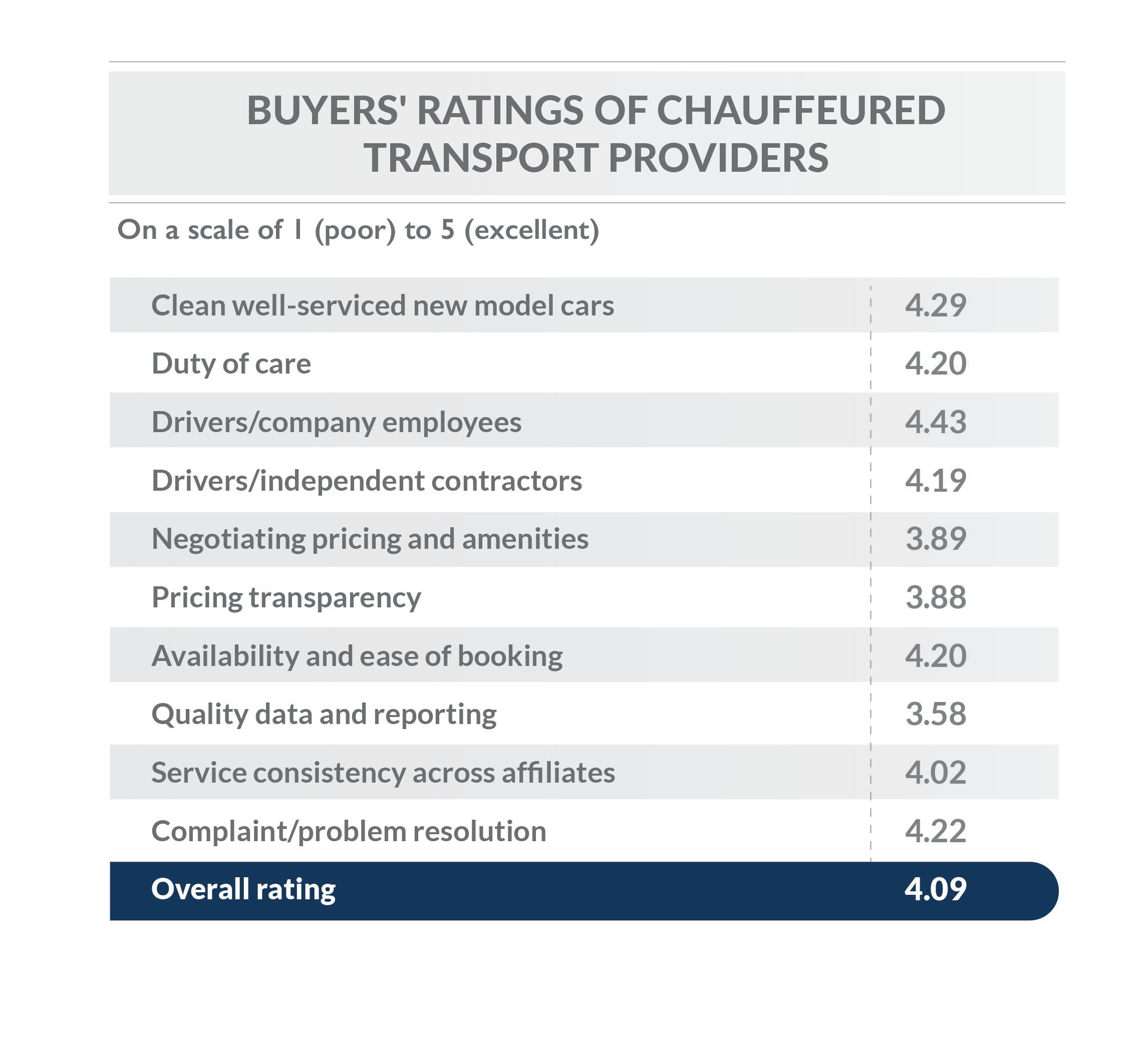
The average chauffeured rating increased to 4.09 on an ascending five-point scale, up from 3.80 a year prior, with each of the 10 categories receiving a higher rating than in 2025.In addition, 25 percent of respondents said overall chauffeured transportation company customer service has improved in the past year, up from 14 percent in 2025.
"Last year, most clients had shifted away and pushed toward ride-hailing versus the chauffeured car service, except in certain circumstances," KesselRun Corporate Travel Solutions VP of program management Krissy Herman said. "Is this increase indicating customers are going back to chauffeured rides? I don't know. But it is nice to see that, overall, there's a pretty big jump in these scores."
GoldSpring Consulting partner Neil Hammond noted on the "significant improvement" that "they really seem to have addressed the weaker categories as well," he said. "We've seen the improvement in their service offering, their ease of doing business, and everything about them has improved across the board."
While slightly more respondents this year than last said they did not have active chauffeured contracts—43 percent compared with 41 percent—for those that do, the number of chauffeured providers per company looks to be on the rise.
About 25 percent said they had one or two chauffeured contracts, down from 31 percent in 2025, but 17 percent said they had three to five, up from 11 percent. Another 11 percent said they had more than five preferred partners, up from 7 percent.
"That's a function of addressing different markets and completing the coverage and building out the programs," Hammond said.
"To be successful in the corporate space, and most importantly to stay relevant, chauffeured car companies have realized that we need to perform," National Limousine Association first vice president and RMA Worldwide Chauffeured Transportation president and CEO Robert Alexander said. "It's more than just a ride. You have to provide a better experience, and that could come with frictionless booking to the in-car experience. … Because there's plenty of other alternatives that the corporate traveler can go to."
Those alternatives include ride-hailing companies and aggregator platforms.
One trend Alexander has seen is when a chauffeured car is delayed "for whatever reason, they cancel, and they say, 'Don't bill me. I'll grab an Uber or another car,' " he said. "Back in the day, they used to be mad at you because the car was late, but you still got the ride. It's a conundrum for us because, yes, we understand that we're not exactly where we were supposed to be, but there are acts of God and our model is, 'don't argue with anybody.' "
Still, "there's a consistency factor when I get a chauffeur driver through a preferred provider versus what I get when I hop into a Lyft or an Uber," Herman said. "That consistency factor continues to make car service an attractive option for certain travelers."
That may be changing. Ride-hailing companies not only have cut into corporate chauffeured rides but also are moving into the luxury space. Uber announced March 30 its agreement to acquire chauffeured transportation platform Blacklane, and Lyft in October 2025 acquired TBR Global Chauffeuring. Each company is based in Europe, adding to Uber's and Lyft's global offerings. In addition, the U.K.-based Wheely chauffeured transportation platform recently launched in New York.
Overall, TBR Global Chauffeuring global CEO Craig Chambers said he has seen a general shift over the years he's been in the ground transportation business. "You can see the professionalism and the standards continuing to increase over time," he said. "As technology advances and other players have come into the market and advanced, that connectivity around not just being a localized or regional player but being able to provide a more consistent service on a global basis all ties into that. It's clear from corporate travel managers and the wider travel industry that they want that level of consistency across the board."
Service consistency across affiliates happened to be the category that had the largest increase for chauffeured car providers this year, gaining 0.47 points to an average of 4.02. Other categories with big jumps included negotiating pricing and amenities, increasing 0.46 points from 2025, drivers who are company employees, gaining 0.42 points and landing as the highest-rated category at 4.43, and complaint and problem resolution, up 0.40 points.
Herman noted that pricing for the chauffeured segment has settled. "It had been climbing maybe from 2023 to 2024, and 2024 to 2025, but it's leveled out, which is really good to see," she said.
"Corporate clients want transparency and a clear picture of what the rates will be," Chambers said. "Also, what are the terms and conditions that come with that? From a budgetary perspective, they don't want hidden surprises. They want clear consistency and transparency over what they're going to receive."
Regarding the high score for drivers who are company employees, "we employ our own chauffeurs and only work with affiliate partners that employ their own chauffeurs and own the vehicles," EmpireCLS EVP of sales Marissa Criaris said. "We're doing full background checks on every single person on a federal, state and city level. People want to know when they're putting a traveler in a car, whether it be a man or a woman, that they're safe, that they're being driven by somebody who has been vetted, not just another individual who owns their own car that potentially might be working for four other limo companies that day. So that's a big focus."
To tackle complaint and problem resolution, Criaris, who oversees the company's customer care department, noted that EmpireCLS has started to conduct survey ratings, on a scale of zero to five, that get sent as a text message as soon as the customer exits the car. The company's average is high—4.85, she said—but when they see anything rated a three or below, "the team reaches out in real time to find out, how did we fail that customer? It's been a game-changer, because we're hearing right then and there whathappened. We can resolve it, waive it, offer something off in the future. And then we share that information with the travel manager. It's been very beneficial."
When asked about how the recent fuel-cost increases could affect the segment, Hammond noted that buyers and end users may see higher pricing. "You're exposed to the fluctuations for Lyft and Uber, and chauffeur as well may change," he said.
All the chauffeured companies interviewed said they were watching the situation on a month-to-month basis but hadn't increased pricing yet.
Sustainability Trends
The current pulse on sustainability for chauffeured services showed that the portion of buyers who had sustainability as a component of their programs increased. About 22 percent said they had such a component in their chauffeured program, up from 16 percent a year prior.
"It's a really important area; the level of expectations, the reporting that our corporate customers are asking for is increasing," Chambers said. "It's very much part of the conversations we're having on a daily basis." TBR's fleet is about 30 percent hybrid and electric vehicles, he added.
EmpireCLS just invested in 120 new Cadillac IQ fully electric vehicles, Criaris said. "In the past 12 months, we are seeing trends in sustainability increase," she added. "We're noticing a lot more customers request these, but even the ones that aren't requesting it, we're doing complimentary upgrades to a lot of our electric vehicles so that they can experience it."
Still, not every company sees an increase in sustainability demand. Alexander said RMA gets about one or two clients that ask for EVs, but that overall, it's "very rare."
Ride-Hailing Trends
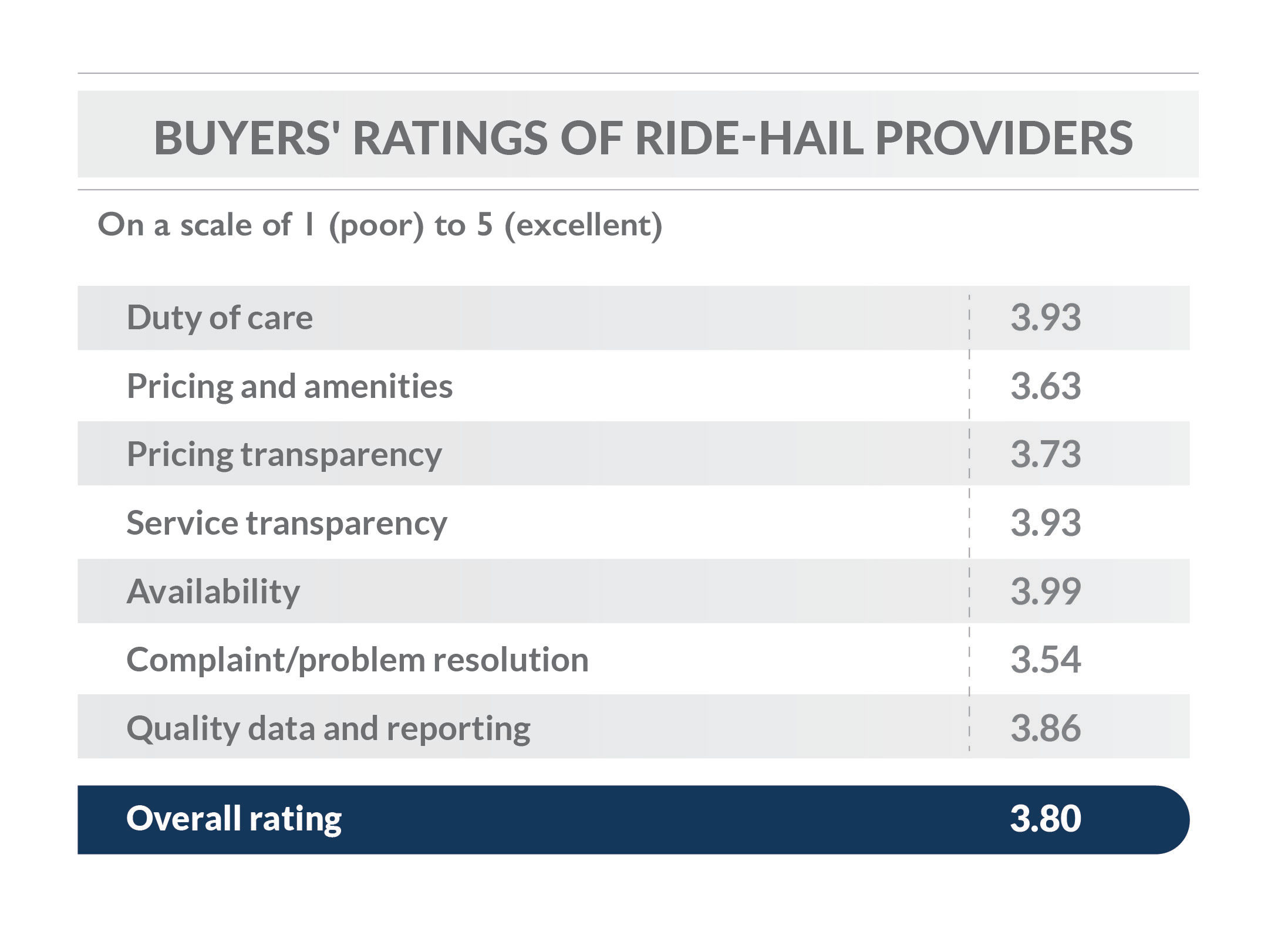
The travel buyer ratings for ride-hail services averaged 3.80 on an ascending five-point scale, up from 3.61 a year prior, and each of the seven categories surveyed increased. About 73 percent of respondents overall said they include ride-hailing services in their programs.
About 69 percent said they used Uber, while 30 percent said they used Lyft. A significant majority of respondents who indicated they have a contract or substantial business with Lyft, however, said they also have the same with Uber. The reverse was not the case.
"The challenge is that Lyft is really only North America [despite their acquisition of TBR], and in many of our clients, there just seems a culture to go to Uber," Herman said, adding that it also could be coming from a "personal use standpoint" with corporate travelers carrying over the brand they use for food delivery or personal rides. "I think there's been a more difficult adoption of a Lyft business program."
Consumer brand recognition becomes another hurdle, for any ride-hail provider competing with Uber for business traveler attention. Hammond summed it up this way: "Uber is used as a proprietary eponym." That's when a popular brand name has become the common term used to describe a product or service, like “Kleenex” has become synonymous with facial tissue, and it’s hard to break a bond like that when a user taps the phone to book a car.
"Uber has really diversified their kinds of offerings to corporate travelers, and Lyft has consistently tried to partner on their core business," Herman said. "Bolt is trying to make a push in the corporate space, but I have not seen any of our North American clients contract with them or have a strong opinion there."
For ride-hail as a whole, the largest ratings shift across the seven criteria surveyed was for service transparency, gaining 0.53 points from 2025.
Another category that showed a marked improvement was duty of care, increasing 0.27 points from 2025. At least one change the ride-hailing operators have made that may play into this rate gain is giving customers the option to select a female driver, which Lyft first piloted in September 2023 then expanded it nationwide in February 2024.
"The female driver option is very well received in many of our client organizations," Herman said.
Uber piloted the feature in July 2025 and expanded it nationwide in March 2026.