With the economy on the upswing, is it a rule that premium
business travel responds in turn? Not exactly.
Of the airfare that corporate travel agencies have settled
each month through ARC, premium-class' share of total volume has been stable,
sitting between 6.7 and 7.9 percent since Januarly 2013. That's despite the
fact that the average ticket price fell 5.7 percent from June 2013 to June
2016.
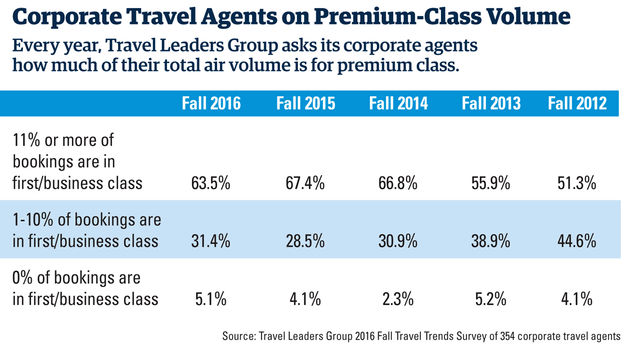
Travel Leaders Group surveyed its corporate travel agents
this summer and found a different story. Among those for whom premium-class air
bookings make up more than 10 percent of total air volume, premium-class
bookings declined in 2016, though that followed a considerable uptick in 2014.
Pricing trends may have had something to do with that jump, but this year's
decline shows organizations remain cautious about extending premium class
allowances too far.
"Anytime the economy gets better, T&E budget belts
may get loosened," said Andy Menkes, CEO and founder of Partnership Travel
Consulting, "but the expectation is that procurement and travel management
will find other ways to optimize spend."
Likewise, DeAnne Dale, senior vice president of global
strategy and consulting for Reed & Mackay, a travel management company that
services more than 48 law firms and 30 hedge fund-type companies, has not
noticed a big change in premium travel. Rather, she's noticed that companies
are looking for more visibility on travel spend and they are looking to
capitalize on growth opportunities. "They're looking for additional
resources to bring on new people," she said.
All About
Productivity
Even if companies aren't upping their investment in
premium-class travel, one travel manager who works in the investment banking
sector said they're certainly not in a position to downgrade. Frequent
travelers expect the same amenities and services that they've always had.
Boarding first, getting upgrades, skipping the car rental counter and being
treated with priority helps manage business better, the travel manager said.
What these travelers also need, she said, is "a little concierge on their
shoulder to help them walk through this madness."
To that end, Menkes said companies are now more willing to
pay for ancillaries for road warriors, including Global Entry and one or two
airline club memberships, as it helps them be productive, especially when
travelers have to make connections or flights are delayed. "That lounge is
not only an emotional oasis; it's a productivity benefit, and coincidentally
you can grab a free meal," Menkes said.
A Global Business Travel Association traveler satisfaction
report released in September said that frequent travelers who had Global Entry
or TSA PreCheck reported a "drastically improved" business travel
experience. The survey also showed that 51 percent of frequent business
travelers paid for one or the other when their companies did not cover the
cost.
One travel manager, who previously worked for a major sports
league, confirmed that trend to BTN, saying the employer had reimbursed
travelers for these programs for the past three years and the travelers loved
the perk.
Dale added that black car services have been in the
spotlight for her clients. Travelers—and travel arrangers—want the ability to
book a black car as part of an overall itinerary, as opposed to separately.
Professional firms depend on black car services, she said, and are not yet
ready to switch to ridesharing alternatives. "Some are even willing to pay
more if they can have a more reliable car service to get them where they need
to be," Dale said.
Mobile Adoption
& Increased Attention to Duty of
Care
"The thing that is changing is technology," said
the investment firm travel manager. "Be it a phone, watch or laptop, they're
becoming more mobile than they've ever been." This owes partly to the
travel industry's natural move toward more supplier mobile apps and to a
younger generation that's influencing travelers of every age to move toward
mobile technology for better travel experiences, the travel manager said.
Another trend that is pushing premium travelers toward
mobile is duty of care, which is in high demand for elite travel programs
looking to invest in the safety of their travelers.
In August, Reed & Mackay rolled out a check-in feature
as part of its duty-of-care suite, which Dale said has been popular with law
firms. "If they're traveling to out-of-the-way destinations, it makes them
feel safe that someone knows where they are," she said.
But don't pan the pretty: Along with duty of
care, road warriors and premium travelers want more mobile services, as well.
Virtual closet service Dufl, which offers to ship, clean and store business
wardrobes and amenities for travelers, is growing its enterprise client base
with companies that want to give time back to their frequent travelers.
Predictive disruption-assistance services like Freebird, which anticipates
travel disruptions and offers rebooking options, are emerging, as well.