The novel coronavirus has devastated business travel around the world. There are imperfect clues about where the industry is in the downcycle or how long that cycle will last. The uncertainty is driven largely by the invisibility of the adversary: a viral infection that may or may not present symptoms and for which, to date, there are insufficient testing and treatment options. Even so, it's not the first travel downcycle precipitated by disease. There was SARS in 2003 and MERS in 2012. The depth of those epidemics didn't come close to Covid-19 in terms of industry disruption, however.
To reduce the contagion, governments have locked down cities and countries. Presidents and prime ministers have closed borders, banned events of 1,000 or more, then 250 or more and, most recently, 50 or more as the threat of the virus became clearer. They've imposed curfews to clear out bars and restaurants and ordered all nonessential workers to stay home or work from home.
Businesses, in many cases, acted faster than governments. By late February, multinational companies had pulled participation from events, barred their employees from business trips and instituted work-at-home policies.
Travel Managers Under Pressure: Get Travelers Home
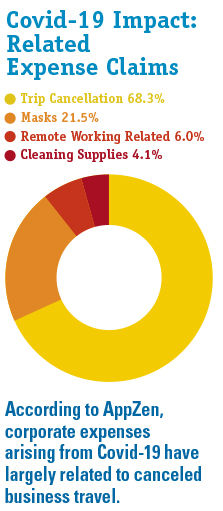
Pressure on travel managers has mounted. Border closings swept across Europe and North America in mid-March, putting immediate deadlines on repatriating those international travelers who reside outside their native countries, since non-citizen immigration now is an issue in many geographies across the U.S., Asia and Europe. Rulemaking has happened quickly in some countries, causing confusion about application, scope and how companies should prioritize repatriation strategies. At the same time, airlines slashed capacity to deal with the cratering demand for bookings, leaving travelers on the road with diminishing opportunities to return home.
Rebecca Bernhard works as a partner at U.S. law firm Dorsey & Whitney and specializes in labor and employment law, including immigration issues for business. She has seen three waves developing for travel managers and their companies as countries tighten borders and airlines ground equipment.
"Multinational companies with extensive ongoing travel have been aware of this since the middle of January and have already started to address that kind of regular travel," she said. So the trajectory for complications on the most transient of business travel already may be waning. But companies with project work or longer-term travelers may be just coming into this curve. "Maybe they really are a U.S. company, but they subcontract to a manufacturing plant in China, for example. Those folks … are wrestling now with this, so that middle trajectory may go on for a while."
There's a third trajectory, however, that companies may need to come to grips with: internal U.S. travel. "That volume is really increasing," she said, citing U.S. hotspots like Seattle, San Francisco and New York City, each of which face curfews and partial shutdowns. "These cities have been thinking about this for all of February, but many other cities, that next size down in the middle of the country, are just starting to. Some are still thinking they don't have many cases yet, so why do they care? The question becomes, do I want to send my colleague from Des Moines to New York? I know I don't want to go to Italy, but what about New York?"
Bernhard predicted travel managers will be dealing with this level of decision-making and adjusting policies and technologies accordingly. That said, many companies will just stop traveling. Many already have.
VP of finance David Wieseneck manages travel for Brooklyn-based startup Letgo, a platform that creates a second-hand market for individuals to buy, sell and trade consumer products. The company was relatively quick in curtailing travel for its workers, roughly following the schedule of tech giants like Google and Microsoft which, together, have grounded hundreds of thousands of business travelers globally.
"In February, when it really started to take hold in Europe and there were few cases in the U.S., we decided to cancel all international travel but not domestic travel," said Weiseneck. "Now if you want domestic travel, you have to get special permission from our CEO."
The company worked with its TMC and technology provider TripActions to make changes to its booking tool to flag all booked travel. They also automated alerts within the technology to identify any existing travelers going into hotspots—including connections and layovers. Letgo pulled the plug on all trips for the next three months.
"We pulled up a report of all flights in the next 90 days, and we got a list of anyone traveling to cancel or change their flight to a further date," said Wieseneck, "because sometimes change fees are less than cancellation fees, so people said, ‘I still want to go, but I'm going to postpone.' Otherwise, most people canceled their flights. I haven't dug into the cancellation fees yet. I'm just telling people to cancel [trips] for their health. We'll worry about the cost on the back end. If we have to ask for a refund, we will, but we haven't started doing that. And, honestly, no one is trying to book any trips."
Suppliers Under Pressure: No Revenue, Suspending Operations
Major airlines have slashed capacity and are reaching out to governments for support. Some regional carriers have suspended operations. According to CAPA, many are on the precipice of bankruptcy by May if bailouts aren't forthcoming.
"As the impact of the coronavirus and multiple government travel reactions sweep through our world, many airlines have probably already been driven into technical bankruptcy, or are at least substantially in breach of debt covenants," according to CAPA. "Cash reserves are running down quickly as fleets are grounded and what flights there are operate much less than half full. Forward bookings are far outweighed by cancellations, and each time there is a new government recommendation, it is to discourage flying."
For corporate travel and meeting managers looking for a guidebook, the business interruption for their own companies and financial issues for the travel industry are tracking similarly to those experienced after the 9/11 terror attacks in 2001 and the financial crash in 2008.
"It's similar," said WorldAware president and founder Bruce McIndoe. "Airlines and global distribution systems will need substantial financial support," with GDS revenues largely tied to passenger name record volume. "The whole travel and transport ecosystem—and I include rail and cruise lines in that—the government is going to have to systematically put them on life support."
U.S. Travel Association president Roger Dow on March 17 asked the federal government to consider a $150 billion relief package for the industry to stem the tide of what USTA predicts will be combined 2020 year-over-year losses of $355 billion for transportation, lodging, retail, attractions and restaurant sectors for a "disaster that was created by circumstances completely out of their control."
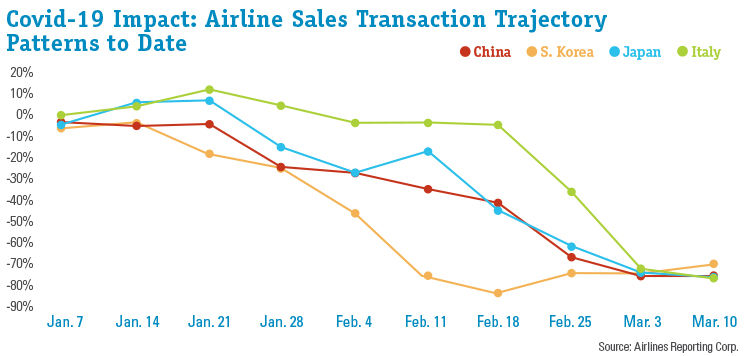
Airlines Reporting Corp. has been tracking the trajectory of cratering demand in key affected markets globally. As Covid-19 spreads in the U.S., the reaction from major U.S. airlines has been swift to cut capacity, anticipating demand drops that mirror those that rolled through China, Japan, South Korea and Italy in the wake of the virus.
American Airlines cut international capacity by 75 percent beginning March 16 through May 6, including almost all service to Europe and Asia.
Delta Air Lines suspended at least until mid-April flights to continental Europe and will reduce overall capacity "in the next few months" by 40 percent as a result of coronavirus-related demand reduction, according to a March 13 letter sent to employees by CEO Ed Bastian. "We are moving quickly to preserve cash and protect our company," he wrote.
As of March 18, United Airlines expected in April to fly two U.S. daily flights to London and have daily service to Brussels and Frankfurt. The company said it would also maintain daily flights to Singapore, Sydney and Tokyo. That said, the situation is fluid with more countries closing their borders to non-citizens and strangling demand.
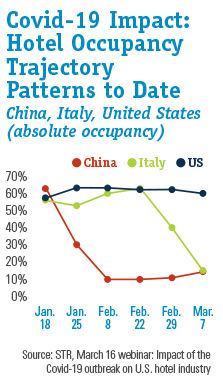
The hospitality environment has been similarly gutted. STR has tracked the impact trajectory on hotel occupancy, average daily rate and revenue per available room in key global locations affected by Covid-19. Considering data available from China and Italy, it appears the United States was on the precipice of a demand cliff during the week ending March 14, although the data was not yet available at press time. If the pattern holds, however, U.S. occupancy rates could drop to 30 percent to its first trough and then further to between 10 percent and 15 percent as businesses and consumers implement travel bans and social distancing measures.
Major hotels are bracing themselves. Marriott International on March 17 began to furlough tens of thousands of workers, though the company said they were working to blunt the impact to workers by extending health coverage and other limited benefits during what looks like an uncertain, but potentially prolonged, time period.
STR SVP Jan Freitag suggested in a March 16 webinar that if the downturn and recovery period mirrors 9/11 or the 2008 financial crash, the hotel sector could expect year-over-year comparisons to register "double-digit RevPAR declines for the foreseeable future."
Importantly, he added, lodging and hospitality companies returned to pre-recessionary figures in three to five years after previous crises, goaded by the needs of business travelers eager to get back on the road to service their clients and engage with partners.
"In the midst of the recession, transient room demand actually started positive growth seven months after the beginning," according to Freitag. "Group demand continued to hurt, so the math worked out to be negative, but if you looked at transient data only, you saw room demand increase."
WorldAware's McIndoe echoed Freitag, projecting the return to transient business travel would be first, with companies holding back on conference and event travel. In the case of travel management service partners, McIndoe predicted many TMCs would not have the financial strength to weather the storm. "We will see failures and substantial opportunities for more consolidation in the travel industry. Smaller TMCs are not going to survive; those doing $50 million or $100 million in travel—the government isn't going to go down that far [with relief measures]."
Recovery: Lay the Groundwork Now
"There's very little a TMC can do to change the trajectory of a pandemic," said American Express Global Business Travel executive VP product and strategy Evan Konwiser. "We are focused are making sure our employees and customers are taken care of as much as possible because this is time of heightened need." But in the longer term, he said, these are times that deepen relationships with customers. "Our value proposition is very strong in times of crisis. … We've been close with a lot of clients as a result of the last few weeks, and we want to make sure that continues to benefit them."
Bizly chief strategy officer Kevin Iwamoto, who weathered both 9/11 and the 2008 financial crisis as a global travel commodities manager for Hewlett-Packard, said taking a rational view of the situation and identifying your true partners are key to recovery.
"Take a look at the impact not just on your company, but the impact on the industry as a whole," said Iwamoto. "Don't expect to go back to the original program once the crisis passes. The landscape may have changed. Who are your preferred suppliers? Which of those will survive the crisis? What about consolidation? You need to look at how the crisis could affect your program and market share to preferred suppliers.
"You also have to be transparent with suppliers—a day or a week after the crisis passes, you may not be at the same volume," he added. "So work realistically about the level of support and start those conversations well before the end of the crisis. You may have suppliers with marketing strategies to get people back in seats, hotel rooms, cars. … You may want to look at their promotions to get people moving again, doing business and strategizing." Suppliers who rejected requests in the past might even be ready to engage, he said.
Writing on LinkedIn, veteran EY travel and meetings global head Karen Hutchings extended her thoughts:
"This is unprecedented times for the travel, meetings and events industry, and the important thing is that we stick together and support each other. Specifically, clients need to support their business suppliers and appreciate and understand this is really difficult times for them, whose whole focus is travel, meetings and events, whereas for the corporates it is not. The travel, meetings and events industry has given me, and many of you, a wonderful career and lifelong friends, and for that we need to be good business partners and help the industry get through this."
—Donna M. Airoldi, Dawit Habtemariam and Michael B. Baker contributed to this report.
__________________________
Correction March 20: A previous version of this article misstated Amex GBT executive Evan Konwiser's title as VP marketing and product strategy. The article has been updated.