The Trump Administration’s move to impose tariffs on imports
from more than 90 nations began to take effect last week, sending a shock wave
through stock markets around the globe. It also sent a wave of uncertainty
through the corporate travel sector, according to respondents to a BTN flash
survey fielded April 3 to April 4, about how their companies would respond to
the market shake up in terms of expected business travel volume for 2025.
On April 5, the U.S. began imposing a blanket 10 percent
tariff on all goods imported to the country. Additional so-called “reciprocal tariffs” of
as much as 50 percent are scheduled to go into effect April 9 across 60 countries—a
34 percent tariff on Chinese goods, 49 percent on Cambodian imports, 46 percent
for products produced in Vietnam, 36 percent for Thai goods, just to name a
few. While some of the steepest tariffs will hit Asian countries, the
administration plans to impose considerable duties on goods from countries like
Bosnia (36 percent), South Africa (30 percent) and across the European Union
(20 percent).
By the weekend, Canada, China and the European Union had announced they would impose retaliatory tariffs on the U.S. According to the White House, 50 countries had reached out to the U.S. to engage in tariff discussions by Sunday evening.
President Trump described the effect of the U.S. levies as “Liberation
Day,” saying the new taxes are needed to eliminate a trade deficit between the
U.S. and other countries. According to the administration, the move ultimately will
result in bringing manufacturing jobs—lost to cheaper foreign labor markets—back
to U.S. soil and boost the domestic economy by “liberating” it from reliance on
foreign goods.
Economists have warned, however, that a protracted trade war
could trigger a global recession.
The U.S. stock market lost $5.4 trillion in two days of sell
offs last week. The Dow dropped 5.5 percent or 2,231 points. The S&P 500
fell 5.97 percent, and the tech-focused Nasdaq Composite dropped 5.83 percent.
The latter fell into a bear market for the first time since 2022—down more than
20 percent from its record high in December.
Tokyo’s Nikkei was down 8 percent at Monday’s opening. India’s
Nifty had tumbled 5 percent. Dow futures tumbled by Sunday night predicting a
rough entry for Monday’s opening bell.
The price of crude, not directly impacted by the tariffs,
looks to have taken a hit as collateral damage. It fell on Saturday to less
than $60 a barrel for the first time since April 2021. The falling trendline for
oil is fear from investors that a trade war could plunge the global economy
into a recession and crater demand for flights, travel, transportation, shipments,
cargo and other activities that require fuel.
Major U.S. airline stocks also have fallen. Delta was down 6
percent at the start of trading on Friday; United had dropped 10 percent. These
dips come on top of a general downward trajectory since the beginning of the
year based on softness in consumer confidence and a pull back from travel at
least at the economy end of the spectrum.
Corporate Travel Impact
Business travel looks like it will not be immune to the
chaos. BTN in January and February surveyed 256 travel buyers regarding their
outlook for business travel in 2025. The data, originally collected for an
upcoming State of the Industry Report that has now been delayed, showed significant
optimism among travel buyers. That optimism is starting to dim, according to
145 travel buyers re-surveyed April 3 to 4 as industries across the board braced
for the impact of Trump’s tariffs.
Forty-one percent of travel buyers surveyed by BTN in April said negative economic indicators including the stock market drop, threat of a trade war caused by tariffs and erosion of consumer confidence were having a significant or very significant impact on their companies' travel activities. Thirty-eight percent said such indicators were having little to no affect on their companies' travel. Twenty-two percent said it was having some impact.
While companies that planned to have the strongest travel budgets
in 2025 remained confident in their original trajectory of spending over 10
percent more on travel than in 2024, other companies had begun to pull back.
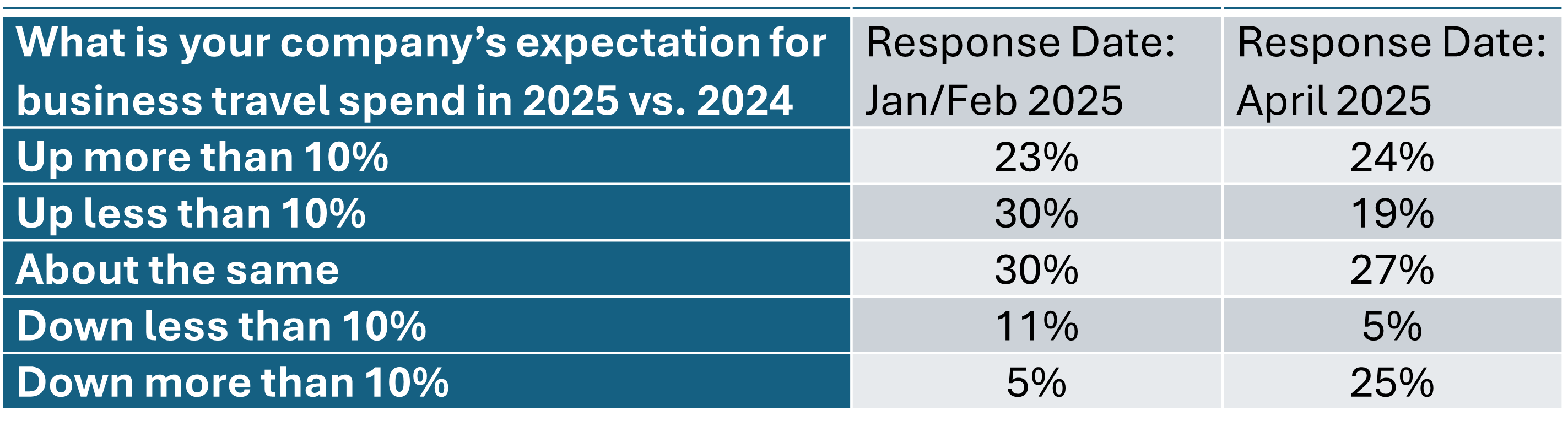
The cohort that said they would spend slightly more than in
2024 were down to just 19 percent by April, compared to the original 30
percent. Twenty-seven percent said their budgets would stay steady—a three
percentage point drop from earlier this year.
Those who had weaker travel budgets going into 2025 had
compounded that weakness by April. While only 5 percent said they would spend
slightly less than last year, compared to 11 percent in the first survey, it
looks as if that group shifted down into the bottom bucket, where now a full
quarter of survey respondents expected travel spend to fall by more than 10
percent from the previous year—that’s five times as many as reported the same
from the Jan./Feb. survey.
That said, companies expecting to spend less on travel this
year, may have a rougher road ahead in realizing that savings. Though airfares
had begun to moderate and even decline on certain routes, increased costs to
manufacture and maintain planes will impact the cost airlines pay for them, not
to mention disrupting established supply chains for everything from food to
lounge furnishings.
Hospitality firms won’t be spared either. Major U.S. hotel
companies saw stocks fall last week and their construction pipelines just got
more expensive with tariffs set to impact major supply lines for lumber and
steel. The cost to operate a hotel also will rise, even as the demand picture
begins to get hazier. Canadian travelers have pulled back on travels to the
U.S. and a CEO of French hospitality giant Accor Hotels told Bloomberg forward
bookings to the U.S. for summer were down 25 percent compared to last year.