.png "May 2026 icon")
Suppliers and analysts alike pointed to strengthening global and U.S. business travel demand in May, even amid the high travel prices spurred by the cost of fuel, sent soaring due to war broke out in the Middle East, which continued. Most, but not all, industry metrics pointed to an environment in which volume increased.
If anything was dragging demand in May, it was likely to be the cost of air travel. The April average price for a U.S. domestic roundtrip ticket increased 18 percent year over year to $628, according to Airlines Reporting Corp., the highest price since May 2022, when it was also $628.
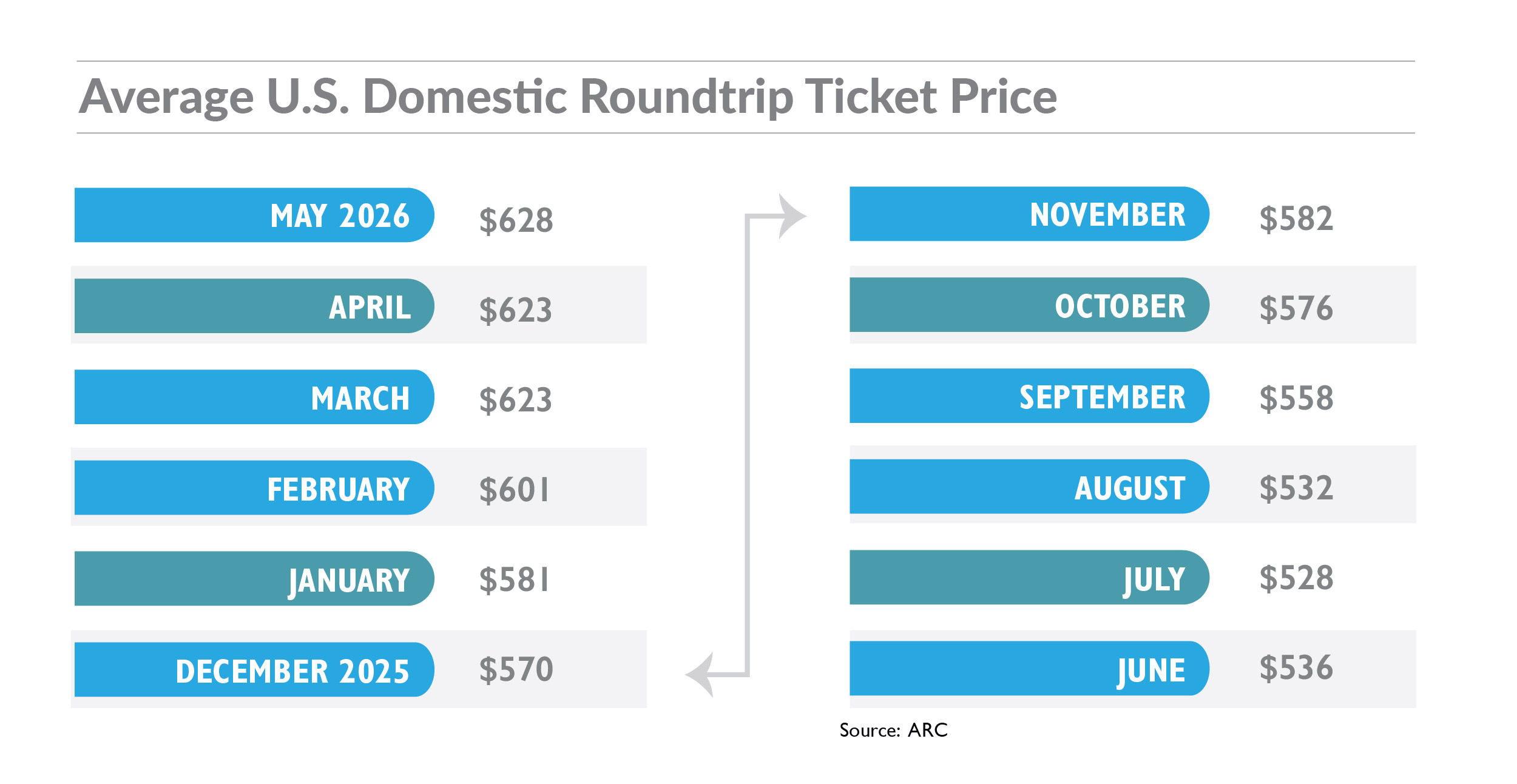
Still, ARC noted total air ticket sales in May increased 15 percent year over year to nearly $10 billion, even as total passengers held about steady. "The May sales data indicates that air travel demand continues to endure, despite evolving economic and political circumstances," ARC chief commercial officer Steve Solomon said in a statement. "Travelers are showing a continued prioritization of travel, keeping overall demand steady as we begin the summer travel season."
The average price for a domestic economy-class ticket in May increased 20 percent year over year to $569, while a domestic premium-class ticket was up 14 percent to $1,429.
ARC for May did not provide its typical breakdown of trips sold by travel agencies with at least 70 percent self-reported corporate and government business. For decades, this provided snapshot of business demand strength, along with trips sold by leisure and online travel agencies. ARC told BTN it was exploring methods to display such segmentation data.
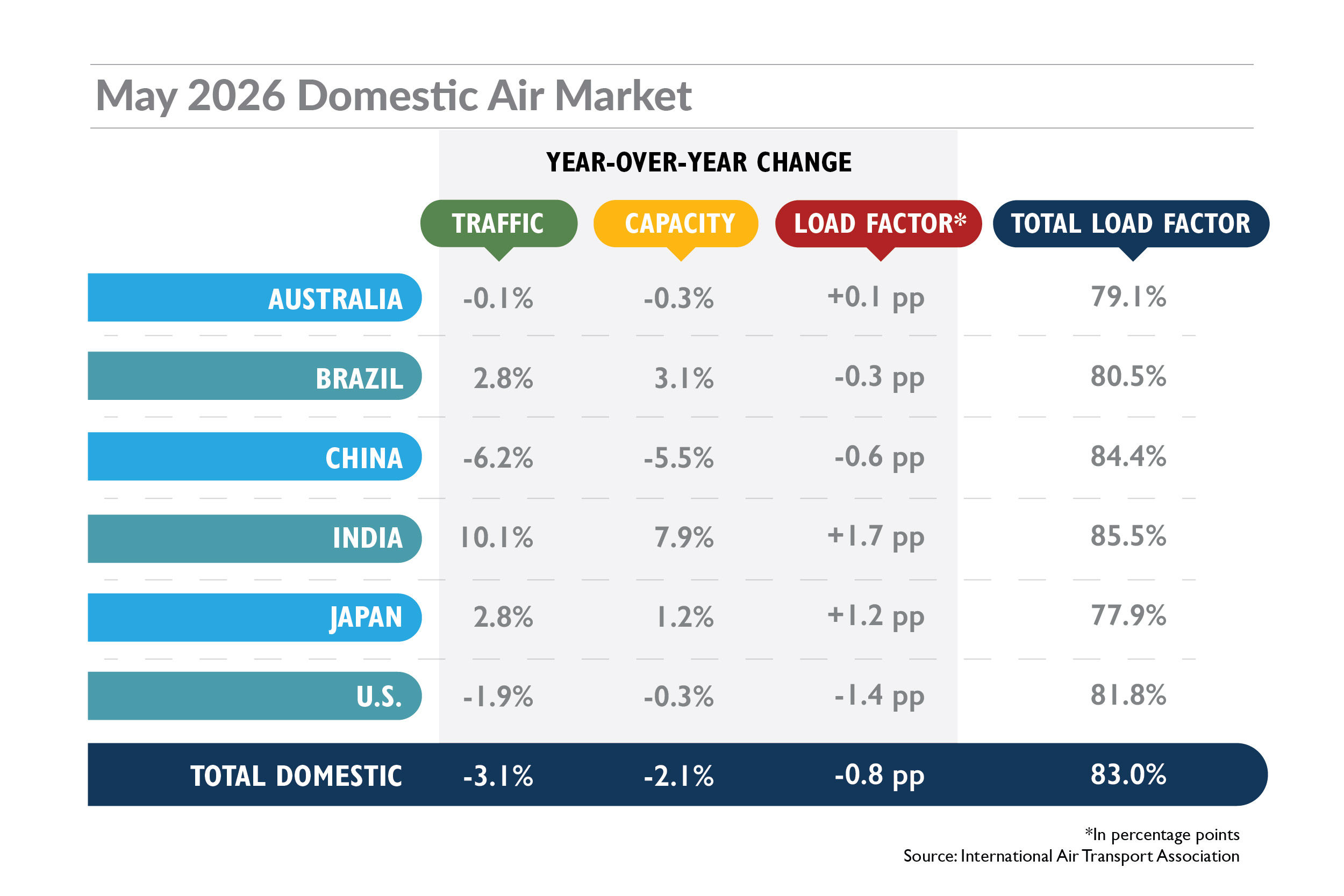
Per ARC, May domestic U.S. air passenger trips increased 1 percent year over year. The International Air Transport Association, meanwhile, said that U.S. domestic air demand May, as measured in revenue passenger kilometers, dropped 1.9 percent year over year. Domestic demand similarly declined in India and Japan.
"May demand still appeared to be largely resilient in the face of high fuel prices and air fares," IATA director general Willie Walsh said in a statement. "While the recent sharp drop in oil prices is an encouraging development, the challenges created by the war will likely persist for some time."
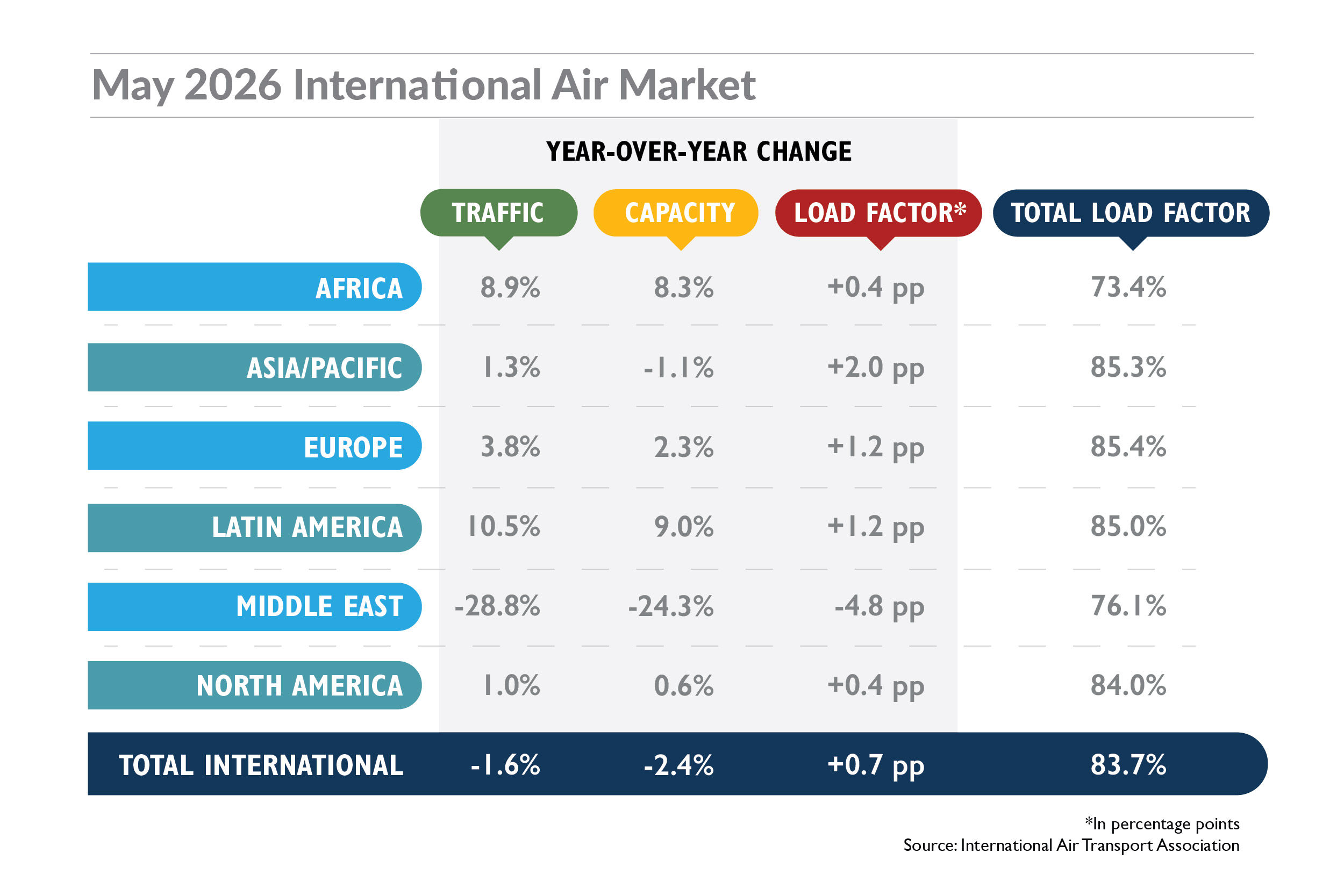
International air demand metrics must take into account the effects of the war in the Middle East, where demand in May dropped almost 29 percent year over year while capacity, as measured in available seat kilometers, dropped more than 24 percent.
Excluding the Middle East, global international demand increased 3.1 percent, according to IATA. International demand on North American carriers increased 1 percent year over year on a 0.6 percent increase in capacity.
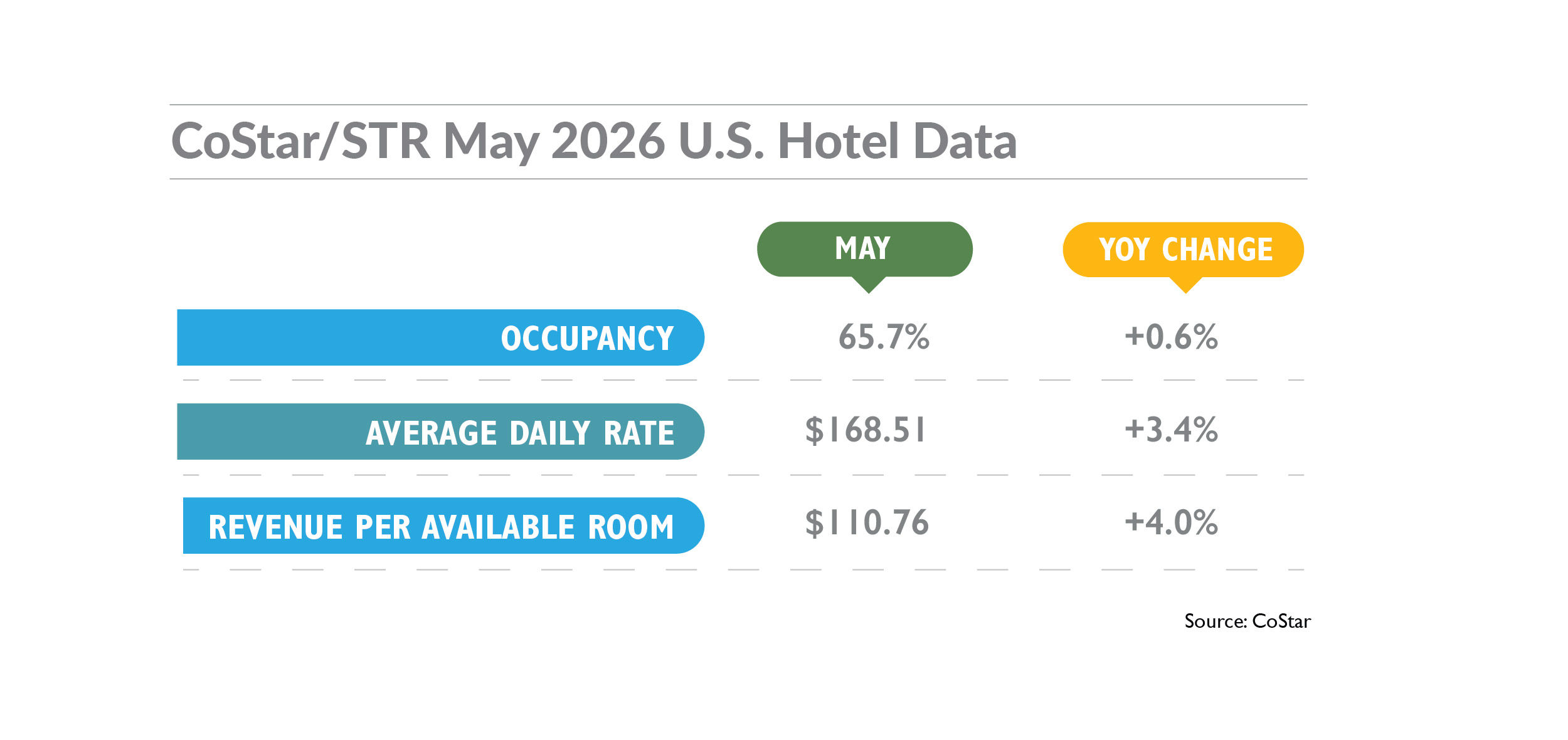
U.S. hotel performance in May remained stout. U.S. occupancy in May increased 0.6 percent year over year, the fourth straight month of increase after 11 straight months of decline, according to STR hospitality data from Costar.
U.S. average daily rate and revenue per available room in May each increased too, up 3.4 percent and 4 percent respectively year over year. It was the fifth consecutive month that RevPAR increased from prior-year levels after nine months of decline.
STR pointed to business travel as the engine for May's demand strength. Weekday RevPAR through Thursday, a metric held as shorthand for business travel, from mid-May through mid-June accounted for 97 percent of overall RevPAR gains, STR reported in a research note.
There's quantitative and qualitative evidence of a U.S. return to business travel in 2026 after some hesitance in 2025; most suppliers, certainly, have touted the performance of the sector throughout the year although revenue gains have widely outstripped volume gains due to increased prices.
To the extent that there remains a structural, rather than market-based, drag on demand, many analysts and suppliers consider the greater post-pandemic tolerance among many companies for allowing employees to work from home at least a factor. It's difficult, after all, to visit clients, if they're not in the office. But even though some high-profile companies, particularly in the technology sector, have in fact called remote employees back to offices, on the whole the work-from-home concept has at least to some extent rooted itself as a work-culture mainstay, at least for now.
That's certainly to the dismay of some executives, and several big companies of late—Dell, Amazon, JPMorgan Chase, Home Depot and Starbucks are among the higher-profile recent examples, along with the U.S. federal government—have increased in-office requirements for employees.
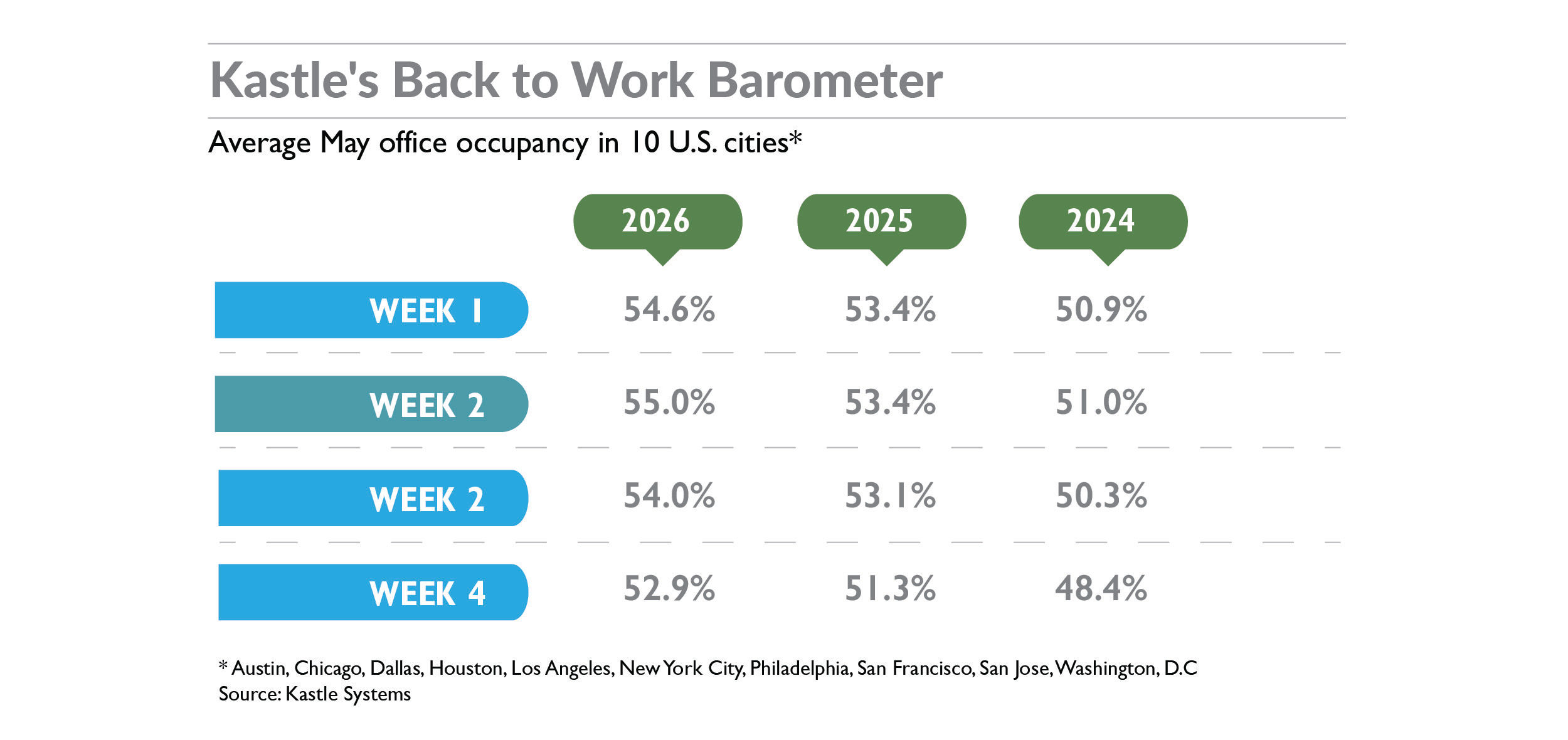
Still, data provided to BTN from Kastle Systems, an office security company that since the pandemic has monitored aggregated card-swipe data to assess office occupancy, shows little momentum in return-to-office policies, despite those high-profile counterexamples. The Kastle data, compiled here for each of the first four weeks in May to allow for year-over-year comparison, shows increasing attendance since 2025 and 2024, but only slightly.
It seems that for now, those banking on a return-to-office spike to stimulate business travel will have to continue to wait as hybrid approaches solidify. "From an economic policymaking standpoint, hybrid work is one of the few instances where there aren't major trade-offs with clear winners and clear losers," Stanford University economist Nicholas Bloom last month told the Stanford Report. "There are almost only winners."