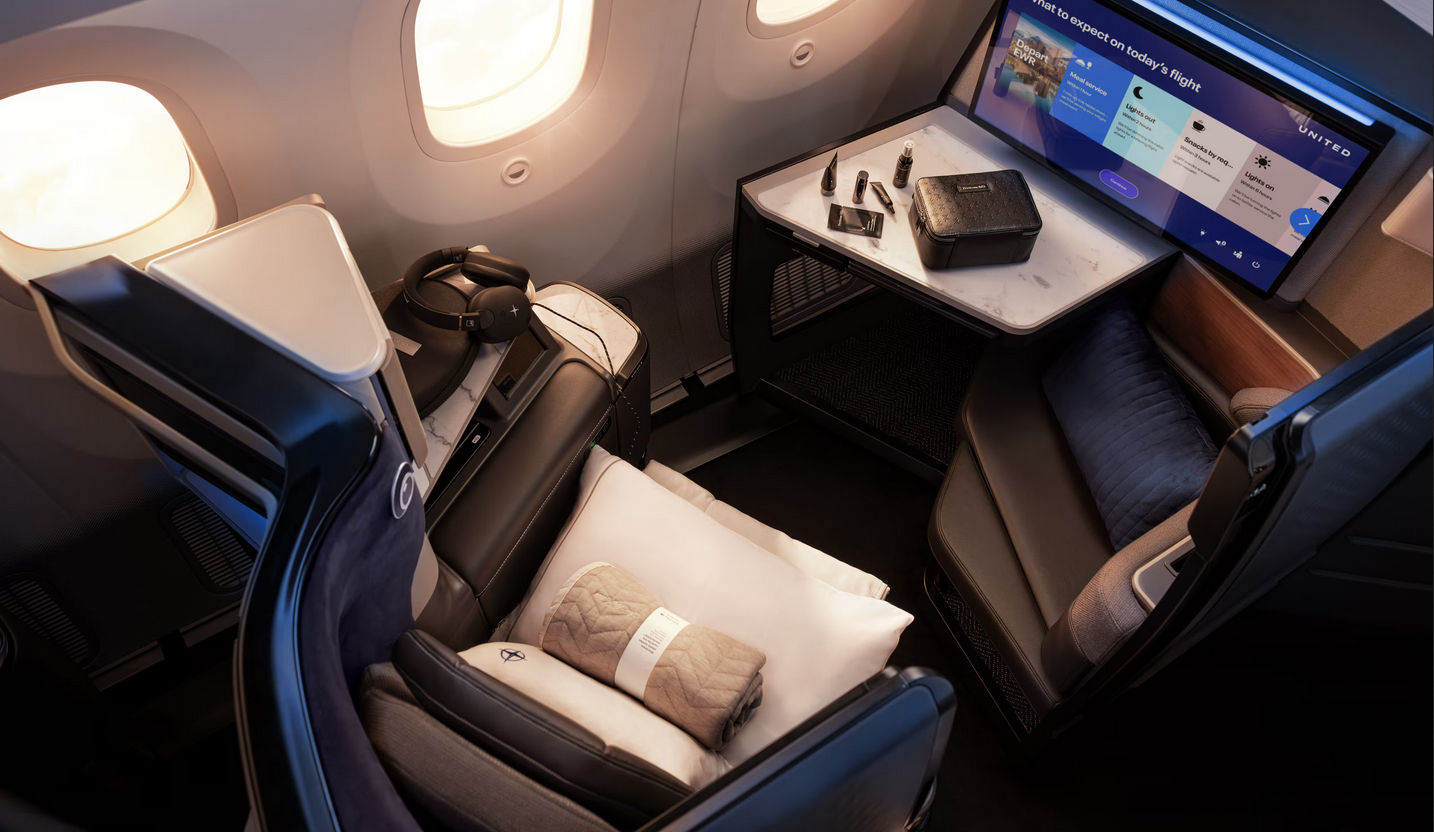
 United's "Elevated" Polaris seats will debut between San Francisco and Singapore on April 22 and between SFO and Heathrow on April 30.
Airlines, both domestic and international, are betting big on premium, the demand for which has skyrocketed since the recovery from the pandemic. It's relatively early days in terms of expanded business class and premium economy cabins taking inventory away from the main cabin, but it is happening—and it's about to accelerate as carriers take delivery of new aircraft or complete retrofits with additional premium seats a priority.
Take United Airlines' Boeing 787-9 Dreamliner with its new Elevated interior, announced last year, being added to service between San Francisco and Singapore on April 22, followed by flights between SFO and London Heathrow on April 30. The plane offers 222 seats, down from 257 in its previous configuration. It will include eight of the new Polaris Studio seats, 56 Polaris seats (up from 48), 35 Premium Plus seats (up from 21), 33 Economy Plus seats (down from 39) and 90 Economy seats (down from 149).
In total, the 99 premium seats will account for about 45 percent of total seats, up from premium previously accounting for approximately 27 percent of the aircraft.
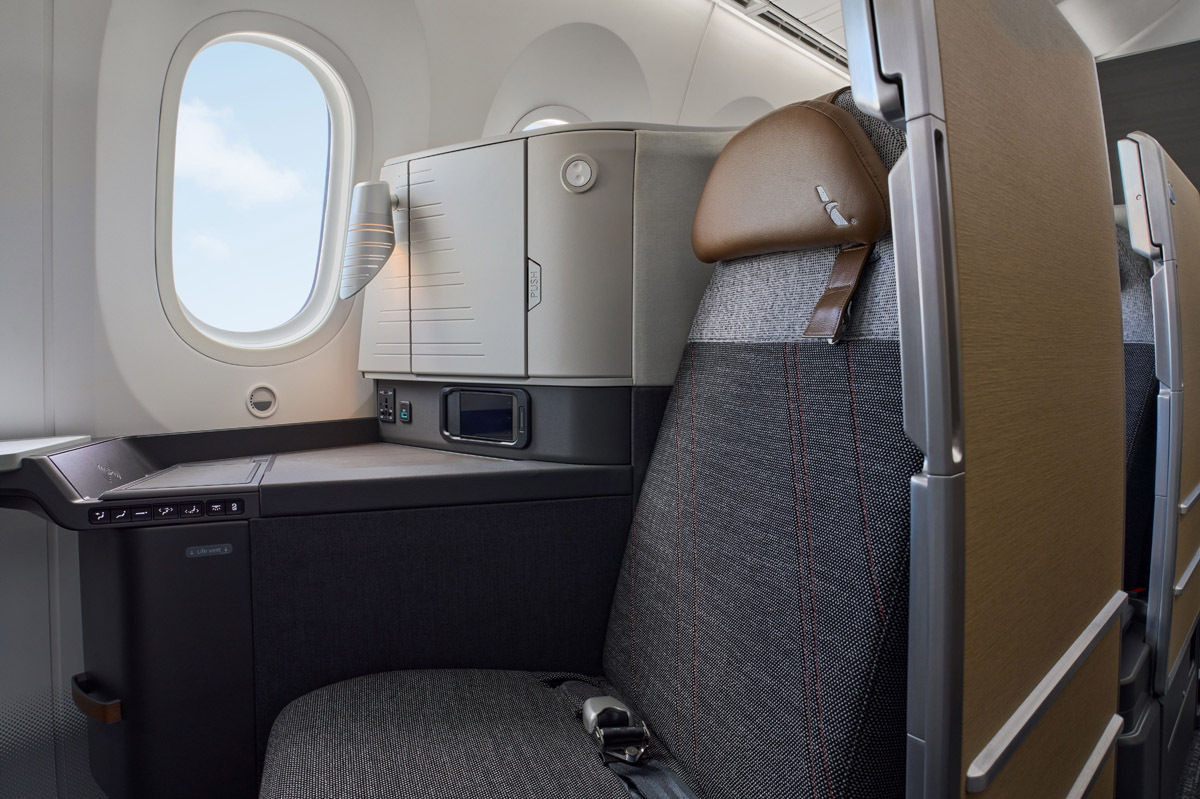 American Airline's Flagship Suite came into service last year.
American Airlines similarly in 2025 launched its new premium Boeing 787-9 aircraft with the carrier's new Flagship Suite and upgraded premium economy cabins.
This shift is starting to affect corporate programs.
"Increases in business and premium economy are certainly having an impact," Oracle director of global travel sourcing and GPO Rita Visser said. "For those who have economy in their policies, it means less seats. For those who don't have premium economy in their policy, it means more of the aircraft is not on the shelf."
Not only are there fewer main cabin seats, but also "lower fares are harder to come by," FCM Consulting senior consultant for air Jason Kramer noted. "It's all about profitability. If you create a scarcity for a product, it initiates greater demand, which will allow for higher prices."
Indeed, all three of the largest U.S. global carriers during their January earnings calls touted the outperformance of premium cabins to the main cabin in Q4 2025 or for the full year.
United chief commercial officer Andrew Nocella said that premium-cabin revenue was up 12 percent year over year for the fourth quarter, and premium passenger revenue per available seat mile outperformed main cabin PRASM by almost 10 points. For the full year, premium revenue increased about 11 percent compared with 2024, while standard and basic economy revenues were down approximately 5 percent.
American CFO Devon May said that fourth quarter premium unit revenue outpaced main cabin by seven points year over year. American president and CEO Robert Isom noted an expected continued improvement in premium unit revenue. "I don't think we're a lot different than our competitors," he said. "We see about 50 percent of our revenue being driven by premium offerings," and the carrier plans to deliver "significant premium-seat growth over the coming years, nearly twice the rate of main-cabin seats."
Delta's Hauenstein said that in 2025, premium revenue grew 7 percent year over year, but the carrier has "not really seen main cabin move yet." He added that in 2026, Delta plans to grow capacity by 3 percent from a year prior, "with all new seat growth concentrated in the premium cabin, driven by interior upgrades and new aircraft deliveries."
Still, some corporates might benefit from the increase in premium economy.
"What I've seen from the big three and others globally is those that have a sizeable premium-economy cabin, their discounts have increased almost across the board over the last 12, 24 months," Kramer said. "I'm not seeing any corresponding [additional] discounts in business-class or fixed fares. I would argue that's more a consequence of [business] still is the volume that the airlines want to win and attract, so they're not willing to pillage their business-class cabin or the revenue they can generate in [it]."
Availability Concerns?
Consultant and former travel buyer Colleen Kearney believes we're going to see more corporates competing with high-spend leisure travelers for those premium seats. She may be right.
In an on-stage interview at The Beat Live in December, United's Nocella noted that there "is a lot less corporate business than it used to be" prior to the pandemic, and that the carrier has been "very effective in filling what were once corporate seats with premium leisure seats," he said. "The world has changed. Your business travel policies have changed. I want you to go back to what it was. That would be easier for all of us."
But business travel—while for some companies still may not be back to 2019 levels or be where it should be when taking a relationship to gross domestic product into account—has been returning. And those main cabins are shrinking.
"And they're not shrinking by accident," Kramer said, bringing up the bottom line again. "Airlines are deliberately adding capacity to premium cabins at the expense of main cabin to improve profitability. Let's not kid ourselves into thinking this is because airlines are trying to improve our standards of comfort."
"There's going to be pressure to look at the flexibility to sit in those premium seats for corporate travelers because of the availability," Kearney said. "Corporate buyers are really going to have to take a look at their policy and clarify who qualifies, because there's going to be more limited availability in the rest of the cabin."
Visser said she hasn't heard travelers not being able to find a seat, even though her company's travel policy does not allow for premium economy, except for when business class is allowed on certain flights, then travelers can see the next lower premium cabin in the booking tool, "but I would say the ability to get a low-inventory seat and/or better pricing is a challenge," she added. "If you start to push that upper level on a price point, are you getting to a point where a high-price economy seat is more expensive than a low-yield premium economy seat that [a traveler] can see on airline.com? And because it's not on our shelf, it's not in our policy, we aren't showing that. So, there's lots of weirdness in that."
If there is no availability and someone must travel, "there is what we call the fall-back rule," Advito managing director and SVP Olivier Benoit said. "What happens when you get stuck and you're not allowed premium but there is no other option? Then it's better that it's already in the travel policy because usually it's last minute, so you don't want to navigate the web of 20 phone calls to get an authorization."
Benoit added that the impact is different by verticals. Some, like automotive, will most likely primarily travel in economy. But financial firms, banking, professional services, "they are more in the premium cabin, he said. "This challenge will not impact corporate travel the same way depending on the travel policy, and usually it's linked to the vertical."
When asked at a March United event that focused on new premium offerings how the airline would ensure corporates could get the premium seating they desired—would it be through distribution? Negotiations on upgrades? Policy?—Nocella said it would be through a combination of all the above.
"But the key thing is the number of premium seats," he added. "What we found is we were selling out way too often, and corporate customers buy at the last moment. If you don't get that mathematical equation correct, you could wind up having sold to all leisure folks and not have enough seats."
Nocella added that United was averaging 50 business-class seats per airplane, and particularly with the new Boeing 787-9 Dreamliners coming online, "we're going to solve that problem," he said. "We're going to create more opportunities for upgrades and more opportunities for reward redemptions as well as by having a bigger aircraft to work with."
And for the smaller economy cabin? "When you get on this aircraft [the new configured Dreamliners], the main cabin is not gigantic, but it is cozy," he said. "It is beautiful, and it is comfortable for a main cabin experience."
Policy Considerations
New premium cabins also can add complexity to travel program options, and therefore policy.
Benoit noted that the multiple options can benefit a program, because "you have a better ability to manage costs and potentially provide better services from a wellbeing perspective to travelers," he said. "On the other hand, it creates complexity and potentially confusion, and it requires travel managers to be very clear, to be very specific on what is in [policy], what is out, what is possible, what is paid by the company and what is potentially allowed for the traveler to pay with their own money."
Some companies are considering lengthening the flight time to qualify for business class and instead will have travelers fly in premium economy instead.
Kramer said Advito's clients are having discussions around if there is a need for a matrix-like policy. "You'll still get your executives that will fly in business class, but for the rank and file, it starts to become a conversation around, 'If I'm going to fly from New York to London and land at 10 in the morning, but my first meeting isn't until the following day, does that require me to have a lie-flat seat in business class?' But then if day of travel they land at 10 a.m. and have to work upon arrival, that lie-flat seat, those meals and amenities in business class will allow that traveler to arrive refreshed and ready to work."
The same goes for a return trip from London to New York. "That's a daytime flight, so does it necessitate the higher cost of business class?" Kramer added. So, those six-hour flights over the Atlantic that would qualify for business class, now that is potentially changing to anything greater than eight hours.
"That six-to-eight-hour window would then be premium economy because they are relatively short flights," Kramer said. "Those types of matrix-like active conversations are happening on the policy side."
"Basic" Premium Fares
Adding an additional challenge is the increase in fare segmentation.
"More and more airlines are getting into micro-segmentation, either adding cabins or adding different options within a cabin," Benoit said. "From a travel policy perspective, there is an impact, absolutely, because our clients now have to address something that is far more complex than [just] 'business' or 'economy.' "
On April 3, United Airlines announced that later this year it would add tiered pricing—"base, standard and flexible"—to its premium cabins Polaris and Premium Plus. Former Delta Air Lines president Glen Hauenstein during a January earnings call indicated the Atlanta-based carrier planned to do the same for its premium cabins. Delta already in November added segmentation on its Comfort cabin, and now offers "Basic, Classic and Extra" for that class as well as for its main cabin.
Corporations typically block basic main-cabin fares from their programs. But will that change, now that the tiered systems will affect premium cabins as well?
Because those fares haven't been introduced yet, "the anecdotal decision at this point is to block it under the same premise as basic economy when that was first introduced," Kramer said. "I don't want my travelers to go to the airport without a seat assignment, without a guarantee they're going to get on that seat to go conduct that client meeting."
Benoit pointed out that booking a basic ticket in any cabin was risky, but also that it's a question of usage. "If you have a meeting to attend with a set date that is strategic, the date is not going to move, if you have a non-flexible ticket, you may go for it," he said. "But that's a very specific situation. If it's to go to a client meeting, which can shift one day before, then you do not take that risk."
Visser said "peer network" responses to micro-segmentation and having basic added to premium cabins have varied. Some are looking at those solutions for when they might make sense, she said, but others don't want to take the limited flexibility of a basic product.
"It's more of a varied response in the business basic or premium basic products because what are you trying to solve for?" she said. "Is it cost savings? It is experience? It depends upon what goals people are trying to meet internally."