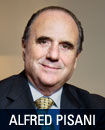
 Alfred Pisani
With the recent opening of the Corinthia Hotel London, the
brand's ninth property, chairman Alfred Pisani said the brand, which began as a
single property in Malta, is nearing a point of "critical mass," when
it could begin a more rapid expansion with third-party development. Pisani and
Corinthia board director and former CEO Tony Potter (see clarification below) recently spoke with Business Travel News lodging
editor Michael B. Baker about expansion plans and the role corporate and group
business will play in Corinthia's growth. Pisani also discussed offering
24-hour check-in at the London property—allowing travelers to pre-arrange
check-in outside of a standard afternoon time—an amenity that's becoming more common.
What's your strategy for expansion?
Alfred Pisani: We're located in Prague and Budapest. We're in Lisbon, and we also went to St. Petersburg, where we have a beautiful property. We're in Tunis and Tripoli and have opened this one in London. We'd like to come [to New York] and go to Paris and all of the capitals. For the last 12 years, our focus has been purely on five-star properties and mainly the known capitals, so this gives us exposure. Ultimately, we may not need to constantly buy our way [in] by developing our own properties, but instead third parties will ask us to manage their properties by using our brands. Once we have the critical mass of 16 hotels, we will be sufficiently known. The soul of your operation, to us, is cardinal. I am happy that as long as we are of a certain size, we've managed to maintain the family culture.
 Tony Potter: We're respectful of the big brands, but when you wake up in a country at a Marriott or Hilton, you'll say, "Where am I?" because they're exactly the same. We think that the hotel owner looking for a management contract will be attracted to a family enterprise. Our role model is more of a Peninsula or Shangri-La-type opportunity, and there aren't many of those in the West, if any.
How much of your business is corporate travel?
Pisani: It varies from destination to destination, but I would think about 35 percent, and it should grow. Our property in Lisbon has the most varied and largest meeting rooms. We are also the number one hotel [for meetings] in Budapest because of the facilities we offer. We have the same situation in St. Petersburg. In the case of London, we do have a lovely ballroom, which is used for meetings and so on, and there are seven other meeting rooms with the business centers you would normally find, but we are more focused on the affluent individuals.
Have you been growing your sales team?
Potter: For a small organization, we have a very wide reach. We have sales offices all across Europe. We have a sales office here in America and we work through the Joe Carino Collection. One thing Corinthia did some years ago, which was the right thing, was to focus on distribution. We have our own reservations platform, completely independent. We've got our own chain code. We've brought in quite a lot of money and expertise to work with us in Malta to get the distribution systems correct. We continue to expand our sales network. It's quite expensive opening an office in a particular country, so we're quite selective. We recently have been looking at opening an office in South America. We have a small office now that feeds our Lisbon operation, but we're looking at building a bigger one. We don't have 25 million people as a member of our loyalty club, but we do have the right representation and the right places.
Have expectations of luxury properties changed in recent years?
Pisani: Today's luxury customer is not so much focused on his attire. It's quite remarkable how casual some people may present themselves. There's far more focus on the quality of the service and the general ambience of the building, and this is what we consider to be our model in every property we want to develop. The corporate traveler is different than the leisure traveler in that he's more focused when he gets to the hotel, having just come from a long distance. He wants quick service then up to the room. With the leisure traveler, you're a couple and you're enjoying the moment, the new location. It really brings a different style of servicing. The high-tech services in the room are of extreme importance. If you had to look back 40 years, I don't think the corporate traveler had such demanding and exacting expectations as today, so you've had to adapt and accommodate.
What has been your sales strategy on the group side?
Potter: We've got quite a few interesting sales products we're very proud of. We have Events at Corinthia, which is our conference product. We had Meet for Free, which was a promotion we targeted at large businesses, and it went well for three years. In the one we're doing now, every fifth delegate has a meeting package free, and every fifth delegate up to a certain maximum has a bedroom free, so it gives the smaller conference organizer an opportunity to buy economically. We felt this was important with the economy for the last few years, as we didn't want to discount our basic room rates, so we felt it was good to give the buyer discounts on the basis of volume.
Why did you introduce 24-hour check-in in London, and is that something you plan to introduce at your other properties?
Pisani: You have a big percentage coming in and having to wait. You probably haven't slept on the plane and want to shave. And they have to make noise about this. Arriving at 7:30 in London, you get to the hotel by 8 and then you have to hang around the hotel until 1. We give you the room before that. It's a financial equation on how this can balance out. Maybe you've lost 5 percent of occupancy to do that, so think about what this 5 percent cost is and spread it.
CLARIFICATION: An earlier version of this interview identified Tony Potter as CEO, but Corinthia Hotels this week disclosed
that late last year he stepped down from that position. He continues to serve as
board director.