A Global Business Travel Association survey of 408 travel
managers and 368 suppliers and intermediary representatives documented business
travel growth in 2024 and projected additional spend and volume expansion going
into 2025.
The survey, conducted in January, found that 48 percent of
travel buyer respondents expected their organizations to travel more in 2025
than they did in 2024. And 57 percent expected to spend more on business travel
in 2025, even if a slice of that percentage didn’t expect employees would take
more trips. More than 70 percent of respondents said their companies traveled
more in 2024 than they did in 2023.
Those sequential gains were prevalent across all geographies
and all program sizes, according to the GBTA survey. In North America, Latin
America and Asia-Pacific, three-quarters of respondents (and slightly higher in
Latin America and Asia-Pac) said their travel volumes had increased in 2024.
Only Europe lagged the trend, with 64 percent increasing trip volume in 2024
compared to 2023.
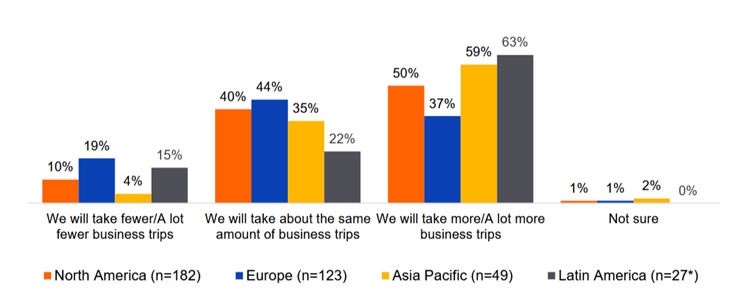
European was notable, again, for its outlook on 2025. Only
37 percent of European buyers said their companies would travel more this year
compared to last. The region’s focus on carbon emissions may come into play for
these expectations. Among North American travel managers, 59 percent said their
organizations would “more” or “a lot more” trips in 2025. That was fewer than
in Asia-Pacific and Latin America, where 59 percent and 63 percent of travel
managers, respectively, expected company employees to take “more” or “a lot
more” trips this year.
_____________________________________________________________________
How Travel Volume Will Change in 2025
(per region)
 Credit: Global Business Travel Association, January 2025 Survey
_____________________________________________________________________
Revenue generating sales travel will lead in terms of trip
purpose in 2025. That’s fairly closely followed, however, by travel associated
with internal meetings, which survey respondents on average said would account
for 21 percent of travel volume this year. External conferences and exhibitions
followed at 14 percent, while training and supplier meetings fell lower companies’
priorities for travel.
Pricing and budget concerns top the list of issues faced by
travel buyers and managers in 2025. Eighty-one percent of travel buyers listed the
rising cost of travel as a significant issue for this year, and half of
respondents expected their budgets may not handle the pricing pressure. Bigger
picture economic concerns and geo-political friction were on the minds of 49
percent and 44 percent of buyers respectively. That topped the number of buyers
who had heightened concerns about travel disruptions, which is notable. Just 37
percent of travel buyers listed that as a critical issue going into 2025. Only
a third listed tech advancements and artificial intelligence as top-of-mind in
their programs.
Buyer concerns in that sense were quite different from
suppliers and travel management company reps who participated in the survey. Just
over half of suppliers and TMC reps listed travel costs as a top concern. Suppliers
were more concerned about the overall economic picture, with 55 percent noting uncertainty.
Forty-seven percent had their minds on AI, showing suppliers much more engaged
with tech changes than buyers this year.
That may be due to the idea that many buyers rely on their
TMCs to outfit them with the proper technology to run a travel program. With
that in mind, 30 percent of travel managers surveyed said they were going out
to bid for a new TMC this year—and many of them reported the initiative was
precipitated by deficient tech or lack of access to New Distribution Capability
content or support. Seventeen percent of respondents said they were already
implementing a new TMC partner. That makes 47 percent either implementing or
evaluating a new TMC—that’s a huge shift.
Forty-one percent said they would be evaluating and possibly
changing payment solutions (much of this was concentrated in Europe and Asia-Pacific).
Thirty-one percent said they would be evaluating new booking tools, while 20
percent said they would be evaluating or changing their expense tool. Asia-Pacific-based
buyers led the pack on several key initiatives, like willingness to integrate
AI or other significant technology into travel management practices. Asia-Pac
also led the way in plans to implement sustainability practices in 2025. North
America was last on sustainability plans.