Perhaps against logic, 2008 for the business travel industry
began with high hopes. Travel budgets were flowing again, suppliers—particularly
hotels—were driving high prices. Airlines were still working hard to figure out
finances, however, with high fuel costs.
That said, business travel revenues seemed promising. Airlines
made pricing maneuvers like unbundling services and requiring minimum stays to
maximize revenues. Unbundling strategies have proven a durable vexation for
travel managers, but a veritable goldmine for airlines that continues to fuel sophisticated
merchandizing strategies we talk about today.
2008 would see Northwest and Delta initiate a merger—to the
chagrin of many travel managers who worried about fewer choices and a possible
decline in service. But the combination resulted in a healthier airline under
the direction of Richard Anderson, who had been CEO of Northwest from 2001 to 2004.
It would take a few years for that tie-up to prove itself—and the fact that it
got its pilot unions to agree to a merged contract in 2008 prior to finalizing
the airline merger was a big deal. Financial health for the new Delta looked
skyward before operations and service did; the airlines competed their
integration in January 2011. United-Continental and Southwest-AirTran read the
tea leaves in the interim, initiating their own mergers in 2010.
But that was in the future… in 2008 there was still a lot of
uncertainty to get through for the airline industry. It was a year of rising
fuel costs in the first half of the year, domestic capacity cuts, and three
small carriers shut down entirely: Aloha Airgroup, ATA Airlines and Skybus
Airlines.
However, all was not dark: It was also a year of transatlantic
partnerships and expansion.
The Open Skies agreement between the United States and the
European Union precipitated some big moves. This included at least one critical
alliance switch—Continental initiated a switch from the SkyTeam alliance (and a
partnership with Delta and Northwest) to joint the Star Alliance, which put
them in a group with United, Lufthansa and Air Canada among other airlines. The
four, however, applied for antitrust immunity to form the Atlantic++ joint
venture that still operates today and was underpinned then by the new Open
Skies agreement, according to DOT records.
British Airways also saw opportunity with Open Skies, going so
far as to launch a namesake airline OpenSkies for new transatlantic service
that could expand landing rights beyond Heathrow its hub. In 2009 the airline
acquired private French carrier L’Avion to strengthen its non-Heathrow routes
to the U.S. It would eventually make additional expansions to major European
gateways before converting the airline to low-cost carrier in 2018 and then
shuttering due to Covid declines in 2020.
As the skies were opening up, so were the minds of business
travel industry professionals—and they were looking beyond Europe, which from a
travel management perspective was already well established ground. Asia,
however, was not, but demand was growing.
According to an American Express Business Travel survey of
Chinese client companies based in Beijing, Guangzhou and Shanghai, dedicated
travel management was on the rise in the region in 2008, especially for companies
with more than 500 employees. At the same time, cost control measures were down
year-over-year, while travel costs themselves were rising across the region. At
least in the first half of the year.
BTN reported in May that BCD Holdings was looking to strengthen
its presence across Asia-Pacific.
"Without any doubt, we must get stronger in the Far
East," BCD Group founder and BCD Holdings shareholder John Fentener van
Vlissingen told BTN at the time. "We have to be one of the top three. Our
investment there in Jepsen [a TMC with a mainland subsidiary in China] was
clearly a very good move." Van Vlissingen noted 50 percent of “Far East”
business was originating in China. "India is growing, but it's not the
same," he said. "Even Thailand or Vietnam might look exciting, but
it's all less than 1 percent. So is it wise to go in all of these countries?
That's part of what we'll look at. Without any doubt, we have to be strong in
China, India and Australia."
CWT, as well, was growing its presence in Asia-Pacific. Then-newly-minted
CEO Douglas Anderson, showed BTN a very conservative stance on the TMC’s growth
in the midst of economic uncertainty especially in the U.S. during a July interview,
but did reveal that the mega was “performing and growing nicely in Latin
America and Asia-Pacific.” That included major client wins like Bayer, which
took its travel program global in 2008, with BCD in the United States but with CWT
in Asia, EMEA and Latin America. CWT in the first half of 2008 saw 39 percent
growth in China, according to its July earnings.
The Global Economy Melts Down
Financial markets going into 2008 were actually not looking
good. The travel industry saw it; and for business travel, the first several
months of the year showed sentiments that perhaps the situation would be
limited to finance and banking industries—two critical client bases, but perhaps
not a devastating drop for the industry overall.
Merrill Lynch, a 95-year-old banking and financial firm, ended
2007 $10 billion in the red in the subprime mortgage fallout. It was acquired
by Bank of America in 2009 despite losing $15 billion more. The brand would
live for 10 more years. Bear Stearns collapsed in March, but had a regulated
bailout arranged through J.P. Morgan Chase.
By May, economic uncertainty was pushing into business travel
budgets. BTN reported on a UBS survey that showed 42 percent of buyers with
more than $10 million in annual air volume pulling back on their spending. That
figure was up from 27 percent in October 2007, representing the largest
pullback over the duration of that twice annual survey, at that time. Hoteliers,
by May, were reporting sluggish demand and some buyers were looking at
opportunities to renegotiate.
By September, when Lehman Brothers collapsed—and neither the
fed nor private industry could come to its aid—the bottom fell out of both the
economy and business travel. And markets around the globe, including Europe,
including Asia and including Latin America were swept up in the maelstrom.
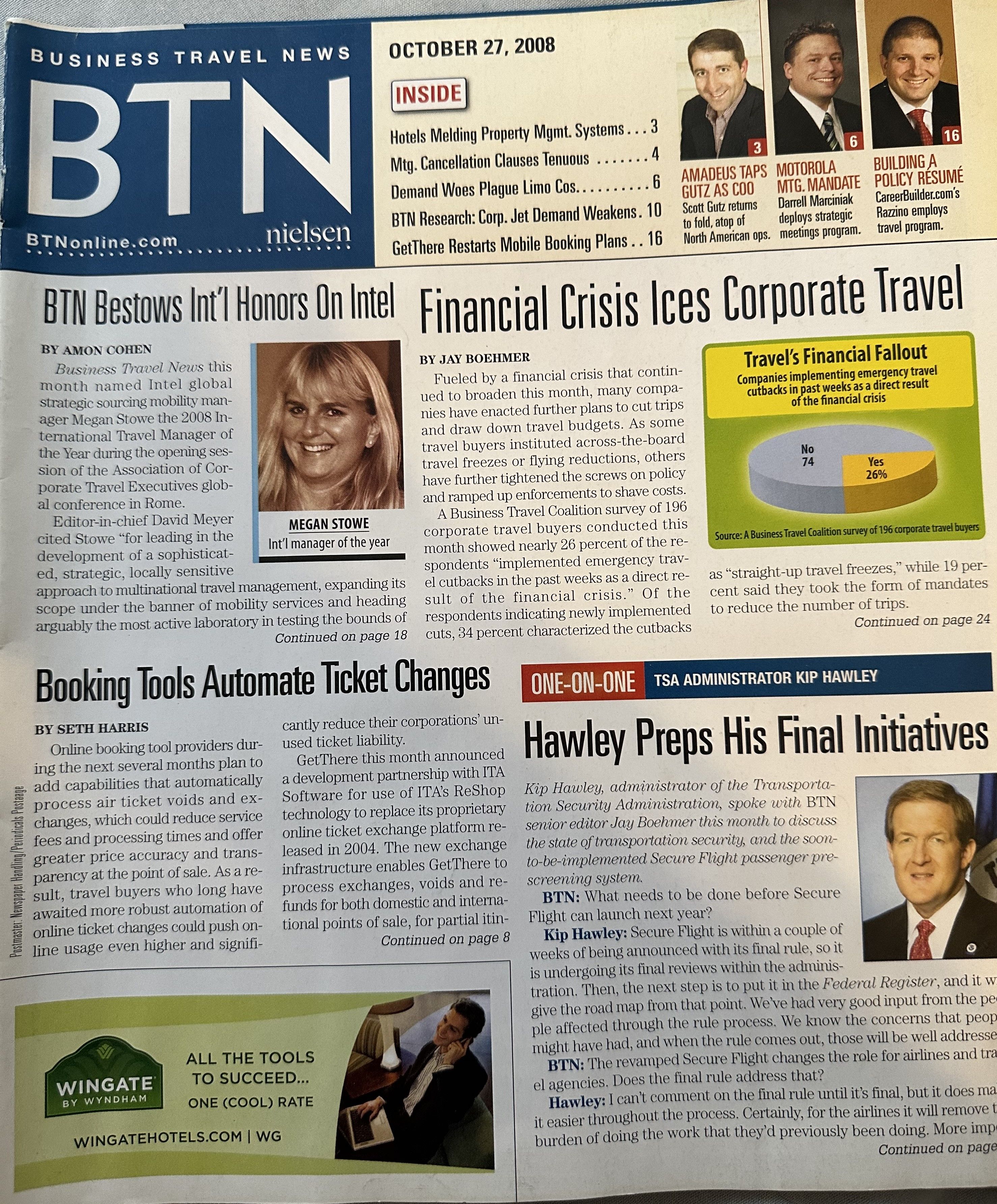
BTN’s October 27 issue was headlined “Financial Crisis Ices
Corporate Travel” and by November suppliers that had been projecting corporate
travel price hikes were staring down a demand cliff. “Financial Fallout Flips ’09
Forecasts.” Both buyers and suppliers delayed negotiations to see if the markets
would regulate before making big decisions.
They didn’t.
_______________________________________________________________________

January
Adjusting its corporate sales strategy to be designed around customers instead of individual hotels, Marriott International moves a chunk of its sales team into account and region-based roles.
As major domestic airline consolidation becomes more likely, buyers express concerns that mergers would cut capacity, increase fares and continue to lower the quality of service.
British Airways announces it will have a new transatlantic carrier called OpenSkies, led by former BA executive Dale Moss. This is partly in response to the growing competition at London Heathrow after the signing of the Open Skies deal between the U.S. and European Union, which goes into effect by end of March 2008.
The U.S. General Services Administration deploys its end-to-end E-Gov Travel Services program to automate all travel booking, reporting and reimbursement processes in one web-enabled system. This is also an operational cost-cutting effort for GSA.
February
Six domestic carriers namely Alaska Airlines, American Airlines, Continental Airlines, JetBlue Airways, Southwest Airlines, and Virgin America gain traction on inflight Internet.
Carlson Wagonlit Travel claims it surpassed competitor American Express in its sales from Q4 2006 to Q3 2007. But this only includes travel sales of booked travel from wholly owned locations and excludes transaction and service fees.
To mitigate high fuel costs and drive pricing efforts, major U.S. carriers plan to further reduce domestic capacity.
Car rental buyers consolidate relationships to one- or two-year deals with two car rental companies. Analysts notice a trend toward more formal contract terms and negotiation times.
March
Organizations traveling to or within the U.K. strive to improve health and safety processes before the Corporate Manslaughter and Corporate Homicide Act becomes effective on April 6.
The corporate travel industry begins to reap the benefits of social networking. Buyers test internal community forums, discussion boards and blogs for policy engagement. Some suppliers plan to introduce their own social networking products.
More travel buyers trade down to add more midprice properties to their hotel programs due to cost control, new amenities and all-inclusive pricing.
In the U.S., U.K., and Western Europe, BCD Travel and HRG scale up tests of internally developed super passenger name record platforms to lessen reliance on GDSs, allow for more agent flexibility, improve data collection and protect buyers from GDS fees.
The Transportation Security Administration works to roll out to six more airports a free pilot program that lets travelers choose security lanes geared to their comfort with checkpoint screening processes.
Singapore Airlines reveals that starting mid-May 2008, it will offer the first all-business-class nonstop transpacific service.
April
Delta Air Lines announces the intention to merge with Northwest Airlines for an all-stock deal valued at $17.7 billion. Many business travel buyers think such a merger will prompt more consolidation, lessen competition, reduce U.S. capacity and further degrade service.
United Airlines and Continental contemplate a merger announcement but don't go through with it.
May
American Express buys GE Money's Corporate Payment Services, while Discover Financial Services buys Citigroup’s Diners Club International. Corporate travel buyers anticipate fewer options for card programs but increased reporting and acceptance.
There’s a rise in airfare unbundling and upselling. Buyers say it makes travel and expense management complex but expect airlines will accelerate the practice.
Carlson Hotels looks to invest in the Asian market and keep growing its brands, according to CEO Jay Witzel and Americas president Paul Kirwin.
Wanting to drive revenue and push corporate travelers into higher fare tiers, several U.S. carriers increase minimum-stay requirements on some routes.
The number of onsite agency configurations designated by the Airlines Reporting Corporation has significantly dropped because of factors like online booking, widespread e-ticketing and costs of maintaining in-house agents.
Concur partners with RideCharge to let customers expense taxi and sedan rides through mobile phones and have the charges directly uploaded into Concur.
BDC Holdings founder John Fentener van Vlissingen becomes a majority shareholder of Hogg Robinson Group. BCD hopes to invest more in Asia-Pacific and emerging markets, and to focus more on the midmarket sector.
Amidst the 2008 financial crisis, travel buyers see a slower domestic demand for hotels. Some believe this could work in their favor with rate negotiations.
Planning to expand internationally, JetBlue Airways hires British Airways’ Robin Hayes as executive vice president and chief commercial officer.
June
Siemens director Steven Schoen collaborates with BCD and Sabre to protect his firm’s corporate travel data from being sold to third parties.
Domestic airlines continue to deal with rising fuel costs by reducing capacity, employee count and fleets. More cutbacks are forecasted to result in pricier fares, more crowded planes and decreased routes.
With the economic downturn, travel buyers are tightening budgets and reducing the number of trips for their companies.
Maritz creates a data warehouse for its strategic meetings management clients, to provide detailed reports on meetings metrics and history.
Citing service demand and rising costs, Amtrak deliberates on modifying corporate discount thresholds on its Acela Express rail service.
Hotel CEOs brace themselves for fewer rate hikes and more discounts in the upcoming business hotel negotiating season.
British Airways’ OpenSkies subsidiary launches service between Orly and JFK.
July
Continental Airlines seeks to move away from SkyTeam and into Star Alliance. It seeked to establish a four-way joint venture with United, Air Canada and Lufthansa, similar to what its SkyTeam partners built.
With gas prices still on the rise, major U.S. cities like Chicago, Philadelphia, Washington D.C. and Miami-Dade start or consider taxi fuel surcharges, adjusting meter rates or adding temporary surcharges.
Delayed hotel negotiations bode ill for suppliers in 2009, with some buyers reluctant to pursue multiyear agreements. They see the 2008 banking crisis as a chance to revisit existing deals for the year.
Carriers like American, United, and US Airways introduce waived first-checked-bag fees for their elite status members.
Orbitz for Business plans to extend its global booking platform to non-English speaking European markets in 2009. It will also consolidate its platform with the former Travelport for Business.
StarCite offers buyers and hotels real-time quoted group room rates, averaged by city and property tier, based on e-RFP data.
Across various industries, business travel programs keep getting downsized. Some buyers report their travel spending has been lowered by more than 20%.
The National Business Travel Association introduces its first comprehensive airline RFP template at its 2008 international convention, in an attempt to standardize airline negotiation.
Online booking tools have been updating point-of-sale interfaces to meet U.S. Department of Transportation regulations for addition of airline baggage fees and further unbundling of services.
While still on track to meet its annual supply growth target, Marriott undergoes a 17 percent year-over-year drop in profit and lagging domestic revenue growth in the second quarter of 2008. This further denotes a hotel negotiation season that leans toward buyers.
August
United Airlines and CWT go their separate ways, as the carrier tries to cut $80 million in annual agency incentive programs.
Amadeus and Travelport GDS say they are unveiling new point-of-sale desktop tools in 2009. Improvements include the movement of profile info into stand-alone databases, to give agencies more flexible options and less reliance on a single GDS for content.
The 2008 NBTA convention gets shortly disrupted by an earthquake that impacted its venue in Los Angeles. Attendees grapple with issues like fuel prices, air fees, and luggage charges. Meanwhile Alan Greenspan, former chairman of the Federal Reserve Board, speaks on long-term changes for corporate travel.
Major expense reporting suppliers disclose new partnerships, product enhancements, or acquisitions. Most notably, Concur bags a 13 percent investment from American Express and expands its analytics capabilities.
Worktopia sets up a new version of its tool that lets clients search and book space, audiovisual services and catering for small meetings online. With the corporate edition of the tool, clients can load preferred suppliers and rates.
September
Sabre CEO Sam Gilliland is interviewed about the travel distribution outlook, airline merchandizing initiatives and the next wave of the firm's business travel offerings.
GDSs are upping inducement compensation and tapping more aggressively into non-traditional markets like North America, as they aim to gain share from big players like Sabre. This is part of a wider strategy to secure contracts, but providers like Amadeus and Travelport also stress long-term value beyond incentives.
Airfares are expected to keep skyrocketing in 2009 due to fuel costs, capacity cuts, and surcharges. CWT predicts domestic fares will rise up to 12 percent and international fares by 16 to 20 percent. Thus, companies are finding ways to control air spend like advanced purchases, switching to economy class, and staying with preferred suppliers.
American Airlines leverages connectivity provider Aircell to become the first U.S. carrier to debut full wireless inflight Internet. Other local carriers also make strides to offer Wi-Fi in the sky. Delta Air Lines and Virgin America have partnered with Aircell as well.
American Airlines, British Airways, and Iberia have strengthened their Oneworld alliance. Together they have also filed for antitrust immunity with the U.S. Department of Transportation.
Pharmaceutical giant Bayer implements a two-agency global travel management configuration with BCD Travel and CWT.
Verizon increases its remote conferencing use to lower meetings spending or unnecessary travel and to support sustainability efforts.
As Wall Street weathers financial collapse, buyers foresee reduced hotel occupancy in New York. Those negotiating for 2009 rates are adjusting their expectations and strategies.
While Intel’s corporate booking tool and TMC are still its preferred channels, the company has allowed its U.S. travelers to book domestic flights directly through carrier websites. This policy update follows a three-month trial that showed travelers booking direct saved 10 percent on airfares.
Buyers try to manage airline baggage fees by revising policies, using preferred status for fee exemptions, and examining budgeting and negotiation tools.
Southwest Airlines is listed among the top choice carriers of BP, Lockheed Martin, Wells Fargo, and Intel, which are some of the companies with the highest air spend in the U.S.
October
Fuel surcharges remain inconsistent across flights even within a single airline. Those in the industry lament over how these surcharges are included in fare filings, excluding them from corporate discounts and in some cases, nonrefundable.
Merrill Lynch has been consolidating its travel program, including migrating Asia-Pacific operations to a follow-the-sun platform, and plans to complete its 24-hour service model by end of 2008.
Incentive travel buyers are budgeting more conservatively by bringing fewer attendees on trips and considering alternate locations. They are also looking more closely at internal and external ROI data.
Rearden Commerce acquires Ground Travel Technology Team (GT3) for automating limousine bookings. Hogg Robinson Group, meanwhile, works with GroundScope to start an integrated ground transportation booking service in Europe.
Due to the ongoing financial crisis, many businesses are enforcing corporate travel freezes or reductions across the board, tightening policy and having more budget cuts.
In the hotels category, buyers get mixed reactions to cancellation and attrition terms. Some properties try to be more flexible to fill space, while others stick to their terms. The banking crisis makes negotiating contracts with protective clauses more tenuous.
Online booking tools will soon roll out features that automatically process air ticket voids and exchanges. This not only reduces service fees and processing times but also offers greater price accuracy and transparency. Buyers could then push for more online usage and largely decrease their company’s unused ticket liability.
After cutting ties with Usablenet, GetThere pauses its mobile booking plans. The company says it faced issues with adapting the mobile model for corporate tools and wants to pilot its own mobile solution in the first half of 2009.
November
Compared to previous ones, the latest pricing forecasts predict a better climate for travel buyers in 2009, with more modest fare hikes or even decreases.
GetThere and Concur Cliqbook have enhanced their rail sourcing and added content unavailable through GDSs. Despite this, European travel managers continue to criticize their products as inadequate for Europe.
Industry experts realize that the economic crisis could make it harder for small and midmarket businesses to negotiate corporate travel and entertainment card programs due to tighter credit. Yet it could also present opportunities, as bank consolidation strengthens market players and opens new alternatives to traditional cards.
According to a survey by American Express Business Travel, cost-control measures in China have lessened, with a decline in the use of tools for managing post-trip spending and pre-trip analysis. The TMC has also announced its pre-trip reporting, Ticket Trax unused ticket tracking, and ECO carbon emissions assessment tools, as well as a new version of Trackpoint for traveler tracking.
December
Southwest Airlines' plan to acquire 14 slots at LaGuardia Airport has sparked hope among buyers that the carrier’s entry into the New York market will lower fares. Some analysts say the influence may be limited due to Southwest's minimal market presence and tightening cost structure.
Convention hotels are going through worse revenue and rate declines than the overall hotel industry, with fewer group bookings expected to keep dropping prices for buyers. Hotels could get stricter about terms like cancellation clauses and food and beverage minimums.
U.S. airline executives believe that the industry will become more profitable in 2009, thanks to declining fuel costs and aggressive 2008 capacity cuts.
Internet travel management companies advance their efforts for global expansion, as many of their clients widen their travel program scopes and think about consolidating suppliers.
HRG expedites building its enhanced, common technology platform. The TMC attempts to refocus its technology development goals, redeploy resources, and make product upgrades a higher priority.
American Express Business Travel, managing companywide budget cuts, carefully examines its technology investment by reducing non-client facing staff and closing infrastructure gaps in its global call centers in emerging markets. In the U.S., it aims to finish converting the Sabre and Apollo agent desktops to its internally made Gateway agent workstations by the next year.
Amadeus promotes its commercial head David Jones to president and CEO, as the incumbent José Antonio Tazón gets ready for retirement and a non-executive role as board chairman.
Timeline produced this week by AI and BTN editorial content and engagement manager Gianna Song
_______________________________________________________________________

Elizabeth West is the editorial director of the
BTN Group. She has reported on the business travel and meetings industries for
24 years. Beth was editor-in-chief of Meeting News from 2006 to 2008 and
director of content solutions for ProMedia Travel from 2008 to 2011, when
ProMedia was acquired by Northstar Travel Media and merged with BTN. She became
editor-in-chief of BTN in 2015 and editorial director of the BTN Group in
2019.
_______________________________________________________________________