We’ve arrived in 1990. Start of a new decade. But there’s a
sense of foreboding growing in the economy, corporations are beginning to see
growth slowing and on the political front pressures in the Middle East are rising.
All of this will work together to initiate, in the United States, a brief
recession, one that perhaps leaves a more enduring stamp on the travel industry—especially
airlines, which will struggle to regain profits for at least five years and, as
a result, will see a number of mergers and acquisitions in the first half of
the decade.
At the movies, however, we are shrugging off the uncertainty
with feel-good fare like Pretty Woman or getting moody with epics like Dances
with Wolves, which won the Oscar that year. Edward Scissorhands came down from the scary house on the hill to polarize the neighborhood while doing some artistic yard work. We are carving out Thursday nights for The Simpsons or Twin Peaks, and
we’re Voguing with Madonna and questioning the legitimacy of 911 with Public Enemy.
And as went to the cinema for a date, hit up Blockbuster for a cheap
Friday night at home, or headed to the Camelot Music at the mall with our Walkman,
we probably brought our loyalty cards. Our punchcards or points were traded in
for free popcorn, Camelot “Repeat Performer” gave you a free CD after 20
purchases—Blockbuster was actually late to the loyalty game and didn’t roll out
Blockbuster Rewards until 1998.
But the travel industry was a loyalty leader. Airlines, in particular, had been leveraging the loyalty game for a while. American Airlines introduced the first airline points program AAdvantage in 1981. But both Holiday Inn and Marriott Hotels had joined up by 1983. Hilton, Hyatt and Best Western launched loyalty in the later '80s. By the 90s Marriott was tweaking its loyalty offerings against competitors (see April in the timeline) and re-balancing the financial impacts of loyalty in a softening economy. One executive said Marriott's "moderate scaleback" aimed "to maintain the program in the boundaries of our budget." But other hotel companies were just getting on the loyalty program train. Radisson was one of those planning for a rollout in 1990, and we'll get to that in a moment.
Corporate cards were also eyeing the loyalty game. They sensed a need among business travel managers to rise above the one-to-one supplier solutions that had inundated the market and, frankly, had flummoxed travel programs by tying business traveler loyalties to certain suppliers that often were not aligned with the preferences of the travel manager and company. A feature article in the November 12 issue of BTN began "Those damned frequent flyer programs!" It went on to give some ideas on how travel managers could leverage such programs, but ended on an ominous quote from a former Texaco Inc. travel manager: "You can get in a lot of trouble with this stuff."
So card providers went a little "meta" with their programs to try to ease the trouble. Diner's Club introduced the first corporate card loyalty program in 1990 called Corporate Club Rewards. Points earned on the Diner's Club program could be redeemed across 16 major travel suppliers, giving corporate travel managers a more flexible universe to offer their travelers. That universe may have lost luster when supplier reward tiers went beyond points to offer enhanced experiences for more elite status travelers, motivating program users to concentrate their loyalty with a single supplier.
Seattle-based Seafirst Bank stepped in with an interesting idea, albeit only particularly applicable for clients in the Pacific Northwest region. An article in the July 23 issue of BTN reads "the financial institution is offering companies in the region a credit card that—when used to buy travel from any airline, hotel or car rental agency—provides points redeemable for tickets on carriers including Alaska, Horizon, Northwest, SAS and TWA," i.e. all concentrated carriers in the region, plus, the card-generated points accrued to the corporation. Employees also got points on whatever airline they flew. The bank said it had 300 customers initially on the card. With all those points rolling around, one wonders if Seafirst was, in the Marriott exec's words, "able to maintain the program in the boundaries of the budget."
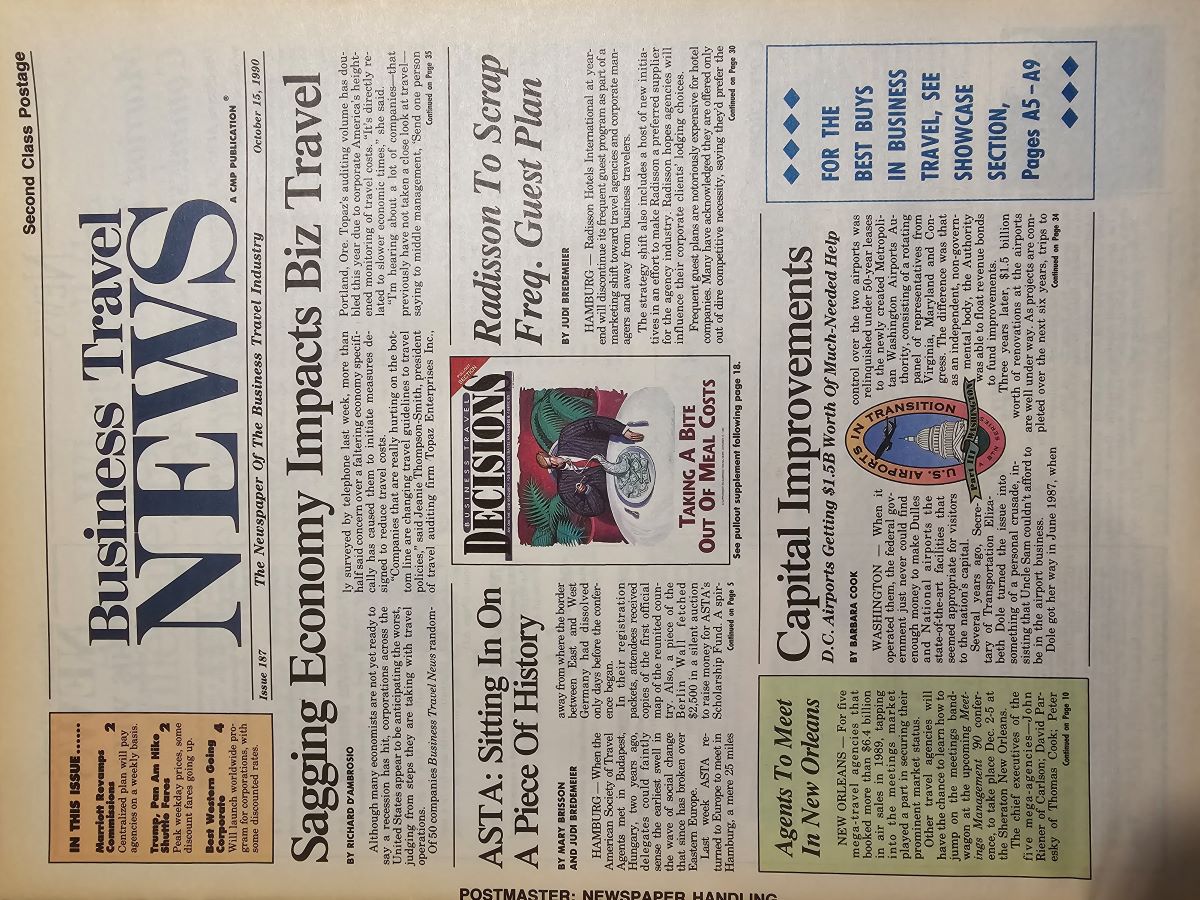
Back to that planned Radisson points program that was ready for a rollout in late 1990. It's hard to say whether it was the tougher economic environment bearing down on the hotel company or a strategic play to drive business travel volume by attracting travel buyers and agencies, but the hotel company claimed the latter when Radisson executives called off the frequent guest rollout. Instead, the hotel company plowed its marketing dollars toward agencies and corporate buyers and avoided an expensive playbook that was clearly making business travel management jobs harder. Radisson ultimately didn't buy into loyalty until 1999.
It's an interesting dynamic that rides along with a lot of interesting changes in the corporate travel industry in 1990. Another notable one is the gradual shift from agency-brokered business travel discounts toward corporate direct discounts. What seemed controversial in 1990—and often cloaked in secrecy and diversion tactics—is commonplace today. Large corporations were commanding larger and larger travel volumes, and those with the biggest budgets were innovating with commercial structures, much as we see today. Look for those instances in the timeline to see who the industry leaders were.
Enjoy this journey through 1990!
_______________________________________________________________________

_______________________________________________________________________

Industry skeptical of Bush administration move to increase airline ticket tax from 8 percent to 10 percent and earmarked for airport and air traffic control upgrades.
Administration adds a proposal for $1 to $4 passenger facility fee a few weeks
later.
Northwest Airlines begins preferring corporate clients who
use agencies that operate on PARS CRS. Does deal with Ford that appears to
discount all corporate rates rather than being tied only to meetings.

Justice Department greenlights Delta-PARS deal, which gives rise
to the JV Worldspan (and eventually Travelport)
Southwest Airlines introduces $59 one-way rates in Calif.
corridor between Oakland and Burbank, challenging mainline carriers avg. $372
round trip SFO to LAX routes; United in July is first to reduce mainline fares but others follow.

Diners Club introduces Corporate Club Rewards to allow companies to generate loyalty points to apply across 16 major travel suppliers.

Eastern Airlines projects 1989 loss of $330 million
Marriott tweaks loyalty program to better align with the company's budget; Hyatt claims its loyalty program now offers travelers more value.
FAA launches airline safety initiative that would eliminate
fines for safety violations if airlines voluntarily uncover and correct them.
ACTE tradeshow operations partner loses confidence in the
organization’s ability to pull off a second event and backs out. ACTE is
surprised and vows to move forward with education conference.
Mega-agency CEOs conference in a BTN-hosted forum to discuss
new revenue streams and service models around group travel and meetings management.
Thomas Cook launches ‘touch-tone’ booking to corporate
travelers, sensing a lack of appetite for “PC-based products”
Marriott sets up its first corporate sales
division, following a growing industry shift toward corporate direct
negotiations. The division has about 10 employees

TWA begins desperate measures to salvage its financial
situation, proposing a lease of its domestic system to America West and using
the profits to invest in its international routes.
Intercontinental sets up corporate discount plan; also plans
to provide more business amenities on corporate floors, floating the idea of
in-room photocopiers and fax machines.
System One launches agency script capability via Prism,
enabling shortcuts for repetitive, multistep functions in the booking pathway;
it’s the third CRS to do so with only Worldspan lagging.

National Car Rental, after three years, repeals its complex
agency commission experiment and reverts to a flat commission percentage
structure.
IVI, having invested in a corporate card partnership a year earlier,
launches a T&E program
DOT sets up Office of Intelligence and Security in response
to a presidential commission that investigated the 1988 terrorist bombing of
Pan Am over Lockerbie, Scotland, and found fault with U.S. intelligence
efforts.
Carlson Travel Network introduces hotel low-rate search software
that includes both client direct negotiated properties and their own negotiated
properties to discover any market rates that undercut negotiations.
DOJ begins antitrust investigations into hub structures to
determine whether they interfere with competition in certain markets.

United Airlines intros bulk-mileage purchasing for individual
employees. “United Pass Plus” is nearly identical to an existing American Airlines program. United
charges $7K per block of 25K miles that must be used within a year.
American Airlines acquires Eastern Airlines Latin America routes.
National Business Travel Association sets objectives to become a legislative force in
Washington, DC
Seattle Bank introduces a corporate card reward program that
attempts to award points only on company preferred airlines, rather than having
travelers sign up directly to airlines for points programs.

Eastern Airlines hit with 60-count indictment for falsifying
maintenance records and coercing employees to sign off on work that was not
done.
Covia launches a dedicated meetings division with about 10 employees.
Gulf Coast crisis—the precursor to the Iraq War—begins to
impact business travel as airlines implement fare hikes due to fuel prices
and/or cancelling routes that have become liabilities. Gov’t investigates
possibility of price gouging by airlines and finds none; begins talks on how to
cooperate with airlines on jet fuel.
Corporates begin evacuating employees and families from the
Gulf Coast region.
TravelPros’ Sunrise 2100 distributed data processing system
gets a CRS partners in BLANK to begin the process of gathering real-time data
for agencies and ultimately management reporting.
Signs build that key aviation personnel may be needed to
support actions in the Middle East.

Nine airlines appeal to the DOT to be awarded lucrative
U.S.-Japan routes as the two countries finalize service plans based on 1989
bilateral aviation agreement.
Covia begins marketing directly to corporate travelers that
they should have influence in what CRS their agency uses to serve their
accounts
Travel managers bristle as mainline carriers, after previously raising fares by
an average of 5.3 percent, move to eliminate 3-day and 7-day advance fares as well as walk-up
discounts.

Worldwide Travel Services Inc in Little Rock, Ark. is first
to utilize and embedded email form to gather itinerary requests and then tap
its database to return itinerary choices via email for a touchless booking.
It’s called ‘Quality Agent’
Dallas Fort Worth airport revs up for expansion just 16 years after debuting as
the largest airport in the U.S.
Topaz cites 100 percent increase in audit activity among customers,
signaling a crackdown on business travel as costs rise and the economy begins to erode.
Radisson scraps frequent guest program to focus its efforts
on agency and travel manager customers.
United Airlines makes play to buy Pan Am’s London routes for $400M; American
Airlines attempts to start a bidding war to protect its own ambitions on the London route that
it has not yet converted through other agreements.
American Express Travel Related Services
announces standardized international management reports for clients,
specifically to support buyer negotiations with suppliers.

Carlson Travel Network lays off corporate account services personnel as economy continues to soften.
Hickory announces plans to enable member agencies with low-fare checker technology, management reporting capability.
Proposed deal between System One and Ross Perot-owned information technology company Electronic Data Systems collapses, deflating promise for Continental's lagging CRS to catch up to competitors.
Buyer-supplier dynamics begin to shift dramatically as airline financials worsen and they come looking for steady corporate revenue.

Continental Airlines files for bankruptcy, attributing the move to the effects of high fuel costs and pressures created by the high cost of interest on its debts. The airline assures travelers and travel managers that it's 'business as usual' in terms of operations.
American Airlines, following the lead of TWA, cuts override percentages to agencies for 1991, citing fuel costs; corporations left to earn less from revenue share agreements.
American Airlines agrees to buy TWA's six London routes to Heathrow and Gatwick for $445M in a bid to keep up with United. Ultimately, the DOJ limits the purchase, which was in approval processes through May 1991, to just the three Heathrow routes, but TWA held out for the full purchase price, signalling the competitive position of international routes, especially U.S.-London, as the stage is set for more airline consolidation in 1991.
Correction: This article has been updated to correct a statement that placed Pulp Fiction's release date as 1990. It was actually released in 1994.
_______________________________________________________________________

Elizabeth West is the editorial director of the
BTN Group. She has reported on the business travel and meetings industries for
24 years. Beth was editor-in-chief of Meeting News from 2006 to 2008 and
director of content solutions for ProMedia Travel from 2008 to 2011, when
ProMedia was acquired by Northstar Travel Media and merged with BTN. She became
editor-in-chief of BTN in 2015 and editorial director of the BTN Group in
2019.
_______________________________________________________________________